After recent events, Nepal is back to normal and ready to share its cultural and natural wonders with you.


Kanchenjunga region lies in the eastern part of the Nepal Himalayas in the Kanchenjunga Conservation Area. It is home to the third-highest mountain in the world, Kanchenjunga (8,586 m). Kanchenjunga means “The five treasures of the high snows,” referring to the five prominent peaks in the Kanchenjunga range. Compared to Everest and Annapurna regions, Kanchenjunga is one of the least explored trekking destinations. Trekking in the Kanchenjunga region involves traversing a diverse landscape, ranging from tropical zones to alpine meadows.
The routes are challenging because of the high altitudes and rugged terrain. But, the journey is rewarding in terms of views of the Kanchenjunga range, lush valleys, and exposure to unique cultures. We have prepared a Kanchenjunga travel guide to help you travel and provide all the necessary information for the trek.
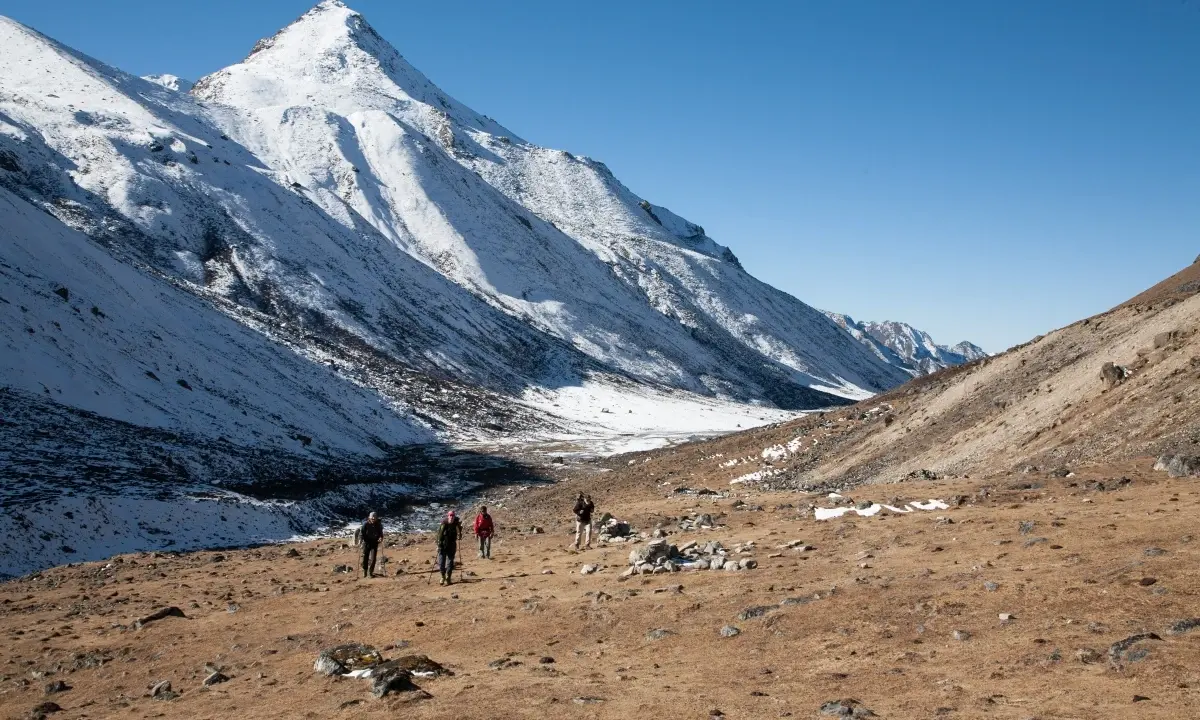
The weather in the Kanchenjunga region is like in any other Himalayan region. The weather conditions are diverse and oftentimes extreme depending on the season and elevation. The temperature in the region can be quite cold, especially in the winter (December to Feburary). The nighttime temperature in regions like Kanchenjunga North Base Cam (5,143 m) can reach up to -15°C. The maximum temperature in winter is also chilly, ranging from 0°C to 2°C. Hence, winter is usually not considered the best season to trek in the Kanchenjunga region.
The weather is similarly harsher in the monsoon season (June to August). The temperature in the lower region can be hot, making it uncomfortable for trekkers. The highest temperature in the summer/monsoon is around 18°C. Spring (March to May) and Autumn (September to November) are the best to trek in the Kanchenjunga as they offer mild temperatures, clear skies, and stable weather conditions. The temperature during these seasons ranges from -8°C to 16°C.


$USD 2,670 per person
26 Days
 Are There Travel Restrictions or Permits Needed for Kanchenjunga?
Taplejung, where Kanchenjunga lies, has some geopolitically sensitive areas. For example, Olangchung Gola shares its border with Tibet, China, Yamphudin with Sikkim, India, and Lelep with both Tibet and India. Hence, Nepal’s government must closely monitor such regions regarding tourism. So, trekkers need to obtain special permits to trek in the area. Here are the permits that you will need to acquire;
Besides the geopolitical sensitivity, the Kanchenjunga region is inhabited by indigenous communities like Rai, Leepchas, and Limbu. The Restricted Area Permit (RAP) ensures the safety of local cultures and traditions. The Department of Immigration (DoI) issues the RAP. The cost of the restricted area permit is:
The restricted areas are;
Kanchenjunga also falls in the Kanchenjunga Conservation Area. The conservation areas are the protected land which is rich in biodiversity. It is home to endemic and endangered flora and fauna. Hence, to ensure the environment’s safety, you must pay a certain amount to enter the region. The price is as follows;
Note: A TIMS card is not necessary for the Kanchenjunga Trek
The Kanchenjunga region is not only rich in biodiversity, but it also has a diverse cultural heritage. It is home to Indigenous communities like Sherpas, Rai, Lepchas, Limbu, and Gurung. They engage in a pastoral and agricultural lifestyle, which is a main source of income in addition to tourism.
The borders with Tibet have influenced Tibetan culture. People there celebrate festivals like Chasok Tangnam (Limbu harvest festival) and Losar with great joy. Besides Buddhism, Aryan communities in the region are keen followers of the Hinduism. During your trek, you should abide by the ancient traditions and respect them.
Until the mid-1800s, Kanchenjunga was considered the highest mountain in the world. However, after the great trigonometrical survey in 1849, it was discovered that Mount Eventually was the tallest mountain. On further survey, Kanchenjunga was named the third highest mountain, second being Mount K2. Around the same time, Sir Joseph Dalton Hooker, a British botanist and a friend of Charles Darwin, documented the biodiversity of Kanchenjunga region.
The government of Nepal opened the area for trekking for international trekkers in 1988. Before that, the Joe Brown and George Band team, with other explorers, ascended the mountain in 1955 as part of the 1955 British Kanchenjunga expedition. Since then, it has become a dream destination for mountaineers and climbers.
