After recent events, Nepal is back to normal and ready to share its cultural and natural wonders with you.

Everest Gokyo Lake Trek
Take a peaceful journey through Gokyo Valley, where you’ll discover serene lakes set against the towering Himalayas. As you walk through lush forests and cross rushing rivers, you'll connect with nature’s untouched beauty. The Gokyo Lakes offer quiet moments to truly appreciate Nepal’s incredible landscapes.
per person
USD 1,445
Duration
13 Days
Difficulty
Moderate
Requires some level of experience in trekking with basic physical ability.
Best Season
March- April- May- Aug- Sep- Oct- Nov.
Max. elevation
5,357 M/ 17,570 Ft.
Trip Code
CT-10010
Destination
Nepal
Region
Everest Region Treks
Activity
Trekking
Start / End Point
Kathmandu / Kathmandu
Accommodation
Guest House | Hotel
Nature Of Trek
Lukla- Namche Bazzar- Dole- Machhermo - Gokyo Lake- Goyko Ri- Namche Bazzar- Lukla Everest Gokyo Lake Trek Highlights 2023
Transportation
Domestic Flight | Private Vehicle
Everest Gokyo Lake Trek Highlights 2024
- Set off on a unique adventure to the Himalayas with a scenic flight.
- Trek on the off-beat and secluded trails of the Everest region.
- Follow the scenic trails within the UNESCO World Heritage Site of Sagarmatha National Park.
- Observe the diverse Himalayan flora and fauna within the national park.
- Marvel at the up-close view of the world’s highest mountain, Mt. Everest, and other surrounding peaks.
- Enter the hidden and secluded Emerald Valley of the Khumbu region, the pristine Gokyo Valley.
- Witness the gorgeous turquoise Gokyo Lakes and hike to Gokyo Ri.
- Walk past villages, dense forests, old monasteries, rivers, gorges, and waterfalls.
- Trek through one of the world’s largest glaciers, Khumbu Glacier.
- Immerse yourself in the unique culture and traditions of Sherpa communities.
- Enjoy the warm hospitality of the Himalayas while staying at rustic yet comfortable teahouses.
Everest Gokyo Lake Trek Overview
If you want to explore the less-traveled and remote areas of the beautiful Khumbu region, the Everest Gokyo Lake Trek is the perfect option. It is an adventurous and unique trekking experience that takes you to the heart of the Nepalese Himalayas. The journey begins with a short but thrilling flight to Lukla. You will start your trek from Lukla and follow the winding trail to Sherpa villages like Phakding and Namche Bazaar. From here, you will begin trekking on the off-beat trail away from the classic Everest Base Camp Trekking trail. You will trek alongside the Dudh Koshi River and through dense subtropical forests, alpine meadows, and glacial moraines. Throughout the Everest Gokyo Lake Trek journey, the Great Himalayan range will accompany you.
Similarly, the magnificent views of turquoise Gokyo Lakes and Nepal’s longest glacier, the Ngozumpa Glacier, will also greet you. The Gokyo Lake Trekking trail runs alongside the glacier, offering dramatic views of the surrounding landscape. You will also have the opportunity to climb to Gokyo Ri (5,357m). The vantage point allows you to enjoy at the spectacular views of Everest, Lhotse, Cho Oyu, Makalu, and more. During the trek, you will come across the ancient monasteries, stupas, and mani walls. You will also get to experience the unique and vibrant Sherpa culture of the Everest region. Thus, the Gokyo Valley Trek in Nepal is a remarkable journey that offers epic adventure and beautiful cross-cultural discovery. It is a perfect trek where the Himalayan peaks touch the surface of calm, emerald-colored glacial lakes.
Brief Itinerary
| Day | Highlights | Altitude |
|---|---|---|
| Day 01 | Arrival to Kathmandu | 1,350m. (Kathmandu) |
| Day 02 | Flight from Kathmandu to Lukla and hike towards Phakding | 2,840m/ 9,315 ft (Lukla) 2,610/ 8,560 ft. (Phakding) |
| Day 03 | Phakding to Namche Bazzar | 3,410 m/ 11,184 ft (Namche Bazzar) |
| Day 04 | Namche Bazzar, Acclimatization Day | 3,720 m/ 12,201 ft. (Syangboche ) |
| Day 05 | Namche Bazzar to Dole | 4,038m/ 13,244 ft. (Dole) |
| Day 06 | Dole to Machherma | 4,470m/ 14,661ft. (Machherma) |
| Day 07 | Machhermo to Gokyo | 4,779m/ 15,711ft (Gokyo) |
| Day 08 | Gokyo to Gokyo Ri to Gokyo | 5,357 m/ 17,570 ft. (Gokyo Ri) 4,779m/ 15,711ft (Gokyo) |
| Day 09 | Gokyo to Phorste Thanga | 3,680m/ 12,070ft (Phorste Thanga) |
| Day 10 | Phorste Thanga to Namche Bazzar | 3,410 m/ 11,284ft (Namche Bazzar) |
| Day 11 | Namche to Lukla | 2,840 m/9,315 ft (Lukla) |
| Day 12 | Lukla to Kathmandu | 1,350 m/ 4,428 ft (Kathmandu) |
| Day 13 | Departure | 1,350m. (Kathmandu) |
Important Note (Read Before You Book):
Everest Gokyo Lake Trek Itinerary
Arrival In Kathmandu
Highest Altitude
1,350 m
Our staff from CoreTreks will receive you at the airport on arrival for a short transfer to your hotel. The hotel accommodation is three-star standard or above, per the client’s preferences. We will have a short briefing session regarding the trip and travel details at our office or in the hotel lobby/meeting rooms. Please feel free to ask questions during the briefing session. After a bit of walking around the streets of Thamel, we will wrap up for the day.
Hotel


Flight From Kathmandu To Lukla And Hike Towards Phakding
Trek Distance
8 km
Trek Duration
3-4 hours
Flight Hours
35 min
Highest Altitude
2,840 m
According to a recent notice from the Aviation Authority, Lukla flights have diverted to Ramechap instead of Kathmandu. The drive from Kathmandu to Ramechap is 4 to 5 hours (140 km) via the B.P. Highway. So, we will depart for Ramechap early in the morning to catch the first flight to Lukla. The flight from Manthali Airport, Ramechhap, to Lukla is equally dramatic and thrilling as the one from Kathmandu. It is also a scenic and short flight that takes around 20 minutes.
After landing at Lukla, your trekking journey will begin. You will get your first taste of trekking in the Khumbu region as you hike alongside the raging Dudh Koshi River. It is mostly a downhill trek with some gentle walking through the pine forest. We will also cross some suspension bridges decorated with prayer flags along the way to Phakding. Similarly, we will pass through Sherpa villages like Chheplung, Thadokoshi, Ghat, and others. The village of Phakding is slightly lower in elevation than Lukla, making it an ideal stopover. We will stay overnight and allow your body to acclimate.
Important Note: Lukla flights have been diverted to Ramechap instead of Kathmandu, according to the recent notice from the Aviation Authority. The drive from Kathmandu to Ramechap is about 4 to 5 hours. (140 k.m) via B.P. Highway. Depart for Ramechap early in the morning to catch the first flight to Lukla. Read more about Lukla’s flight diversion here.
Breakfast, Lunch, & Dinner
Guesthouse


Phakding To Namche Bazaar
Trek Distance
10 km
Trek Duration
6 hours
Highest Altitude
3,410 m
After your breakfast at Phakding, you will resume your Everest Gokyo Lake Trek. Today, you will follow the winding and diverse trail to the Sherpa capital of Namche Bazaar. The trail once again goes alongside the Dudh Koshi River. You will cross several suspension bridges along the way. En route, we will pass by several small settlements and villages. From Monjo, the trail then leads through the entrance of Sagarmatha National Park. We will trek through dense forests of rhododendrons, oaks, and firs. The trail becomes steeper from the village of Jorsalle.
Similarly, we will cross the famous Hillary Suspension Bridge named after Sir Edmund Hillary, the first mountaineer to conquer Mount Everest with Tenzing Norgay Sherpa. It is a long uphill climb on a steep trail through a forest of rhododendrons and pine. Just before you reach Namche Bazaar, you will get your first glimpse at Mount Everest. We will stay at a teahouse here for two nights.
Breakfast, Lunch, & Dinner
Guesthouse


Namche Bazaar, Acclimatization Day
Trek Duration
3 hours
Highest Altitude
3,720 m
Today we will take an acclimatization day at Namche Bazaar. The beautiful town is the main trading hub in the Khumbu region, also known as the Everest region. There are good-standard restaurants, pubs, internet cafes, excellent lodges, and hotels in the area. It sits at a perfect altitude for acclimatization. However, it is crucial to stay active to adapt to the growing elevation. Hence, we will take a short hike to Everest View Hotel (3,880m) after breakfast.
We will trek on the steep trail through the pine forests and alpine meadows right above Namche. It will first take us to Syangboche Airport (3,780m), which is one of the world’s highest airstrips. However, it is not used for commercial flights. A short walk from the airstrip will take us to the Everest View Hotel. It is a luxurious hotel and one of the highest hotels in the world. We can witness a stunning view of Everest, Ama Dablam, and Kongde Ri from the hotel while enjoying a delightful gourmet lunch. Then, we will return to Namche Bazaar. With spare time, we can explore the market and narrow alleys in the town.
Breakfast, Lunch, & Dinner
Guesthouse


Namche Bazaar To Dole
Trek Distance
6 km
Trek Duration
5 hours
Highest Altitude
4,038 m
From Namche Bazaar, our adventure continues with a morning short climb. The walk becomes gentle along a gradual, winding path to Kyanjima, a small settlement. From there, our route leaves the main busy trail and ascends steeply to Mong Danda. We can witness a grand panorama of snow-capped peaks after ascending to a high ridge with a few small lodges and tea houses. Then, the Gokyo Lake Trekking trail begins to descend steeply to Phortse Tenga. You will also cross a suspension bridge over the Dudh Koshi River.
We will enjoy the views down to Phortse Tenga for lunch in a shady area by the Dudh Koshi River gorge. A dense forest of pines and rhododendron trees covers the entire region. It is another uphill ascent towards Dole. As you get closer, the forest trail opens up to green pastures. Dole will be our overnight stop, so we will take afternoon walks up into a narrow gorge in the cool shade of the forest. We will rest in a comfortable lodge on a small plateau enclosed by high, towering, rocky cliff walls.
Breakfast, Lunch, & Dinner
Guesthouse
Dole To Machherma
Trek Distance
5-6 km
Trek Duration
5 hours
Highest Altitude
4,470 m
After breakfast, we will briefly climb a ridge and then gradually walk on an exposed high ridge line. You will trek through green high pastures and see yaks grazing leisurely. Then, we will come out of a deep gorge, hiking through an arid and barren terrain. We will also see a change in scenery as the subtropical tree lines fade for short juniper bushes. The trail from Lhabarma is carved into the hillside. Along the way, you will trek on rocky terrain and cross a few suspension bridges. Then, we will reach a beautiful Luza settlement before reaching a high ridge.
We get our first grand views of Mt. Cho Oyu from the high ridge. Similarly, we can see other snow-capped peaks, such as Thamserku and Kangtega. From Luza, we will continue our ascent along a hillside path. The trail opens up to the wide valley, and we will pass by a few mani walls to reach Machhermo. The Machhermo village sits in a gorge facing the towering peaks of Machhermo and Cholatse in the far distance. We will spend the night at a teahouse in the village.
Breakfast, Lunch & Dinner
Guesthouse

Machhermo To Gokyo
Trek Distance
4-5 km
Trek Duration
4 hours
Highest Altitude
4,779 m
Today, we will reach our ultimate destination, the main Gokyo Lake in the valley, and its glacial lakes. From Machhermo, we will begin our morning with a slight descent into the river valley. The Everest Gokyo Lake Trekking route will bring you to a small resting point of Pangka. From here, we will begin your gentle ascent on rocky terrain. After crossing a small stream that flows from the Ngozumpa Glacier, we will soon reach the first of the Gokyo Lakes, Longponga. Across the glacier from Gokyo, we will come across the trail that connects the Cho La Pass route to Gokyo via Thagnak. However, it does not merge at the first lake.
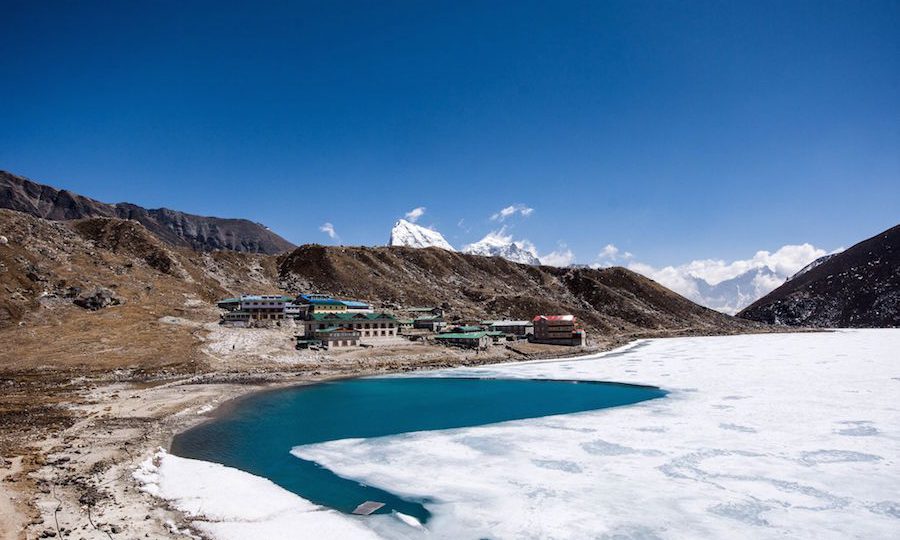
We will continue trekking on the left side of the glacial valley and head towards the second lake, Taujung Tsho. The trail continues to ascend, and we will finally arrive at the third and largest lake of Gokyo, the Dudh Pokhari. The village is located on the eastern shore of the third Gokyo Lake. There are several lodges in the area. We will stay in Gokyo for two nights. There will be enough time to enjoy the lake and the snow-covered peaks. You can also see a spectacular and up-close view of Cho Oyu, Cholatse, and other surrounding snow-capped mountains.
Breakfast, Lunch & Dinner
Guesthouse


Gokyo To Gokyo Ri To Gokyo
Trek Distance
4-5 km
Trek Duration
4 hours
Highest Altitude
5,357 m
We will take an early morning hike up to the summit of Gokyo Ri, which sits at 5,357 meters. The hike will be the day’s first activity. We will begin our uphill climb from the northern end of the Gokyo village. The climb is steep and rocky. The winding trail follows a western ridge of Gokyo Ri. After a vertical elevation gain on rocky terrain with some loose debris. Upon reaching the top, we will see several prayer flag poles decorating the surroundings. There is also a summit chorten or stone stupa and stone benches. The viewpoint offers spectacular views of the Himalayas.
The beauty of the scenery from Gokyo Ri is as good as the view from Kala Patthar, if not even better. From a very close range, we can observe four of the tallest mountain peaks in the world: Everest, Lhotse, Makalu, and Cho Oyu. After the hike, we will then head back towards the valley. With the spare time, we’ll be sightseeing around the valley a bit. We can also spend the rest of the day immersing ourselves in the beauty of the Himalayas.
Breakfast, Lunch & Dinner
Guesthouse


Gokyo To Phorste Thanga
Trek Distance
7 km
Trek Duration
6 hours
Highest Altitude
4,790 m
After an enjoyable and exciting time at Gokyo with its beautiful lakes and serene atmosphere, it is time to head back. We will have a hearty breakfast in Gokyo and begin our walks towards Phorste Thanga. The Gokyo Valley Trek trail starts by descending along the Ngozumpa Glacier. We will also cross a few streams and icy sections as we retrace our steps on familiar ground.
The trail goes downhill to Machhermo, followed by a short and steep uphill. As the walk follows the gradual trail to Dole, we will descend into a river gorge. Similarly, we will also trek on narrow stone steps. Finally, we will reach Phortse Thanga, which is a beautiful river basin. We will stay overnight in one of its simple, cozy lodges while listening to the sound of the flowing river.
Breakfast, Lunch & Dinner
Guesthouse
Phorste Thanga To Namche Bazaar
Trek Distance
8 km
Trek Duration
5 hours
Highest Altitude
3,680 m
On this day, we will descend towards the village of Namche Bazaar. The trail becomes much easier as we begin to descend. The decrease in elevation also helps us regain more energy and stamina. However, we will still have to trek on a winding trail with some steep sections and diverse terrain. En route, we will also get to enjoy gorgeous mountain views of Everest, Ama Dablam, Taboche, Thamserku, and more.
The barren landscape also once again changes into a lush forest and pine. We will also pass by ancient monasteries, prayer flags, mani walls, and chortens. After reaching Namche Bazaar, we will rest our tired feet at a teahouse there. You can take a well-deserved rest and explore around the town for souvenirs. Likewise, we can enjoy the night in the beautiful Sherpa capital.
Breakfast, Lunch & Dinner
Guesthouse


Namche Bazzar To Lukla
Trek Distance
10 km
Trek Duration
6 hours
Highest Altitude
3,440 m
We will enjoy breakfast in the peaceful atmosphere and take in the incredible views at Namche. Then, we will resume our trek. We leave Namche Bazaar and head towards Lukla, which will be a pretty long trek. However, it is a relatively easier downhill trek, and the altitude gets much lower. We will retrace our steps back on the same trail with a short climb to Jorsalle and then reach the exit gate of Sagarmatha National Park.
The trail takes us to Monjo, crossing a long bridge to Benkar. We will continue trekking to Phakding for a possible lunch stop. The trail follows an up-and-downhill path, passing by Ghat and Thado Koshi. Climbing to Lukla takes an hour or less. Upon reaching Lukla, we will bid farewell to the porters. Then, you can enjoy the final night in the Everest region.
Breakfast, Lunch & Dinner
Guesthouse


Lukla To Kathmandu
Flight Hours
30-40 min
Highest Altitude
2,860 m
It is a short walk to Tenzing-Hillary Airport. The flight usually departs in the morning for Manthali Airport, Ramechap. After checking in, you will board a small aircraft. It is a 35-minute flight to Ramechap, and you can see the beautiful mountain peaks through the aircraft’s window one last time. Once we reach Manthali Airport, we will drive back to Kathmandu via the B.P. Highway.
After reaching Kathmandu, CoreTreks will host a farewell dinner in a lovely traditional Nepali restaurant. The dinner will be accompanied by a cultural dance performance at the venue. Then, you can enjoy individual activities or shop for souvenirs on your last day in Kathmandu.
Breakfast, Lunch & farewell Dinner
Hotel


Departure
Highest Altitude
1,350 m
The day has come to bid farewell to your Nepal adventure along with our guides and staff. CoreTreks staff will transfer you to Tribhuvan International Airport at least three hours before your international flight home. Thank you for choosing CoreTreks for your dream holiday in Nepal!
Breakfast
Not satisfied with this itinerary?
CoreTreks offers a customized itinerary option that allows you to personalize your trek according to your preferences and requirements.
Everest Gokyo Lake Trek Altitude Chart
Altitude in:
Temperature by Month at Gokyo Lake
Trip Includes
- Airport transfers by Private Vehicles.
- Standard twin-sharing accommodation in a three-star hotel in Kathmandu, breakfast included. (2 Nights).
- Twin-sharing accommodation during the Gokyo Lake trek. (10 Nights).
- Round trip flight Kathmandu – Lukla / Lukla – Kathmandu including departure taxes.
- Three daily meals with tea/coffee (breakfast, lunch, and dinner) during the trek.
- TIMS Fee- Trekkers’ Information Management System & Trekking permit (Please bring 2 passport-size photos).
- One highly experienced, helpful, and friendly guide. Porters (1 porter for 2 people) and their food, accommodation, salary, and equipment. Accident insurance for all staff
- Farewell dinner in a traditional Nepali restaurant with cultural performances.
- Personal care & attention.
- Local and government taxes.
Complimentary Services
Available after complete Booking
- Down jacket and four seasonal sleeping bags (to be returned after completion of the trip).
- Core Trek duffle bag, T-shirt, and a trekking map.
- A self-sufficient medical first aid kit containing vital medications.
- Company-branded water bottle with purification tablets
- Warm woolen hat
- Solar panel for battery charging in the mountain
- Oximeter
Trip Excludes
- All kinds of beverages including mineral water, Phone calls, laundry, and hot shower during Trek
- Travel and Rescue Insurance
- Tipping to the crew.
- Personal mountaineering gears
- Optional trips and sightseeing if extended
- International airfare and airport departure tax
- Visa fee, you obtain a visa easily upon your arrival at Tribhuwan International Airport Kathmandu
- Do not mention the services apart from the services mentioned in “Cost Included services”
Essential info for Everest Gokyo Lake Trek
Packing List
Packing List
What To Expect While Gokyo Lake Trek
While trekking to Gokyo Lakes, here are a few things that you should expect:
- Altitude: The trek reaches high altitude areas, so you should expect to experience the effects of altitude sickness, such as shortness of breath, headaches, nausea, and fatigue. Acclimatizing properly and taking necessary precautions to minimize the risk of altitude sickness is crucial.
- Weather: The weather in the mountains can be unpredictable. It can be sunny and warm one moment and then become cloudy, windy, and cold quickly. Thus, you should prepare for changes in weather conditions. Pack proper and adequate clothing and gear for the trek.
- Challenging Terrain: The trail to Gokyo Lakes is quite challenging, with steep ascents and descents, narrow paths, and rocky terrain. You should be physically fit and prepared for the demanding trek.
- Basic Accommodation: The lodges in the region offer basic accommodation facilities such as shared rooms, common bathrooms, and limited hot water for showering. You should not expect luxury accommodations during the trek.
- Sherpa Culture: The region is inhabited by the Sherpa people, and you will encounter their unique culture and traditions during the trek. Respect their culture and beliefs and be open to learning about their way of life.
The Everest Gokyo Lakes trek is challenging but rewarding. It is an excellent opportunity to witness the stunning Himalayan vistas while immersing yourself in the local culture. With proper preparation and a positive attitude, you can have the best trekking experience.
Best Season For Everest Gokyo Lake Trek
The best seasons for trekking to Everest Gokyo Lake in Nepal are spring (March to May) and autumn (September to November). During these months, the weather is generally clear with warm daytime temperatures, making it ideal for trekking. Trekking is possible during the summer/monsoon (June to August) and winter (December to February). However, these seasons are characterized by difficult weather conditions, including heavy rain, snowfall, and strong winds.
When deciding the best time to trek to the Everest Gokyo Trek Nepal, consider the weather conditions and your personal preferences. Here is a brief on each season for the Gokyo Valley Trekking:
Spring (March to May)
It is the most popular trekking season with the best weather conditions and mild temperatures. At the beginning of spring, the temperature at higher altitudes is slightly lower, and there can be traces of snow on the trail. As the season progresses, the weather gradually becomes warmer.
The warm temperature also makes the flora and fauna active. Hence, you can see blooming rhododendron forests and wildflowers on the lower trails of the Gokyo Lake Trek. Due to the lower precipitation level, the trekking trails are dry and stable. However, the trails are more crowded and teahouses are busier at these times.
- Avg. daytime temperature at lower elevation: 10°C to 18°C (50°F to 64°F)
- Avg. daytime temperature at higher elevation: 0°C and 8°C (32°F and 46°F)
Autumn (September to November)
The autumn season follows the monsoon. As a result, there can be slight rainfall in early September. As the season progresses, the weather becomes more stable. Similarly, the temperature is also mild with crisp air and clear blue skies. The rain from the monsoon cleanses the surroundings and vegetation. Thus, Autumn is the ideal time to appreciate the stunning scenery of the Everest landscape and snow-capped mountain vistas.
The biggest Nepalese festivals, like Dashain and Tihar, also fall during this season. Hence, you will get to see and may even get to participate in the festive celebration. The favorable weather also draws in more trekkers, so the trails are crowded. Likewise, there is high demand for flights, accommodations, guides, and porters. This increases the cost, and one must book these resources in advance.
- Avg. daytime temperature at lower elevation: 8°C to 16°C (46°F to 61°F)
- Avg. daytime temperature at higher elevation: -2°C to 7°C (28°F to 45°F)
Summer (June to August)
The summer season, which coincides with monsoon, is the least favorable time for the Everest Gokyo Lake Trek. There is heavy rainfall in hilly areas, which causes the forest trails to become muddy and slippery. Additionally, the lower trails become infested with leeches. Heavy rain clouds often cause poor visibility. As a result, flights to Lukla are often postponed or canceled.
On the other hand, the trails are quieter and the teahouses are emptier. The prices of accommodations and fees for porters and guides are lower. Summer also treats you with lush scenery. The entire forest and the lower valleys turn vibrantly green. As there are only a few trekkers in the teahouses, the services and hospitality are also better.
- Avg. daytime temperature at lower elevation: 12°C to 20°C (54°F to 68°F)
- Avg. daytime temperature at higher elevation: 5°C to 12°C (41°F to 54°F)
Winter (December to February)
The winter season in the Himalayas can be harsh and turn extreme. However, it is the perfect time for adventurers. The winter trek to Everest Gokyo Lake is even more unique. It offers amazing views of snow-covered higher areas in the Everest region. Similarly, the views of the snow-capped vistas and frozen Gokyo Lakes are even more captivating. The quiet trails and clear skies make the journey more enjoyable.
Trekking to Gokyo in winter requires proper preparation and may require gear like an ice axe, crampons, and microspikes. The trails of higher regions are covered with snow. Hence, it is icy and slippery. Heavy snow can also block the high mountain passes. The cold temperature also requires adequate warm clothing. Trekkers must also plan their pace carefully as the daylight is shorter. They must also take proper precautions, as the cold can mask the symptoms of altitude sickness.
- Avg. daytime temperature at lower elevation: 2°C to 10°C (36°F to 50°F)
- Avg. daytime temperature at higher elevation: -10°C to 0°C (14°F to 32°F)
Gokyo Lake Trek Difficulty
The Gokyo Trek in Nepal is considered a moderate to strenuous trek. It has some challenging sections that require a good level of fitness and endurance. The trek involves high altitude, steep ascents and descents, and a long duration.
The trek’s highest point is Gokyo Ri (5,357 meters/17,575 feet). Due to the high altitude, trekkers may experience symptoms of altitude sickness, such as shortness of breath, headaches, and fatigue. Moreover, climbing uphill on rough and diverse terrain makes the journey more challenging. The most challenging part of the trek is the ascent and descent to Gokyo Ri. It involves steep uphill and downhill sections that require proper trekking gear and preparation.
The Everest Gokyo Lakes adventure takes about 12-14 days to complete. It covers a distance of approximately 120 kilometers. Therefore, it requires a good level of fitness and stamina to complete the entire trip. Additionally, the unpredictable weather in the Khumbu region adds to the trek difficulty. There are high chances of sudden changes in temperature and wind, depending on the elevation. Proper preparation and equipment are necessary for changing weather conditions.

Despite the challenges, the Gokyo Lake Trek offers stunning views of the Himalayan mountain range and the turquoise Gokyo Lakes. The traditional Sherpa villages provide warm hospitality and a rich cultural experience. These make the trek and its challenges worth undertaking. With proper preparation and training, most trekkers with a good fitness level can complete the trek.
Despite the challenges, the Gokyo Lake Trek offers stunning views of the Himalayan mountain range, the turquoise Gokyo Lakes, and the traditional Sherpa villages. With proper preparation and training, most trekkers with a good fitness level can successfully complete the trek.
Everest Gokyo Lakes Trekking Route
The Everest Base Camp Trek via Gokyo Lakes is an exciting journey into the secluded areas of the Khumbu region. It follows the classic route of Everest Base Camp up until Namche Bazaar, from where the trekking trail separates.
We will take an acclimatization day at Namche Bazaar. From Namche Bazaar, you will follow the winding paths to Kyanjima and make a steep ascend to Mong Danda and then to Phortse Tenga. After walking up a narrow gorge and crossing Mong La Pass (3,957 meters), you will reach Dole. The trail from Dole enters a dense forest of rhododendrons and pines.
Your next destination is Machhermo. You will briefly climb a ridge and walk on an exposed high ridge line. You will walk past a deep gorge through arid and barren terrain. From a small settlement in Luza, you will ascend a high ridge and make a short descent to Machhermo. You will begin your journey to Gokyo from here.
The trail goes through an open high ridge with views of stunning peaks and follows a winding uphill path to small settlements. You will come across the first lake where the trail of Chola Pass joins at Nha. Then, you will head to the second lake before finally arriving at the third main Gokyo Lake. You will stay two nights at Gokyo Valley. You will hike to Gokyo-Ri, the highest point of the trek, which gives amazing views of Mount Everest, Makalu, Lhotse, and Cho Oyu.
From Gokyo, you will begin your descent to Phorste Thanga. To reach Phorste Thanga, you will retrace your steps to Machhermo and Dole. Again, you will trek back to the familiar path to Namche Bazaar and then to Lukla. You will fly early to Manthali Airport, Ramechhap, and then drive back to Kathmandu.
Benefits of Booking Everest Gokyo Lake Trek with CoreTreks
Take a look at some of the benefits of the Everest Gokyo Lakes adventure with CoreTreks:
- Customize your services as per your requirements and preferences.
- 15 years of experience in the field with local expertise.
- Reliable services with 100% attention to safety measures.
- Easy Payment and lifetime deposit services.
- 24/7 customer service.
- Airport pickup and departure in a private vehicle.
- Complimentary services include a down jacket, four seasonal sleeping bags, a duffle bag, a medical first aid kit, a company-branded water bottle, water purification tablets, a solar panel for charging, and an oximeter.
- Personal care and attention to clients.
FAQs For Everest Gokyo Lake Trek
General
How difficult is the Everest Gokyo Lake Trek in Nepal?
Is it safe to trek to the Everest Gokyo Lake in Nepal?
What can I expect during the trek to the Everest Gokyo Lake Trek?
What accommodation and food facilities can be expected during the Everest Gokyo Lake trek?
Can beginners take the Everest Gokyo Lake Trek?
When is the best time for the Everest Gokyo Lake Trek?
Do I need travel insurance for the Everest Gokyo Lake Trek?
What is the highest point of the Everest Gokyo Lake Trek?
What permits do I need for the Everest Gokyo Lake Trek?
Are there ATM facilities available along the Everest Gokyo Lake route?
Is there a risk of altitude sickness during the Everest Gokyo Lake Trek?
Is safe drinking water available during the Gokyo Lake trek?
Where can I buy trekking equipment and gear during my Gokyo Lake Trek in Nepal?
Which mountains are visible during your Gokyo Lake Trek?
How long does it take to complete the Gokyo Lake Trek?
Everest Gokyo Lake Trek Additional Information
Altitude Sickness Concerns During The Gokyo Lakes Trek
The likelihood of altitude sickness is significant on the Everest Gokyo Lakes trek adventure, with the highest point reaching an elevation of 4750 meters at Gokyo. Experts strongly recommend limiting ascent to a range of 300 to 400 meters per day once you surpass the 3000-meter mark.
It is crucial to prioritize time and proceed cautiously. The key to preventing altitude sickness lies in a gradual ascent. It allows sufficient time for your body to acclimate to higher altitudes and ensure adequate hydration. While Diamox may aid acclimatization, it cannot cure severe altitude sickness once symptoms manifest. In such cases, the only recourse is to descend to lower altitudes promptly.
It is crucial to prioritize time and proceed cautiously. The key to preventing altitude sickness lies in a gradual ascent, allowing sufficient time for your body to acclimate to higher altitudes and ensuring adequate hydration. While Diamox may aid acclimatization, it cannot cure severe altitude sickness once symptoms manifest. In such cases, the only recourse is to promptly descend to lower altitudes.
Mild symptoms may include fatigue and increased breathlessness, while severe manifestations encompass headaches, dizziness, sleep disturbances, breathing difficulties, appetite loss, nausea, and vomiting.
Severe symptoms may indicate the onset of high-altitude cerebral edema (HACE) or high-altitude pulmonary edema (HAPE), both of which can be fatal without a timely descent to lower elevations.
It is imperative to take symptoms seriously and remain vigilant, extending concern even to Nepali guides and porters, as they are not immune to altitude sickness.
Although the Gokyo Lakes trek itinerary provided in this post minimizes the risk of altitude sickness through an acclimatization day in Namche and a gradual ascent, mild symptoms were still experienced at Gokyo, preventing the ascent of Gokyo Ri Note:
Everest Gokyo Lakes Cost
The cost of Everest Gokyo Lake Trek usually ranges from USD 1,200 to USD 2,500 per person. It can vary depending on the season, time duration, and services. At peak season, i.e., spring and autumn, many trekkers flock to Nepal for trek. Hence, the cost of flights and accommodations is higher due to high demand.
On the other hand, if you are traveling in off-seasons, there are very few trekkers. The flight and accommodation costs are comparatively lower at this time. Similarly, customization and additional services can increase the trek package cost. Our standard Everest Gokyo Lake Trek package includes airport transfers in a private vehicle, a round-trip flight, accommodation in twin-sharing, meals (breakfast, lunch, and dinner), and permits. It also includes fees for the guide and porter.
Accommodation
Teahouses, lodges, and guesthouses are mostly available in the Everest region. You will find a few luxurious accommodations in Namche Bazaar, but they are pretty expensive. We will arrange your stay at a 3-star hotel in Kathmandu. During the trek period, you will stay in cozy local guesthouses. All the accommodations will be on a twin-sharing basis.
Most of the accommodations in the Everest region offer basic facilities with limited amenities. There are usually communal squat-style bathrooms, except for a few Western-style bathrooms. For services like internet, hot shower/ water, charging electronic devices, etc., you have to pay additional charges, which trekkers have to bear themselves.
Meal
On challenging treks like Everest Gokyo Lake, you must take nutritious and high-carb meals to energize you. Your meal must contain lots of carbohydrates and proteins. In lower regions, you will find a variety of food menus that consist of local, Indian, and Western cuisines. However, as you climb to the higher altitude regions, the menu becomes shorter.

During the trek, you will eat a lot of Dal Bhat, a staple Nepali cuisine. It is a perfect high-carb and protein meal to keep you going. Similarly, the food menu can consist of momo, bread (chapati/ Tibetan), noodles, thukpa, soup, Sherpa stew, porridges, cornflakes, oatmeal, pancakes, sandwiches, pasta, pizza, curries, etc.
CoreTreks’ Everest Gokyo Lake package includes three daily meals with tea/ coffee (breakfast, lunch, and dinner) during the trek. The teahouses source the ingredients locally and prepare them fresh. The package does not include other drinks except standard meals, such as alcoholic beverages, hot drinks, and soft drinks.
Typical Day
Everest Gokyo Lake Trek adventure is a challenging but scenic and rewarding journey. Each day, you will enjoy new scenery, trek on scenic trails, experience the local culture, and explore traditional settlements. Your trek guide will provide insights and information regarding the places you come across. Meanwhile, the porter will carry most of your heavy luggage.
We will begin our day early and journey after breakfast, around 7 to 8 AM. The departure time can vary depending on our day’s destination. We will usually have lunch around midday.

After reaching our destination, you can explore or rest until dinner time. You will have your dinner around 6 to 7 PM. Then, your trek guide will briefly brief the next day’s journey. You can spend the evening as you please or retire for the night.
Luggage
We assign one porter for each of the two trekkers. A single porter will carry 18 to 20 kg of weight during the trek, so the weight limit is 9 to 10 kg per person. We will arrange more porters if there is excess luggage for an extra charge. Carry a backpack to put your documents and valuables for the trek. You can leave the rest of your luggage at your hotel in Kathmandu or our office free of charge.
Electricity And Water
You will have no problem finding electricity and safe drinking water during the Everest Gokyo Lake Trek. All the accommodations provide these facilities, but you may have to pay extra fees of around USD 2.
Nepal uses standard plug types C, D, and M. The standard voltage is 230 V with a 50 Hz frequency. Ensure your electric devices are compatible; bring a voltage converter and adapter. Similarly, you can also carry a power bank.
You can buy bottled mineral water at the local shops and accommodations. However, plastic bottles are not eco-friendly, so we suggest you bring your water bottle. You can fill your bottle with boiled or filtered water at accommodations for a charge. You can also use a water purification tablet.
CoreTreks provides complimentary services in the Himalayas, including company-branded water bottles, purification tablets, and solar panels for battery charging.
Communication
Most of the accommodations along the Everest Gokyo Lake route provide WiFi/ internet services with additional charges. You can stay in touch with your loved ones using the Internet. However, the connectivity is poor. As we get to the higher altitude, the service can be nonexistent.
You can use the phone to contact your family and friends at such times. You can purchase a local SIM card for communication purposes. Nepal Telecom (NTC) offers the best services in rural areas. Remember, the signals can get weaker at times.
Trek Safety
CoreTreks has 15 years of experience trekking and touring in Nepal. We strive to provide reliable service with 100% attention to safety measures. All our guides have proper licenses and years of experience trekking in the Himalayas. They have also undergone intensive first-aid training and discipline for safety and precautions.

Our guides carry high-quality equipment, gear, and supplies for the trek, including first aid kits. They also carry oximeters and constantly check your oxygen level at higher altitudes. They take personal care and watch out for symptoms of altitude sickness among trekkers. In case of accidents, injuries, or illness, your trek guide will have the authority to make decisions. They will make the decision that best ensures your safety and security.
Visa
All foreigners except Indian citizens will need a Nepalese visa to enter the country. You can easily get the visa on arrival at the Tribhuvan International Airport, Kathmandu. However, your passport must be valid for at least six months before expiry. Those traveling by land can get visas at the Nepal border Immigration checkposts. You must also provide your passport photo while applying for the visa.
Travelers can apply for single-entry or multiple-entry visas. Children under age 10 are eligible for a free visa. The fees are as follows:
- 15 days: USD 30
- 30 days: USD 50
- 90 days: USD 125
Note: Residents of Nigeria, Zimbabwe, Ghana, Cameroon, Somalia, Ethiopia, Swaziland, Afghanistan, Iraq, Palestine, and Liberia cannot get an on-arrival visa. They must apply for it at the Nepal Embassy in their home or neighboring country.
Currency Exchange
Nepal’s national currency is the Nepalese Rupee (NPR). There are legitimate money exchange centers all around Thamel, Kathmandu. You can also exchange currencies at the local banks. The exchange centers display the day’s currency exchange rate to see. So you are sure you will get the best rate.
You can also withdraw cash from ATMs in Kathmandu, which are open 24/7. You can use foreign credit cards such as Visa, Mastercard, and UnionPay. At a time, you can only withdraw NPR 35,000 for NPR 500 processing fees. There will be a service fee of 4% or more if you use money exchange facilities at banks or financial institutions.
Extra Personal Expenses
The package covers the cost of accommodations, transportation, three meals, permits, and fees for guides and porters. Trekkers must cover the visa fees, travel insurance, and other possible charges.
Trekkers must also pay for beverages other than drinks with standard meals, including mineral water. Similarly, they have to cover charges for extra facilities such as internet/ WiFi, hot shower/ water, charging devices, phone calls, etc. Other extra personal expenses include tips, souvenirs, etc. There are no ATMs or card facilities along the Himalayan routes. Thus, bring sufficient cash for the duration of the trek.
Travellers Reviews
57 Reviews in TripAdvisor
Advisor linkBest Destination On Earth To Travel
I’ve traveled to many places, but Nepal stands out as the best for me. I had heard about the Himalayas before, but seeing them in real life and living close to the people changed how I see things.
This trip was full of special moments. I got to explore the wild and see the Himalayas up close. Big thanks to CoreTreks for helping me pick the right package and for all the helpful info along the way.
Nick Banks
Big Thanks to the CoreTreks
This trip went beyond what I expected. I didn’t think I’d find such warm and amazing hospitality in Nepal. The people were cheerful and kind everywhere we went.
It’s a trip I’ll always remember. Big thanks to the CoreTreks team for being honest and helpful. They looked after me and my stuff really well. I had no worries at all, just a great time. Loved it!
Julian Dawson
Canada
Best Trip Of My Life
Honestly, this was the best trip of my life. I love traveling and have been to many places, but this one felt truly special.
If you're going to Nepal, I really recommend it. The CoreTreks team was amazing friendly, polite, and always ready to talk and help. They made everything easy and enjoyable.
Alisa Roberts
Virgin Islands (U.S.)
Plan your private Trip
If these dates do not suit your plans, please contact us to request alternative dates. We are more than happy to customise the itinerary and schedule to better fit your needs.
There is no additional cost on the private trip. Group discount will be applied on checkout.


Popular Trips
Lets do a great journey.

$USD 1,520 per person
6 Nights 7 Days Bhutan Tour
Reach 4,000m in 7 Days


