Peak Climbing in Nepal offers an unforgettable experience to nature and adventure lovers. Nepal is the ultimate Peak climbing destination, with 1310 identified mountain peaks and 414 officially open for climbing. Mountaineering in Nepal includes trekking Peaks and expedition Peaks. People from worldwide take mountain climbing adventures in Nepal because Nepal covers diverse landscapes from low terai to the Himalayas. Eight of the 14th tallest mountains above 8000m are found in Nepal, including Mt.Everest and Mt.Annapurna. Achieving a summit is physically and mentally challenging; reaching the summit gives a sense of accomplishment.
Many people like to connect with Nature and seek an adventure journey that is possible in the Himalayas in Nepal. Peak climbing in Nepal is challenging but offers peaks that suit beginners and experienced climbers. The first climbing history in Nepal was recorded in 1953 by Sir Edmund Hillary and Tenzing Norway. Climbing and trekking in Nepal is also an affordable option in terms of costs. Moreover, one can immerse themselves in the unique and rich culture of Hindus and Buddhists in the Himalayan region of Nepal. Thus, peak climbing in Nepal is a must-do activity and has received global recognition for mountaineering.
Top Peak Climbing Peaks in Nepal
Peak climbing and expeditions are some of the most challenging activities. Nepal is the best choice for mountaineers to do Himalayan expeditions and trekking, with eight mountain peaks of over 8000m and 1310 peaks of over 6000m. Trekking and expedition peaks differ in difficulty, height, permits, and rules and regulations for climbing. Trekking peaks fall between 5000m and 7000m, requiring less technical and mountaineering skills, and can be completed within weeks. For trekking peaks, a climbing permit should be obtained from the Nepal Mountaineering Association, such as Mera Peak, Island Peak, Lobuche East, etc.
Expedition peaks here are above 7000m high and require technical and advanced climbing skills and experience. The Department of Tourism of Nepal must issue the expedition permit. Completing the climbing takes weeks to months because it involves acclimatization days and logistics support. Professional mountaineering guides and Sherpa support are necessary for expedition peak climbing.
Nepal Mountaineering Association(NMA) is a non-profit, non-governmental, and non-political organization that promotes mountain tourism and climbing sports, protects mountain environments, and preserves and promotes mountain people’s cultural heritage. It is the only club that issues climbing permits for Nepal’s 27 mountain peaks. The organization also provides training for climbing sports and aims to promote skilled human capital for mountain climbing.
Below is an overview of the Top Peak Climbing Peaks in Nepal:
Alpine grade: F / 2-3 (Alpine/fitness grading info)
Highlights of Mera Peak Climbing
Reach the Summit of Mera Peak at 6476m
You can enjoy wide, open views of the tallest mountains in the Everest region.
Scenic and adventure flight from Lukla
Visit ancient Monasteries and Stupas
Experience the warm hospitality and rich culture of the Sherpa People
Trek through authentic Sherpa villages, deep valleys, cascading waterfalls, and pristine glaciers.
Mera Peak is the highest trekking peak in Nepal, with an elevation of 6,476m. Though it is one of the challenging climbing peaks, it is suitable for first-time climbers because of its gradual ascent. Mera Peak was explored in the early 1950s by the team of Sir Edmund Hillary, Eric Shipton, and George Lowe, who led a British expedition. The first mountaineers to reach the summit of Mera Peaks were Col. Jimmy Roberts and Sen Tenzing in 1953. The Peak lies in the Hinku Valley of the Khumbu region of Nepal. It is one of Nepal’s most popular trekking peaks among mountaineers. You can witness the views of the highest mountains from the summit, including Mt. Everest (8,848.68 m), Mt. Makalu (8,485 m),Mt. Lhotse (8,516 m), Mt. Cho Oyu (8,188 m), and Mt. Kanchenjunga (8,586 m).
There is no need for technical mountaineering skills, but you need to hire skilled guides and Sherpa support because it can be challenging at a higher altitude. The journey offers a blend of adventure, beautiful scenery, and the rich culture of the Everest region. You can start the trip with a flight from Kathmandu to Lukla, then hike towards the Paiya Village. After that, you reach Khare via Panggom, Ningsow, Kothe, and Thaknak after 6 days of trekking, taking acclimatization days whenever needed. Then, you progress to Mera High Camp(5780m) and head to the Mera Peak summit. Along the trek, you pass through the Sherpa villages and Monasteries. You will encounter the Sherpa people along the route and learn about their cultural significance and respect towards Buddhism.
Island Peak Climbing – 6,189 M / 20,305 ft
Overview of Island Peak Climbing
Climbers experience level: Beginners/Novice to Intermediate
Type: Semi-technical climb/Jummar
Starts At: Lukla
Duration: 18 days
Cost: $3100
Location: Everest Khumbu Region/Imja Valley
Best Time to climb: March-May or September – November
Alpine grade: PD/3 (Alpine/fitness grading info)
Highlights of Island Peak Climbing
Trek through the Sagarmatha National Park
Visit the ancient monasteries like the Tengboche monastery
Ascend to Kala Pathhar and Everest Base Camp
Experience the Local culture of the Sherpa people
Views Mount Everest, Lhotse, Nuptse, Makalu, Baruntse
Reach the Summit of Island Peak at 6189m
Island Peak climbing is among the most popular and adventurous activities in the mysterious Himalayas. This Peak gives you the most thrilling climbing experience. It is smaller than the Mera Peak but more challenging as you have to climb almost 90-degree vertically to the Summit of the Peak. Moreover, It is graded as a semi-technical climb, and you need moderate technical mountaineering skills to reach the Summit.
The Island Peak lies in the Imja Valley of the Everest Khumbu region and sits at the top of Chukung Glaciers. You will encounter the rich Sherpa culture and traditions along the trek. It is also known as Imja Tse in the Sherpa language. The route to Island Peak climbing is the same as the Everest Base Camp route and can be combined with the EBC trek with Island Peak. This combination attracts numerous trekkers and mountaineers every year. The best time for Island Peak Climbing is Spring and Autumn because of the stable weather conditions.
Acclimatization is necessary to prevent acute mountain sickness because this trip is challenging and has high altitudes. The journey starts from Lukla and trek for 9 days to reach Everest Base Camp. Then, trek to Kala Patthar and Chukung. From Chukung, you will head to Island Peak Base Camp at 5240m and have professional mountaineering training there. When you reach the summit, you will be rewarded with wide views of Everest, Lhotse, Nuptse, Makalu, Baruntse, and more. Also, you can witness the Imja Valley and Imja Glacier from the Summit.
Lobuche Peak Climbing – 6,119M / 20,072 ft
Overview of Lobuche Peak Climbing
Climbers experience level: Beginners/Novice to Intermediate
Type: Semi-technical/Jummar
Starts at: Lukla
Duration: 19 days
Cost: $3125
Location:Everest Khumbu Region
Best Time to climb: Spring and Autumn
Alpine grade: PD/3 (Alpine/fitness grading info)
Highlights of Lobuche Peak Climbing
Reach the Summit of Lobuche East Peak at 6119m
Thrilling and scenic flight to Lukla
Explore Sherpa villages in the Everest region
Explore Everest Base Camp and Kala Patthar.
Visit ancient Monasteries and Stupas in the Everest region
Encounter with local Sherpa people
Witness the highest mountains like Mount Everest, Lhotse, Nuptse, Cholatse, Ama Dablam, and Pumori.
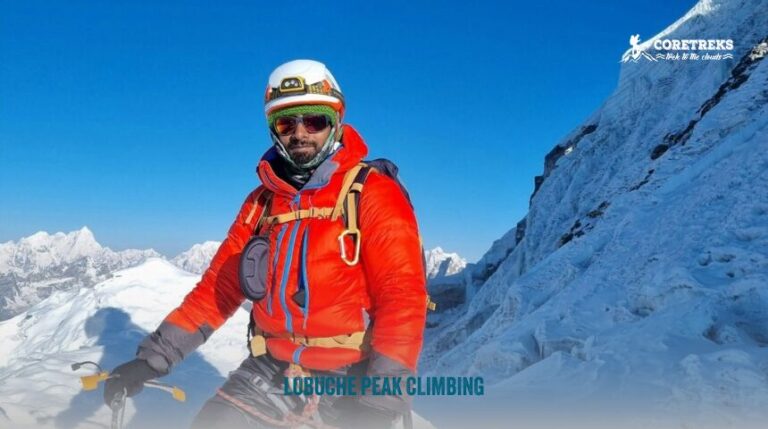
Lobuche Peak Climbing is one of Nepal’s most challenging climbing peaks, requiring technicality. There are two Summits of Lobuche Peak: Lobuche East (6119m) and Lobuche West(6145m). Lobuche Peak climbing is generally done in the Lobuche East Peak because climbing in West Peak is more difficult and needs an expedition permit. You need moderate technical skills and good cardiovascular fitness to complete the East Peak climbing. The Peak is located in the Sagarmatha National Park in the Khumbu region of Nepal.
The route of Lobuche Peak is the same as the EBC trek route. The journey starts with the scenic Lukla flight, then trekking to the Everest Base Camp. After that, ascend to the Kala Patthar and reach the Lochuche Base Camp, then High Camp. Finally, after one acclimatization day in High Camp, you ascend to the Summit of Lobuche East. From the top of the peak, you can see amazing views of Mount Everest, Lhotse, Nuptse, Cholatse, Ama Dablam, Pumori, and nearby mountains.
Three Peak Climbing – 6189m
Coretreks offers you an opportunity to have an adventurous experience with the Three Peak climbing in Nepal. It is a challenging journey involving the three Peaks of the Khumbu region: Lobuche Peak, Mera Peak, and Island Peak. As this is a combined climbing plan, you must have good Physical fitness and moderate mountaineering skills. You need to be Physically and Mentally fit to take this challenge.
While on this journey, you will pass through authentic Sherpa villages and iconic landmarks such as Everest Base Camp, Kala Patthar, and the Khumbu glaciers. It is recommended that you trek in a group, as it involves huge challenges. CoreTreks offers 30 days of Three-Peak Climbing in Nepal, with reasonably priced amenities. Among the three Peaks, Mera Peak climbing is a little more challenging than the others.
The journey starts with the Lukla flight and follows the Everest Base Camp trek route. Then, hike to Kala Pathhar and trek towards Lobuche. After that, climb to Lobuche East High Camp and finally reach the Summit of Lobche East Peak. Then, head towards the Island Peak Base Camp and ascend to the Summit of the Peak. Our last destination is Mera Peak; we head towards the Mera Peak High Camp via Amphu Labtsa North Base Camp, Seto Pokhari, and Kongma Dingma, and finally ascend to the Summit of Mera Peak.
Popular Regions for Peak Climbing in Nepal
Everest Region
Everest Region is one of Nepal’s most popular regions for peak climbing. The region offers you natural beauty with diverse, stunning landscapes. The world’s highest peak, Mount Everest, also lies in the Everest region. The region allows you to immerse yourself in the rich culture and tradition of Sherpa People. Also, it offers climbing peaks that are suitable for both beginners and experienced trekkers. The best time to visit the Everest region is Spring and Autumn because of the stable weather and mild temperatures. Some of the climbing peaks in the Everest region are Mera Peak, Island Peak, Lobuche Peak, and others.
Annapurna Region
Annapurna region is also a popular climbing destination after the Everest region. The region offers various peaks for climbers, like Tent Peak, Pisang Peak, Chulu West Peak, Chulu East Peak, Mardi Himal Peak, and many more. The Annapurna region is popular because Annapurna I, one of the 8000-er mountains, lies here. You can get to Annapurna region with easier access from Pokhara.
The region is famous for the villages like Ghandruk, Chhomrong, and Ghorepani. Furthermore, you can encounter the region’s rich culture and tradition of the Gurung and Ghale people. Moreover, you can witness the rare view of Macchapuchhre Himal and other highest mountain vistas like Annapurna I (8,091 m), Annapurna II (7,937 m), Gangapurna (7,455 m), Hiuchuli (6,441 m),
Langtang Region
Another popular region for peak climbing in Nepal is the Langtang region, closer to Kathmandu. The region has quiet trails where you can enjoy peace and the calm beauty of nature. Likewise, you can witness the rich Tamang heritage, scenic Langtang Valley, and Gosainkuna Lake, a sacred place for Hindus. The major attraction of the Langtang region is Langtang National Park, which allows you to witness rare flora and fauna. Some of the climbing Peaks of the Langtang region are Yala Peak and Naya Kanga Peak.
Manaslu Region
Mount Manaslu (8,163M)
Manaslu region lies in the northern part of the Gorkha district in Nepal. It is one of the remote and less explored areas. The major attraction of the Manaslu region is Mount Manaslu (8164m), one of the highest peaks above 8000m high lies here. The region is in the eastern part of the Manaslu Conservation Area. Similarly, it offers climbing Peaks like Himlung Peak and Larkya La Peak. You can also climb Mount Manaslu, but expedition permits and technical mountaineering skills are required. You get to see the untouched landscapes and warm hospitality of the Gurung and Bhutias people in the Manaslu region.
Packing list for Peak Climbing in Nepal
Are you wondering what to bring for Peak Climbing in Nepal? Here is a detailed Packing list that includes essentials.
Extra pair of prescription glasses and contact lens supplies
Sunscreen
Toiletries and Personal Hygiene
Toothbrush
Toothpaste
Personal First Aid Kit
A small bar or soap bottle
Dry Shampoo
Quick-drying towel
Multi-purpose soap
Deodorants
Nail Brush & Clippers
Hairbrush
Face Flannel
Hand and face moisturizing cream
Toilet paper
Wet wipes
Anti-bacterial handwash
Hand sanitizer
Pee Bottle
Pee funnel
Renting vs Purchasing Equipment
Every trekker or climber needs gear and equipment in technical and non-technical trekking or climbing destinations. If you need equipment and are considering whether to rent or buy, you should consider some factors first. You should prioritize reliability and safety whether you are renting or Purchasing. Buying bulk gear is not a good idea if you are a beginner with a low budget. You should purchase the equipment if you are a seasoned trekker or climber with long-term mountaineering plans. Here, we will provide you with the pros and cons of renting and purchasing the equipment to help you decide.
Pros of Renting
It is cost-effective, needs a low initial investment, and is suitable for beginners.
It is more convenient and available in trekking hubs like Kathmandu and Pokhara.
After climbing, you don’t have to worry about storing bulky gear and equipment.
Cons of Renting
It is less reliable as the gear may have worn out
If the equipment is low quality, then it might affect the climbing
In the Peak seasons, every kind of equipment may not be available
Pros of Purchasing
You can purchase according to your needs and fit, which ensures safety and comfort.
If you are a frequent climber, it’s a long-term investment for you
Reliable, well-maintained, and high-quality gear
Cons of Purchasing
You need to invest a high amount of money initially
You need storage and maintenance from time to time
It does not suit and is not ideal for beginners
How to Prepare and Train for Peak Climbing
Peak climbing is mentally and physically challenging. So, you should consider proper preparation and planning before undertaking peak climbing. First-time climbers need more preparation than the experienced climbers. You should begin your training four to five months before you start climbing. You must work on your physical fitness and technical climbing skills and be mentally ready to take this challenging journey.
Physical fitness requirements
For any climbing trip, physical fitness is essential because climbers have to go across rugged terrain, higher altitudes, and uneven weather. You need to focus on building strength and muscles. Some of the recommended training you should do is resistance training for strength and muscle endurance and Cardiovascular training for strengthening your heart. Moreover, you can swim, jog, cycle, run, climb stairs, etc in your free time.
Technical Climbing Skills
Peak climbing requires technical climbing skills to reach the Summit safely. However, one of the skills every climber should have is survival skills. Furthermore, learn technical skills likeBasic Ice Axe Grip, Self-Arrest Grip, Deadman Anchor, Picket: Top-Clipped & Picket, and many more. You should join the training to learn technical climbing skills.
Importance of acclimatization
Acclimatization is when your body adapts to higher altitudes and lower oxygen levels. It is essential to know the importance of acclimatization in peak climbing. At higher elevations, there is a risk of altitude sickness, which can become life-threatening if it worsens, such as HAPE and HACE. Thus, acclimatization is necessary to prevent altitude sickness.
Best Seasons for Peak Climbing
Spring and autumn are the best seasons for peak climbing in Nepal. The weather is calm and pleasant, offering clear views of the Himalayas. The blue and crystal-clear skies provide sunrise and sunset views over the Himalayas’ peaks. Summer and Winter are less favorable for Peak climbing because of the uneven weather and colder temperatures.
Spring (March-May)
Springs falls from March to May, which offers a pleasant temperature and minimal chances of rainfall and snow. The clear skies provide a great view of the highest peaks. Along the route, you can witness the blooming rhododendrons and vibrant landscapes. The season offers a moderate temperature, which is ideal for trekking. The average daytime temperature in spring ranges from 15 to 25 degrees Celsius and generally drops at nighttime from -2 to -10 degrees.
Autumn (September-November)
Another good time for peak climbing is the autumn season, which falls from September to November. During this season, the sky is very clear, giving you perfect views of the snowy peaks. The weather is dry, which makes the climbing conditions stable. Moreover, you can also encounter Nepalese festivals if you plan your trip in this season. The average temperature in the daytime ranges from 10 to 20 degrees Celsius. The nighttime temperature drops to -5 to -15 degrees Celsius.
Tips for Successful Peak Climbing In Nepal
You must prepare adequately to make your peak climbing experience successful and comfortable. You will face many challenges throughout the journey. You should choose the right peak based on your skill level and experience. Furthermore, you should select a reliable trekking agency and get travel insurance to ensure safety.
Choose a Reliable Trekking Agency
Choosing a reliable trekking agency ensures a safe and successful climbing experience. Reliable trekking agencies are registered with the Nepal Tourism Board and affiliated with the Nepal Mountaineering Association. They provide a certified guide to help you in high-altitude regions. We Coretreks ensure your safety and give you unforgettable experiences with our services. We offer you a complete package at a reasonable price.
Travel Insurance
Peak climbing in Nepal requires compulsory travel insurance due to the high risk involved in high-altitude climbing. Travel insurance includes emergency rescue, medical expenses, and lost or damaged gear.
Conclusion
In conclusion, climbing the Peak in Nepal is a once-in-a-lifetime experience. Nepal offers diverse climbing peaks that are suitable for both first-time travelers and experienced climbers. It is challenging, but you can attend the Summit of the Peak with proper preparation. After summiting the Peak, you will be rewarded with the best views of the highest mountains, such as Everest, Annapurna, Dhaulagiri, Manaslu, and many more. You must choose a reliable trekking agency for a safe and guided journey. We, Coretreks, will ensure your safety and success in climbing the Peaks. You will have the best and most memorable experience with us.
FAQs
What are the climbing peaks in Nepal?
Climbing Peaks are those that are between 5000m and 7000m high and don’t require technical mountaineering skills. Reaching the summit of a peak takes a few days to weeks. Examples include Mera Peak, Island Peak, Lobuche Peak, Pisang Peak, and many more.
Who has climbed most mountains?
Kami Rita, a Nepali guide, has climbed the most mountains globally. He is the first person to climb the 8000m Peaks for the 38 times. In 2023, he broke the record for Mount Everest by summiting the Peak of Everest for the 28th time.
How hard is Lobuche Peak?
Lobuche Peak is challenging but does not require advanced mountaineering skills. The remote area, longer duration, rocky terrain, and high altitude above 5500m make the Lobuche Peak Hard. A good level of fitness and basic rock and ice climbing is recommended for climbing Lobuche Peak.
How many 6000m peaks are there in Nepal?
Nepal has 297 peaks over 6000m, including climbed and unclimbed Peaks. They are open for climbing. Some of the famous peaks climbing include Mera Peak, Yala Peak, Pisang Peak, Island Peak, Chulu Peak, and many others.
Which Nepali climbed all 8000m peaks?
Nirmal Purja, a Nepal-born but neutralized British mountaineer, has climbed all 8000-meter peaks in six months and six days using bottled oxygen. Other mountaineers, such as Kristine Harlia and Tenjen Sherpa, have also climbed all 8000-meter peaks, breaking Nirmal Purja’s record.
Which is the easiest peak to climb?
Yala Peak is one of the easiest mountains to climb in Nepal because it is not too hard or technical. It takes shorter days to reach the Summit of the Peak. There are several other easy peaks in Nepal to climb, including Mera Peak, Island Peak, Pokalde Peak, Chulu Peak, and many more.
Who lives near the highest peaks of Nepal?
The Sherpas, known for their mountaineering skills, live near the highest peaks of Nepal. They have set many records for Climbing in the highest mountains. They mostly live in Nepal’s eastern regions, including Solkhumbu, Barun, Khatra, etc. They also live in the north of Kathmandu and the Helambu regions.
Is Annapurna one of the 14 Peaks?
Yes, Annapurna is one of the 14 peaks in the world, having an altitude of over 8000m. It is the tallest mountain in the Annapurna Massif, with an elevation of 8091m above sea level. It is known as one of the most dangerous mountains in the world to climb because of the steeper slope.
Who is the youngest person to climb all 14 peaks?
Nima Rinji Sherpa, an 18-year-old mountaineer, is the youngest person to climb all 14 peaks above 8000m globally. The record is set after he reached the summit of Mount Shishapangma in the Xizang autonomous region, China, on October 9, 2024.
Boudhanath Stupa is one of the most sacred Buddhist sites in the world. It is a religious site and a cultural hub for pilgrims, especially Tibetan Buddhists. Similarly, it is one of Nepal's largest, 36-meter-high, and 100-meter-wide stupas in the capital city of Kathmandu. The stupa is located just 7 km northeast of central Kathmandu,…
The Everest Base Camp Trek in February is a one-of-a-kind experience that trek enthusiasts must take once. Contrary to many trekkers who believe winter months are unsuitable for Himalayan ventures, trekking in February is doable. It is just the time when the cold winter slowly transitions into the warm spring season. Therefore, trekking on the…
Many of you might be curious about the Manaslu Circuit Trek after earthquake in Nepal and whether it is safe for trekking. Fortunately, yes. The trail that was heavily damaged by the 2015 Nepal earthquake has re-opened. So what are the conditions of the trails, accommodation availability, and risks of Manaslu Circuit Trek after the…
This site uses cookies to optimize your user experience. By using this site, you are consenting to our use of these cookies. Check out our Privacy Policy.