After recent events, Nepal is back to normal and ready to share its cultural and natural wonders with you.



Annapurna Base Camp Trek
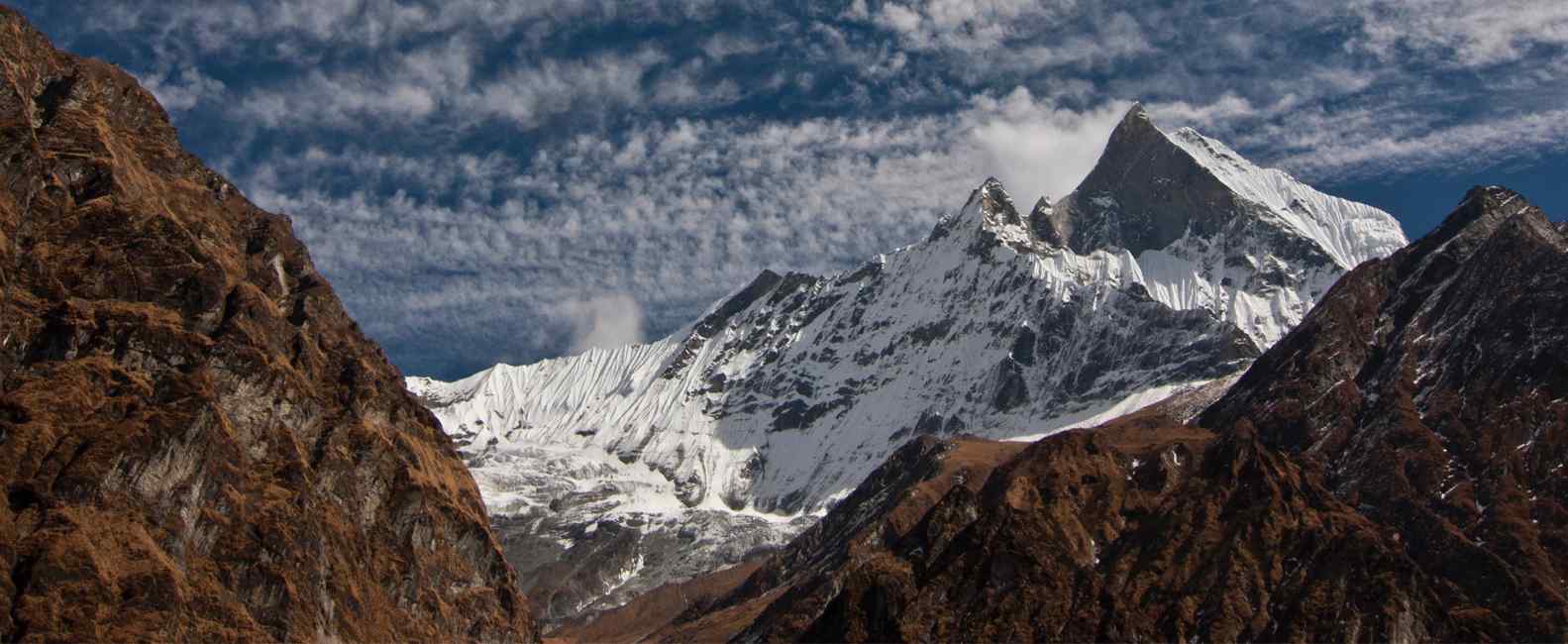
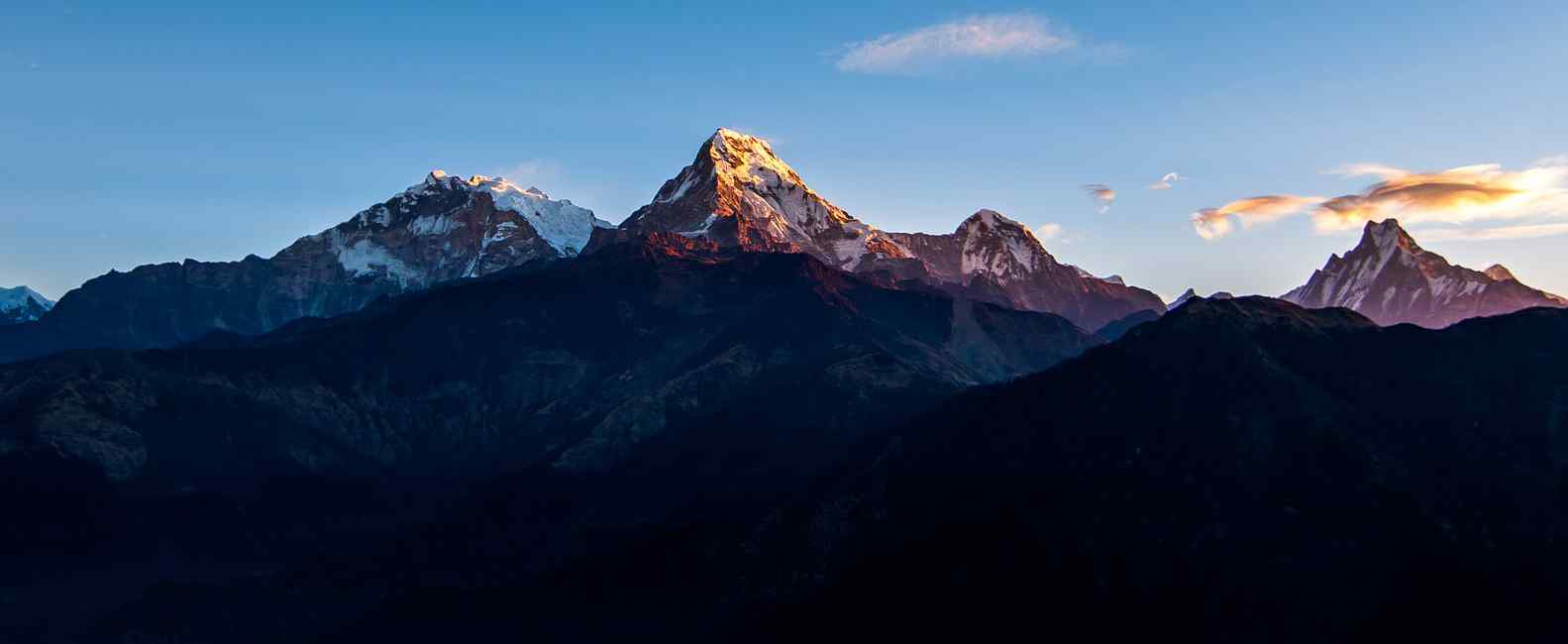
Your trek begins from Pokhara, with stunning views of the Annapurna range. Then, you will hike to Poon Hill for a beautiful sunrise. After that, you head towards Machhapuchhre Base Camp with incredible views of Machhapuchhre and Annapurna South. Finally, you’ll reach Annapurna Base Camp, surrounded by the tall peaks of the Annapurna range. The best 13-day trek plan that will make you experience rich culture and enjoy the scenic beauty.
per person
USD 1,010
Duration
13 Days
Difficulty
Moderate
Requires some level of experience in trekking with basic physical ability.
Best Season
March- April- May- August- September- October- November- December- January- February
Max. elevation
4,130 m/13,550 ft
Trip Code
CT-10029
Meals
Included
Included
Breakfast at the hotel in cities (Kathmandu and Pokhara). Breakfast, Lunch, Dinner during trek days and a farewell dinner on the last day in Kathmandu
Destination
Nepal
Region
Annapurna Region Treks
Activity
Trekking
Start / End Point
Kathmandu / Kathmandu
Accommodation
Guest House | Hotel
Activity Per Day
Approx. 4-7 hrs walking
Transportation
Tourist Bus | Domestic Flight | Private Vehicle
Route
Kathmandu - Nayapul - Ulleri - Ghorepani - Poonhill - Tadapani - Chhomrong - Himalaya - Annapurna Base Camp - Bamboo - Jhinu Danda - Pokhara - Kathmandu
ABC Trek Highlights
- A classic trek destination with low altitude risk and high reward.
- Trek on the diverse trail of the Annapurna region that goes from dense subtropical verdant to alpine meadows and glaciers.
- Explore Nepal’s largest conservation area, the Annapurna Conservation Area.
- Follow the Modhi Khola river’s tributaries, gorges, and waterfalls.
- Enter the natural amphitheater, the Annapurna Sanctuary, surrounded by 8,000 m peaks.
- Observe a magical sunrise view from the Poon Hill Viewpoint (3,210 m / 10,531 ft).
- Witness stunning views of Annapurna I (8,091 m/ 26,545 ft), Annapurna II (7,937 m/ 26,040 ft), Annapurna III (7,555 m/ 24,786 ft), Annapurna South (7,219 m/ 23,684 ft), Machhapuchhre (6,993 m/ 22,943 ft), and more.
- Explore the Machhapuchhre Base Camp (3,700 m/12,140 ft) on the way to Annapurna Base Camp.
- Stay overnight at Annapurna Base Camp (4,130 m/13,550 ft) and explore the Annapurna Sanctuary.
- Dip into the natural hot spring of Jhinu Danda with healing properties.
- Trek past charming Gurung and Magar villages, terrace farms, shrines, prayer flags, and stone cairns, while immersing in the local culture.
Annapurna Base Camp Trek Overview
The Annapurna Base Camp Trek is a spectacular journey into the tranquil Himalayas of the Annapurna region. This classic trek is a whirlwind of thrilling adventure that offers magnificent views of towering mountains and an enriching cultural experience.
The Annapurna region lies in the Gandaki Province in north-central Nepal. You can start the ABC trek with a scenic 7-hour drive on the Prithvi Highway or a short 30-minute flight from Kathmandu to Pokhara. Then, the trek begins from Nayapul, traversing charming Gurung and Magar villages and terrace farms. The trail also passes through lush forests, conifers, and highland pastures. Along the way, you will come across several cascading waterfalls, rivers, suspension bridges, glaciers, and moraines. The ABC Trek is also famous for its surreal sunrise view from Poon Hill View Tower (3,120 m/ 10,531 ft) and the gleaming mountain views. Similarly, the ABC Trekking route lies within the Annapurna Conservation Area. It is a fantastic opportunity to witness the region’s diverse biodiversity.
The Annapurna Base Camp sits at 4,130 m (13,549 ft) with the natural amphitheatre, Annapurna Sanctuary. It offers a close view of the mighty Annapurna, Machhapuchhre (Fishtail), Dhaulagiri, and other surrounding peaks. You will also get to dip at the natural hot spring at the end of the trek. The Gurung and Magar people are native to the region. They have a deep-rooted history and a unique culture and customs. They are world-renowned for their bravery and service in the British and Indian Gurkha Armies. The trek offers a window to glimpse into the culture and lifestyle of the locals. If you too want to experience the perfect blend of adventure, natural beauty, and cultural immersion, join our 13-day Annapurna Base Camp Trek. With a well-curated itinerary and strategic pacing, the trek is doable for beginners to experienced trekkers alike!
Annapurna Base Camp Trek Itinerary
Arrival in Kathmandu
Highest Altitude
1,350 m/ 4,429ft
Our CoreTreks representative will pick you up at the airport. They will receive you from the terminal and transfer you to your hotel. We will arrange your stay in a three-star hotel or any accommodation that suits your preference.
We will have a short briefing session at our office, the hotel lobby, or a meeting room. During the briefing session, we will provide information about the trek. You can also ask us questions. After our briefing session, you can venture around Thamel’s streets or retire for the day
Hotel


Kathmandu to Pokhara
Flight Hours
25 min
Drive Hours
7 hours by luxury tourist bus
Highest Altitude
1,350 m/ 4,429ft
After breakfast, we will board a luxury tourist bus early in the morning and head towards Pokhara. You can fly from the capital city to Pokhara. The flight between Kathmandu and Pokhara takes approximately 25 minutes. During this trip, you will witness the gorgeous Himalayas and landscapes from a bird’s-eye view. However, it is a more expensive transportation option.
You will drive on the winding and scenic Prithvi Highway. The road follows the Trishuli River, passing by hills, terrace farms, and picturesque countryside. It takes approximately 7 hours to drive to Pokhara on a luxury tourist bus. If you want to enjoy the scenic beauty of rural Nepal, taking the roadway is an excellent choice. However, air travel is the best, quickest, and most comfortable option. Either way, you will witness the beauty of Nepal’s diverse landscapes.
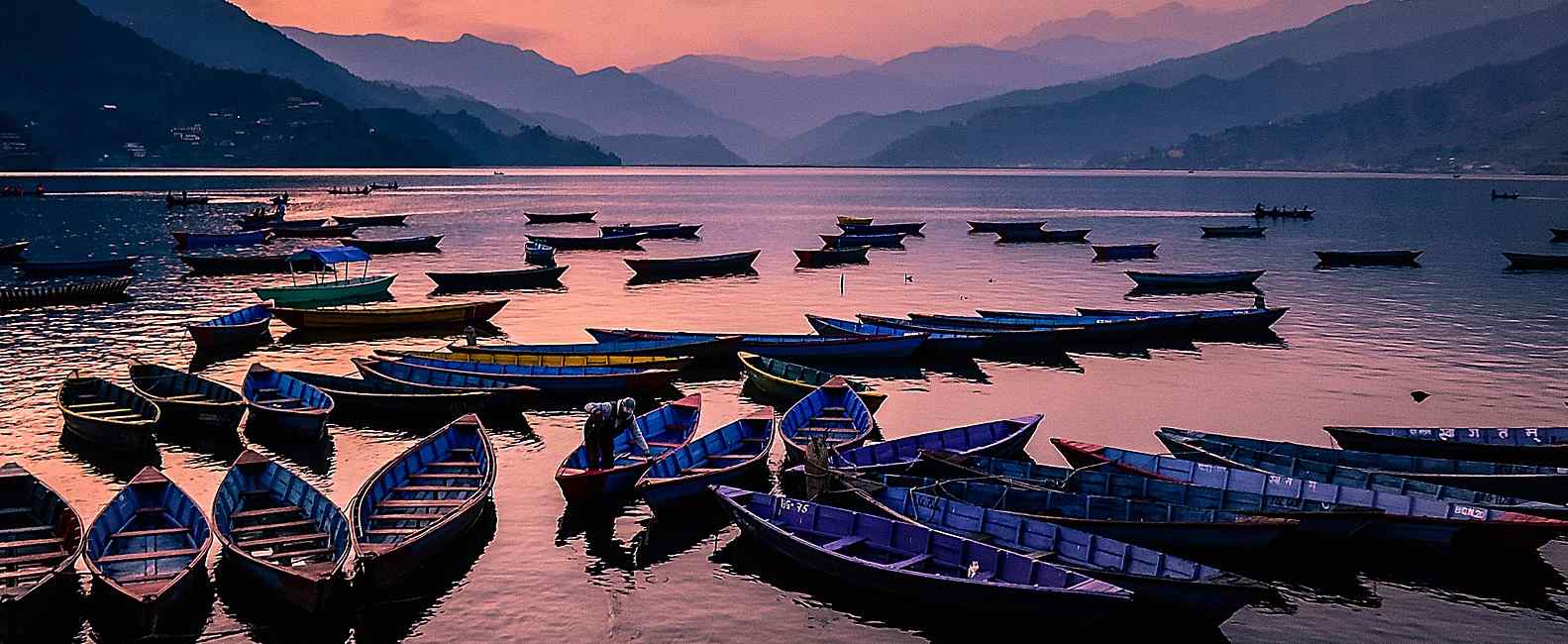
Pokhara is the second-largest city in Nepal and a popular tourist hub. It is the gateway for trekking in the Annapurna region. You will stay at a hotel here. The famous Lakeside lies right next to the Phewa Lake. So, you can boat on the lake. There are numerous restaurants, shops, and bars in the area. The whole area comes to life with lights, live music, and cultural programs in the evening. You will get a glimpse of the Pokhara nightlife and enjoy the atmosphere.
Note: You can opt for a budget-friendly tourist bus or hire a private vehicle for a more convenient drive.
Breakfast, Lunch & Dinner
Hotel


Drive to Nayapul & Trek to Ulleri
Trek Distance
10 km/ 6.21 miles
Trek Duration
5 hours
Drive Hours
1 ½ hours
Highest Altitude
2,020 m/ 6,627ft
We will enjoy breakfast in Pokhara, with views of Phewa Lake and the surrounding mountain vistas. Then, we will hop on a jeep and ride through the Baglung Highway towards Nayapul. It’s a one-and-a-half-hour scenic drive. The road is smooth and paved up to Lumle. It gets rugged from here on. Nayapul is the starting point of our Annapurna Base Camp Trek.
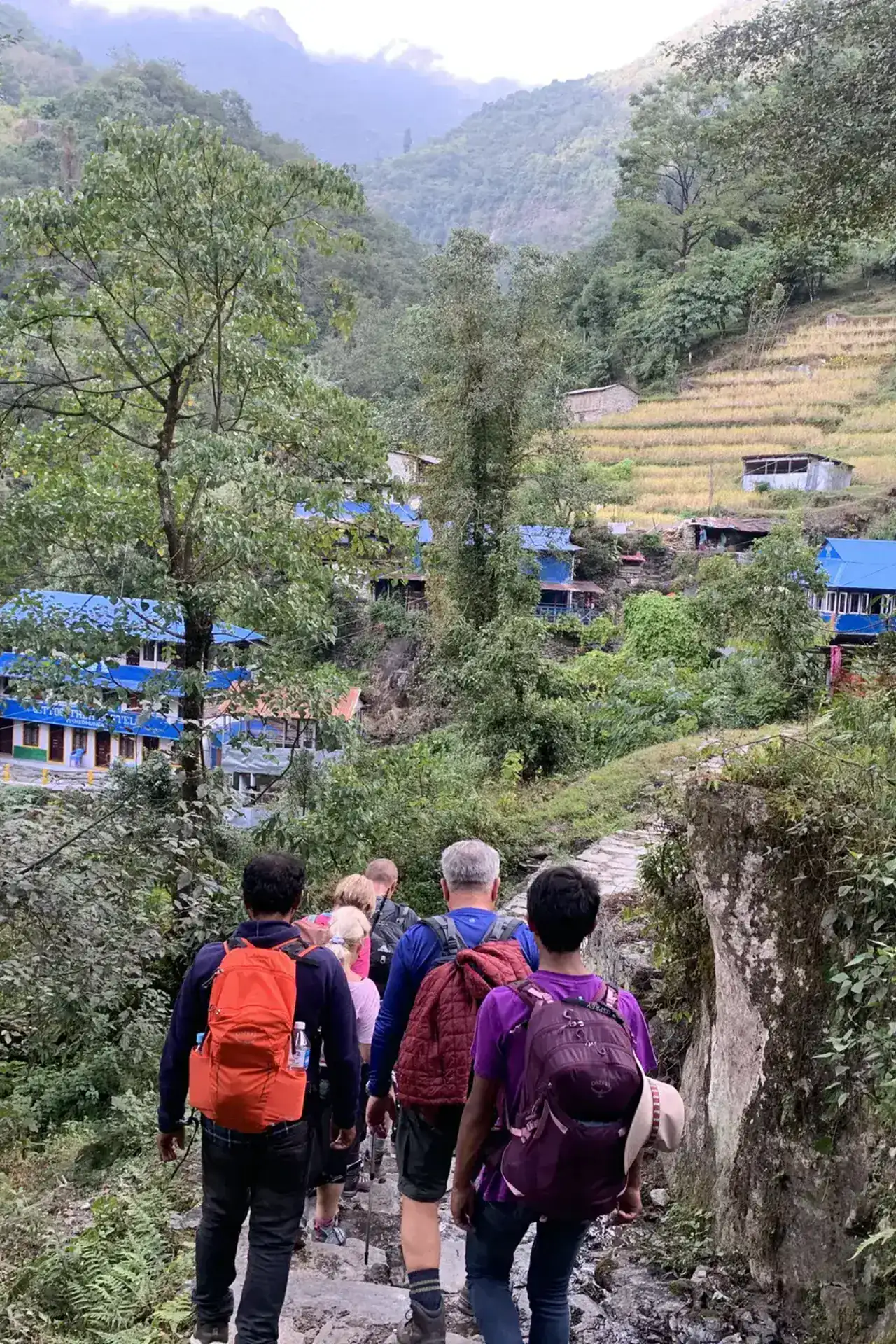
From Nayapul, we will slowly begin walking past small villages and terrace farms. The trail enters the forest region alongside the Bhurungdi River. Then, we will pass through the villages of Birethanti in the Modi River Valley. It also takes us past the villages of Sudame and Hile. The trekking trail on this day requires us to hike on stone steps and dirt paths. There are also a few gradual climbing sections and suspension bridges. From Tikhedhunga, we will begin ascending the legendary stone staircases to Ulleri. There are more than 3,000 stone steps, which are the most challenging part of today’s journey.
Ulleri is a small yet beautiful village offering gorgeous views of Annapurna South and Hiunchuli. It is a popular rest stop for the Annapurna Base Camp Trek. The majority of the locals are Magar. You can see numerous traditional slate-roofed houses, stone-paved paths, and terrace farms. Hence, you will get your first glimpse at their unique culture and lifestyle. You will stay here overnight and enjoy their warm rural hospitality.
Breakfast, Lunch & Dinner
Guesthouse
Ulleri to Ghorepani
Trek Distance
7 km/ 4.35 miles
Trek Duration
3-4 hours
Highest Altitude
2,860 m/ 9,383 ft
Our destination for the day is the picturesque Magar village of Ghorepani. The trail slowly ascends through a dense forest of rhododendrons, oaks, and firs towards Nangethanti. As we climb higher, we can also glimpse Annapurna and Machhapuchhre. Take a break to enjoy the views or capture nature’s masterpiece. We will continue on our Annapurna Base Camp Trekking trail, and pass by notable villages like Banthanti and Hile. The trails also consist of stone-paved staircases.
Along the way, you can see cascading waterfalls, rivers, small settlements, and paddy fields. After about 6 hours, we will reach Gorepani. The village offers views of the magnificent Annapurna range, Machhapuchhre, and Hiunchuli. Ghorepani is a Magar village and a popular stop for trekkers. It sits amidst the dense rhododendron forests. In springtime, you get to witness the spectacular blooms of rhododendrons. It is also a gateway to Poon Hill View Point. The accommodations in Ghorepani are basic but comfortable and cozy. We will stay here overnight.
Breakfast, Lunch & Dinner
Guesthouse


Ghorepani to Poon Hill to Tadapani
Trek Distance
12 km/ 7.46 miles
Trek Duration
7 hours
Highest Altitude
3,210 m/ 10,531ft
Today, we will head to Poon Hill View Tower early in the morning before sunrise. The hike to Poon Hill takes about an hour through dense rhododendron forests and stone-paved staircases. The view tower offers a gorgeous sunrise against the snow-peaked mountains. You can see the Annapurna Massif, Machhapuchhre, Dhaulagiri, Nilgiri, and other peaks. The golden sunrise and the stunning surroundings make it the most popular viewpoint among trekkers and photographers. After catching a glimpse of one of the best sunrises, we will head back to Ghorepani.
We will have breakfast and then head northeast towards Tadapani. The Annapurna Base Camp Trekking trail once again enters the dense forest area. It passes through Gurung Hill and several villages before reaching Tadapani. The trek to Tadapani takes around 7 hours. Tadapani is a small, serene village offering breathtaking views of Annapurna South, Machhapuchre, and Hiunchuli. From here, you can witness stunning sunrises and sunsets. A dense rhododendron forest surrounds the village, and you can catch sight of many bird species and animals, such as langurs and mountain goats. The tranquil atmosphere of Tadapani is perfect for resting your legs after a long day’s walk.
Breakfast, Lunch & Dinner
Guesthouse


Tadapani to Chhomrong
Trek Distance
5-6 km/ 3.11–3.73 miles
Trek Duration
4-5 hours
Highest Altitude
2,630 m/ 8,628 ft
From Tadapani, we will head towards Chhomrong village. As we leave the village of Tadapani, the trails once again enter the dense rhododendron forest. The ABC Trekking trail descends at the beginning. It then becomes steep and rocky. There are small wooden footbridges over small streams. Along the route, we will pass by small villages like Bamboo and Sinuwa. The trail then descends towards the Kimron River and continues to Chhomrong.
You can view Mount Annapurna South, Machhapuchhre, and Himchuli more closely here. We will rest for the night at Chhomrong. As we get closer to Chhomrong, the trail becomes flatter. Chhomrong is a charming Gurung village with incredible scenery. It is the last major village on the route to the Annapurna Base Camp. Similarly, it is a popular stop for acclimatization. Here, you can see many traditional Gurung houses, stone-paved pathways, and terrace farms. We will rest here overnight, while enjoying the warm and unique Gurung hospitality.
Breakfast, Lunch & Dinner
Guesthouse

Chhomrong to Himalaya
Trek Distance
6-7 km/ 3.73–4.35 miles
Trek Duration
6 hours
Highest Altitude
2,950 m/ 9,678 ft
On this day, we will ascend to a slightly higher elevation towards the Himalaya. The trek starts with a long descent on a stone-paved staircase towards the Chhomrong Khola. Along the way, the ABC Trek trail once again enters the rhododendron forests. However, as we move forward, it changes into bamboo forests. Similarly, we will cross several suspension bridges. The route begins to ascend from the river, and we will start trekking on dirt trails and stone steps. Along the way, we will pass by the beautiful village of Sinuwa. It is a popular stop for tea and snacks. We can take a short break to enjoy the views of Mount Hiunchuli and Machhapuchhre.
From Sinuwa, we will continue to climb uphill on a mixed trail. We will come across occasional open spots along the way. For the final stretch of today’s trek, we will continue trekking uphill on a more rocky terrain. It takes us to the Himalaya Village, which sits on a ridge and is surrounded by towering cliffs. There are very few accommodations available, and they only offer basic services. The surroundings are barren, and the atmosphere is peaceful. Similarly, there are also waterfalls and rivers near the village. The village’s isolated location allows trekkers to relax and enjoy the surrounding views. We will stay here overnight.
Breakfast, Lunch & Dinner
Guesthouse
Himalaya to Annapurna Base Camp via Machhapuchhre Base Camp
Trek Distance
8-10 km/ 4.97–6.21 miles
Trek Duration
5 hours
Highest Altitude
4,130 m/ 13,550 ft
Today marks the peak of our Annapurna Base Camp Trek, as we finally reach the Annapurna Base Camp. After a hearty breakfast at Himalaya village, we will begin the most challenging part of the trek. The trails follow the narrow gorge along the valley and enter the forest area. However, it becomes thinner as we gain elevation. Although it is a gradual ascent, we can feel the altitude and the air around us get thinner. Then, we will pass by the famous Hinku Cave. It is a massive natural rock shelter and a notable landmark of the ABC Trekking route. We can take a detour to the cave.
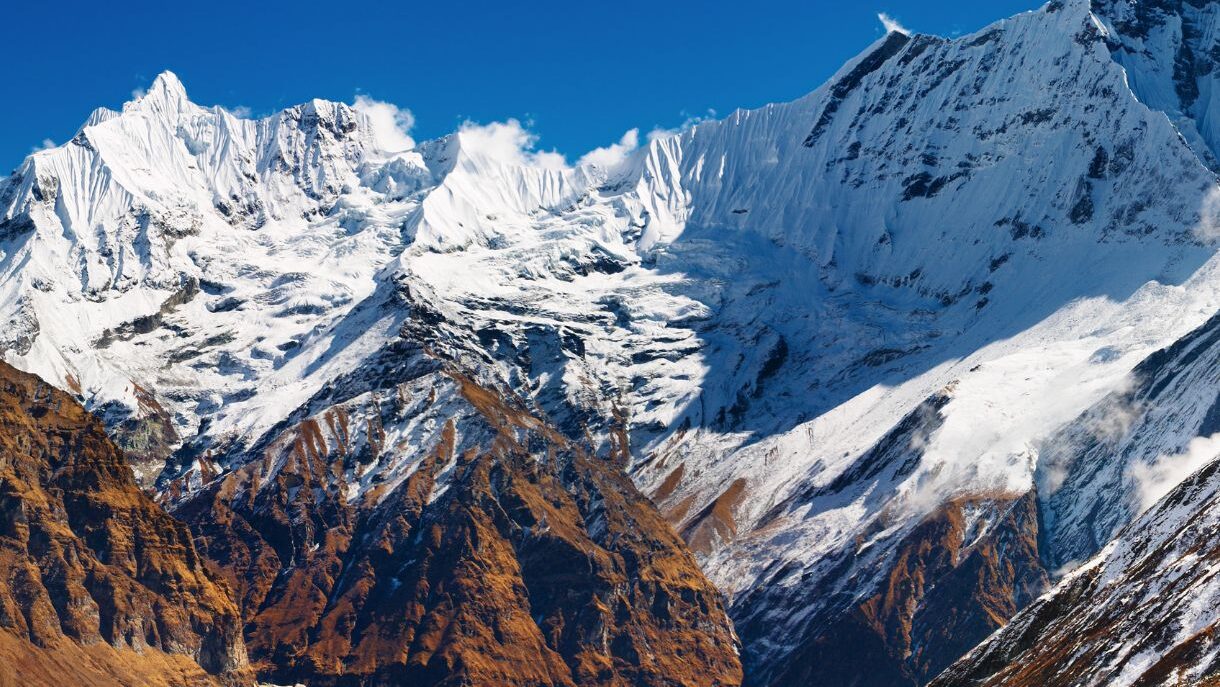
The trail then ascends towards Deurali and gets steeper. The valley starts to open up, and we will enter the Annapurna Sanctuary. It provides us with our first glimpse of the glacial basin. Along the way, we will cross the Machhapuchhre Base Camp (3500 m/ 11,483 ft). It sits right below the gigantic Mount Machhapuchhre (6693 m/ 21,958 ft) and offers panoramic views of the Annapurna range and others. The trail from here heads northwest. We will trek alongside the moraine walls, icy streams, and riverbed.
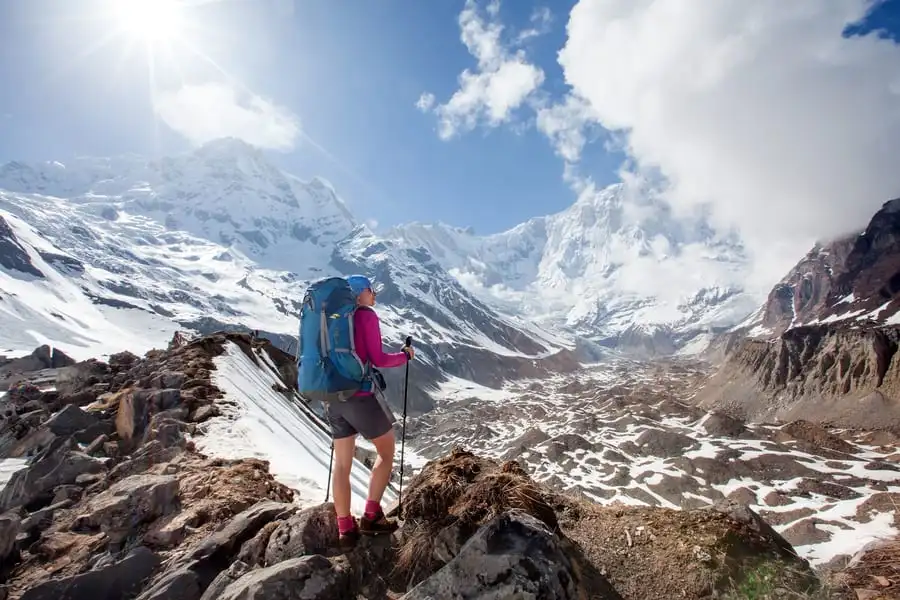
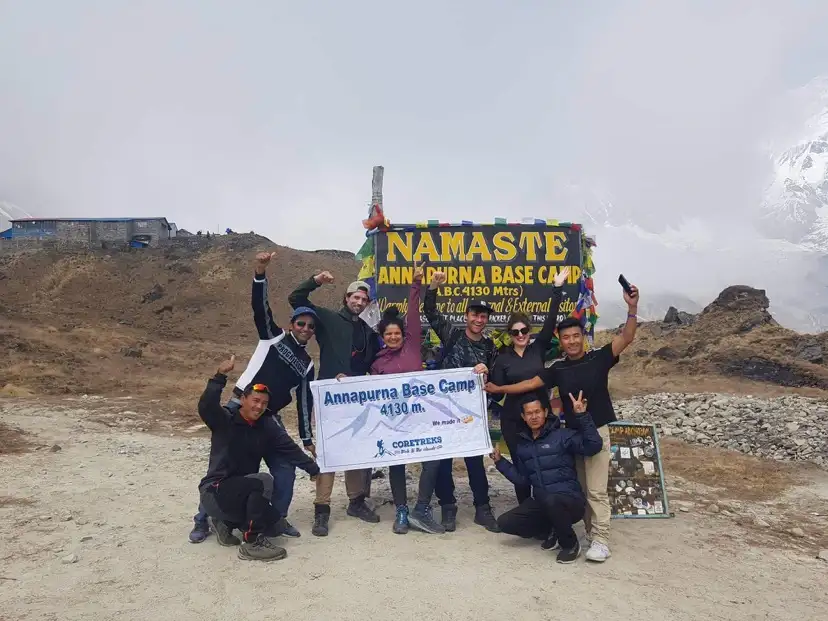
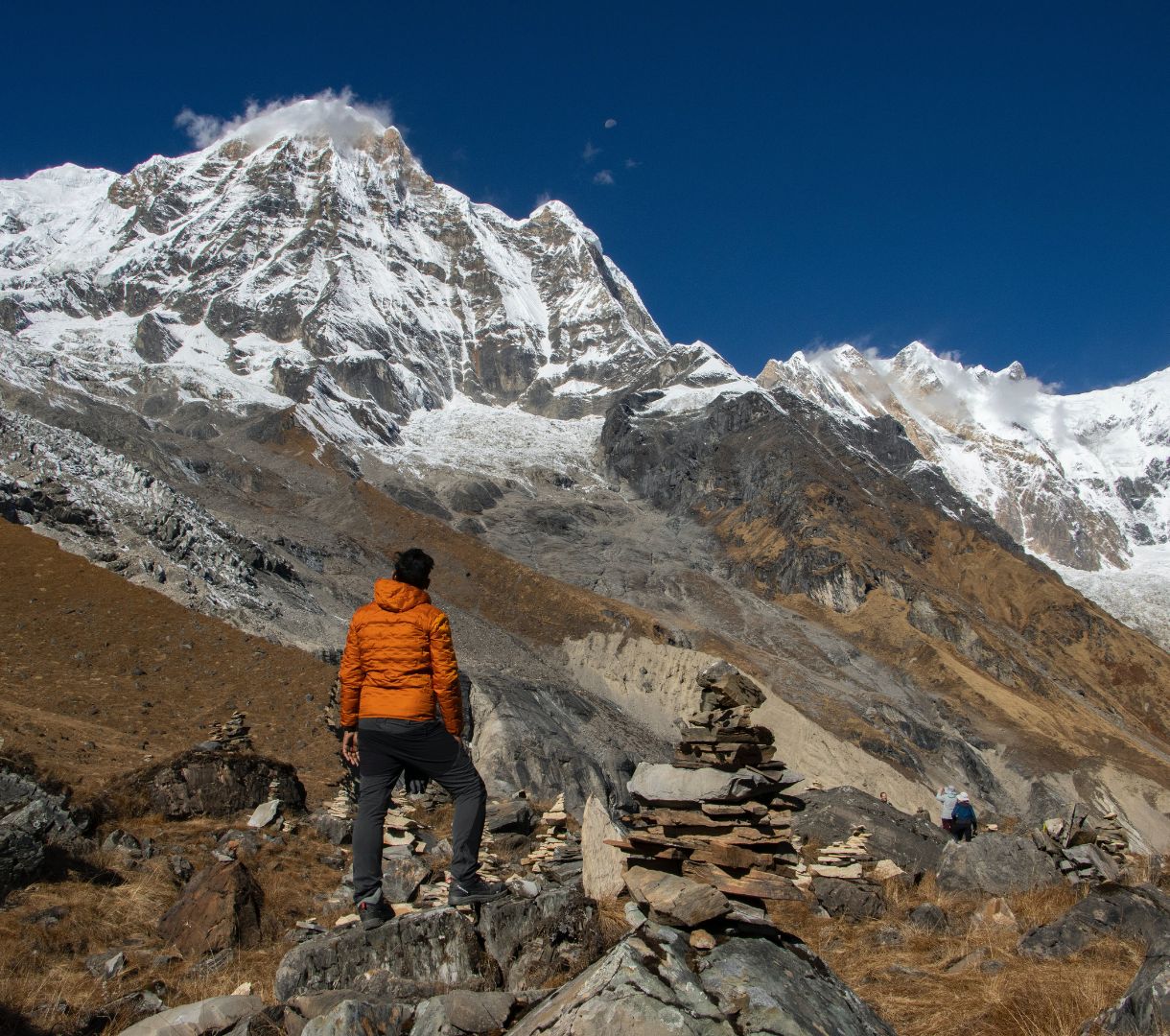
After an hour-long trek from Machhapuchre Base Camp, the trail opens into a vast rocky field. Finally, we will reach base camp, where you can see the iconic “Annapurna Base Camp” signboard. We can witness a stunning sunset that lights up Mount Annapurna South and Hounchuli. We will stay at the base camp overnight.
Breakfast, Lunch & Dinner
Guesthouse


Annapurna Base Camp to Bamboo
Trek Distance
13-14 km/ 8.08–8.70 miles
Trek Duration
6-7 hours
Highest Altitude
2,310 m/ 7,579 ft
We will wake up early to witness a gorgeous sunrise and the beauty of Annapurna Base Camp. It offers close-up and 360-degree views of Mount Annapurna I, Annapurna South, Machhapuchre, Hiunchuli, and several other snow-covered peaks. We will have our breakfast while relishing the stunning mountains. Then, we will descend towards Bamboo. Descending from the base camp is slightly easier than ascending. However, it is physically demanding.
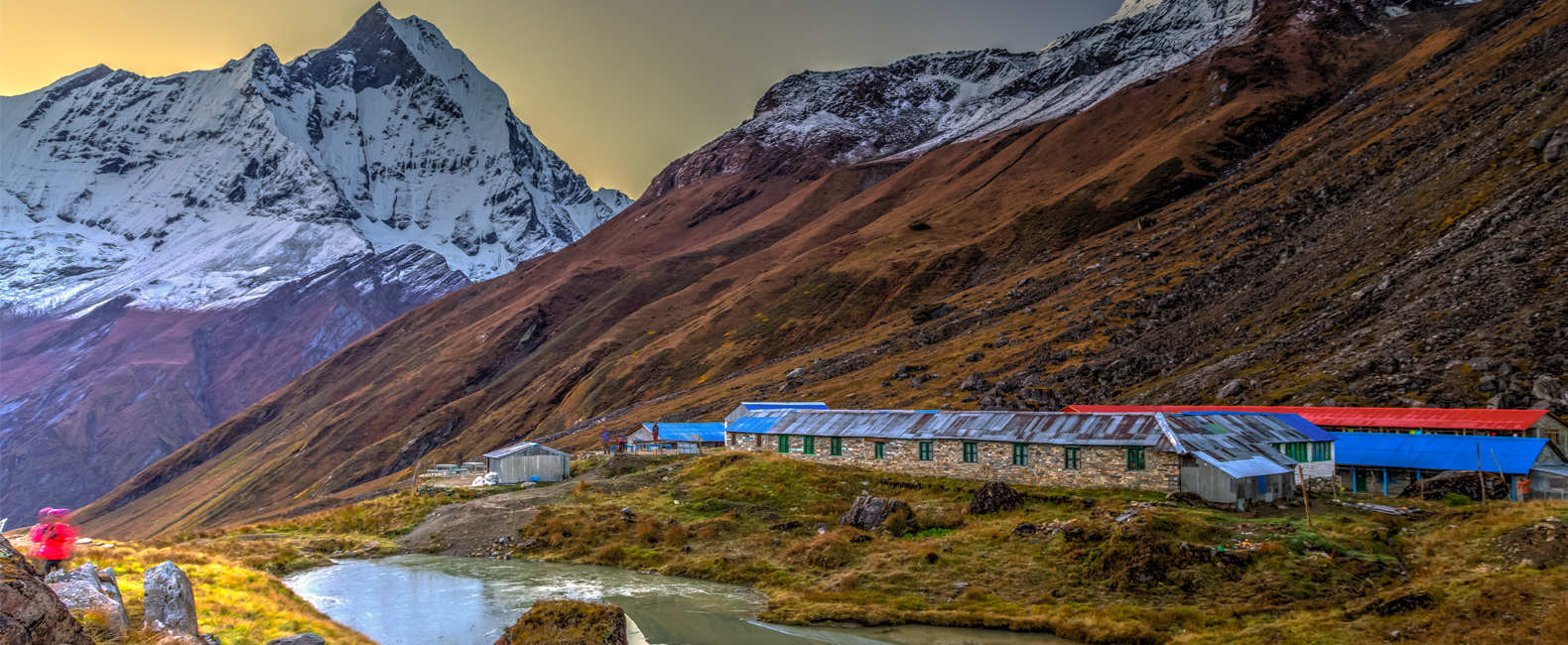
We will retrace our steps back to Chhomrong and then to Bamboo Village. The highland pasture scenery changes into bamboo forests. The village sits adjacent to a dense bamboo forest and a massive cliff. It lies within the Annapurna Sanctuary. You can hear the sound of the rushing river nearby. The village serves as a popular stop for trekkers. You will stay in a basic teahouse in the Bamboo village. The service may be limited, but the stunning surroundings and serene atmosphere make up for it. We will stay overnight in the village while enjoying the atmosphere.
Breakfast, Lunch & Dinner
Guesthouse


Bamboo to Jhinu Danda
Trek Distance
7-8 km/ 4.35–4.97 miles
Trek Duration
4-5 hours
Flight Hours
25 min
Highest Altitude
1,780 m/ 5,840 ft
We will leave the Bamboo village and climb the narrow ridge. The bamboo forest again changes into a dense forest of rhododendrons and oaks. After a while, we will reach the Sinuwa, from where the trail drops down to the Chhomrong River. We will cross a river and make a slight ascent towards Chhomrong. The trail begins to descend after you reach Chhomrong.
We will trek alongside the exposed ridge right before reaching Jhinu Danda, which is relatively easier today. Jhinu Danda is famous for its natural hot spring. You can dip into the hot spring in the evening and relax your tired muscles. The natural hot spring is just a 15-minute walk from the village. Green forests and hills surround the area. Its secluded location also makes it a popular spot for rewinding. You can also witness beautiful valleys, snow-capped mountains, and beautiful terrace fields from Jhinu Danda. After dipping in the hot spring, you will return to the village and stay overnight.
Breakfast, Lunch & Dinner
Guesthouse

Jhinu Danda to Pokhara
Trek Distance
6–7 km/ 3.73–4.35 miles
Trek Duration
3 hours
Drive Hours
1.5 hours
Highest Altitude
1,780 m/ 5,840 ft
After a refreshing dip at Jhinu Danda the night before, we will prepare for our return to Pokhara. After breakfast, we will begin our trek downhill towards Siwai. It is a short, around 3-hour trek. We will mostly trek downhill along the Modi Khola River. Similarly, we will pass by small villages, terrace farms, and bamboo groves one last time.
From Siwai, we will take a jeep to Pokhara. The drive takes about 1.5 hours along a winding road through a lush green valley. We will pass by beautiful villages, paddy fields, and rivers. Upon reaching Pokhara, we will check in at the hotel. If we have spare time, we can opt for sightseeing around the city. In the evening, you can relax or stroll around the Lakeside. There are plenty of restaurants and pubs where you can enjoy local or Western cuisines. We will stay overnight at Pokhara.
Breakfast & Lunch
Guesthouse


Drive back to Kathmandu
Flight Hours
30 min
Drive Hours
7 hours
Highest Altitude
1,350 m/ 4,429ft
After our breakfast in Pokhara, we will head back to Kathmandu. Like when traveling to Pokhara, there are a few other options for getting to Pokhara from Kathmandu. You can take a flight, hire a private vehicle, or take a tourist bus.
Once you reach Kathmandu, you can take a break for refreshments. In the evening, we will hold a dinner party for our guests in a traditional Nepali restaurant. The dinner will be a celebration of a successful trek and wonderful memories. You can also provide us with your feedback and your trekking experience. If you want to join any other trek, we can make further arrangements for you. Then, you can stroll around the city and shop for souvenirs. You can also enjoy the vibrant nightlife of the capital city.
Breakfast & Farewell dinner
Hotel


Departure
Highest Altitude
1,350 m/ 4,429ft
This will be the final day of your trek package. After breakfast, a representative from our CoreTreks will pick you up at your hotel. They will drop you off at the Tribhuvan International Airport two hours before your flight. We will say our goodbyes and hope to see you again in Nepal for more adventure.
Breakfast
Altitude in:
Temperature by Month During Annapurna Base Camp Trek
Trip Includes
- Airport transfers by Private Vehicles.
- Standard twin-sharing accommodation in three-star hotels in Kathmandu & Pokhara, breakfast included. (4 Nights).
- Twin-sharing accommodation during the trek. (6 Nights).
- Kathmandu – Pokhara– Kathmandu by Luxury tourist bus (If you want both ways private vehicle is also available at an additional cost).
- Pokhara to Khade (Trekking Start Point) & Siwai to Pokhara by Private Vehicle.
- Three daily meals with tea/coffee (breakfast, lunch, and dinner) during the trek.
- TIMS Fee- Trekkers’ Information Management System & Annapurna Conservation area permit (Please bring 2 passport-size photos).
- One highly experienced, helpful, and friendly guide. Porters (1 porter for 2 people) and their food, accommodation, salary, and equipment. Accident insurance for all staff
- Farewell dinner in a traditional Nepali restaurant with cultural performances.
- Personal care & attention.
- Local and government taxes.
Complimentary Services
AVAILABLE AFTER COMPLETE BOOKING
- Down jacket and four seasonal sleeping bags (to be returned after completion of the trip).
- Core Trek duffle bag, T-shirt, and a trekking map.
- A self-sufficient medical first aid kit containing vital medications.
- Company-branded water bottle with purification tablets
- Trip certificate.
- Oximeter to check your oxygen saturation & pulse rate daily during the trip.
Trip Excludes
- All kinds of beverage including mineral water, Phone calls, laundry, hot shower during Trek
- Travel and Rescue Insurance
- Tipping to the crew.
- Personal mountaineering gears
- Optional trips and sightseeing if extended
- International airfare and airport departure tax
- Visa fee, you obtain a visa easily upon your arrival at Tribhuvan International Airport Kathmandu
- Do not mention the services apart from the services mentioned in “Cost Included services”
Essential info for Annapurna Base Camp Trek
Why Annapurna Base Camp Trek Stands Out
The Annapurna Base Camp is the second-most popular trek destination in Nepal. What makes it popular is not only the stunning mountain vistas. Its diverse trekking trails, stunning mountain views, and cultural experiences are among the major attractions. Here are some of the reasons why the trek stands out from the rest:
The Ultimate Himalayan Sunrise View From Poon Hill
The first reason why you should take the Annapurna Base Camp Trek is that you will get a chance to enjoy the scenic sunrise and mountain views from the famous Poon Hill Viewpoint (3,120 m). The viewpoint is a short 1-hour hike from Ghorepani Village. It offers mesmerizing Himalayan views of Annapurna South, Dhaulagiri, Hiunchuli, Nilgiri, Lamjung Himal, Manaslu, etc. Trekkers climb up to the viewpoint before dawn to experience the beautiful sunrise. The golden sun rises over the snow-capped mountains, painting them in shades of pink, orange, and gold. It is truly a memorable moment, and the photographs love the Poon Hill viewpoint.
Jhinu Danda’s Soothing Natural Hot Spring
Another reason to take the Annapurna Base Camp Trek is to dip in the natural hot spring at Jhinu Danda. The hot spring is believed to have healing properties. It relaxes your tired muscles and offers a rejuvenating experience. Moreover, stunning scenery surrounds the hot spring. The hot spring lies right next to the Modi River. Therefore, you can enjoy the peaceful atmosphere by listening to the sound of the flowing river. Jhinu Dada is the last stop of the Annapurna Base Camp. There is no other way to finish this incredible journey than with a dip in a relaxing hot spring.
Pokhara: The city of lights
The beautiful city of Pokhara is the gateway to Annapurna Base Camp Trek. The Lakeside area, near Phewa Lake, is a popular tourist hub in Nepal. There are numerous shops, bars, and eateries in the surrounding area. The shops and streets are decorated with lights. Moreover, they come alive at night with live music and cultural programs. The lights from the lakeside reflect on the Phewa Lake, resembling floating lights. Hence, it has earned the name “The City of Lights.”
There are so many things that you can do in Pokhara. You can go boating on the Phews Lake, watch sunrise and sunset from viewpoints like Sarangkot and Peace Pagoda, and visit other attractions such as Begnas Lake, Rupa Lake, Davis Falls, Gupteshwor Cave, Tal Barahi Temple, Bindhyabasini Temple, etc. You can also participate in adventurous activities like paragliding, bungee jumping, ultralight flights, etc. No wonder Pokhara City is a top tourist hub.
Unmatched Views of Annapurna I and Machhapuchhr
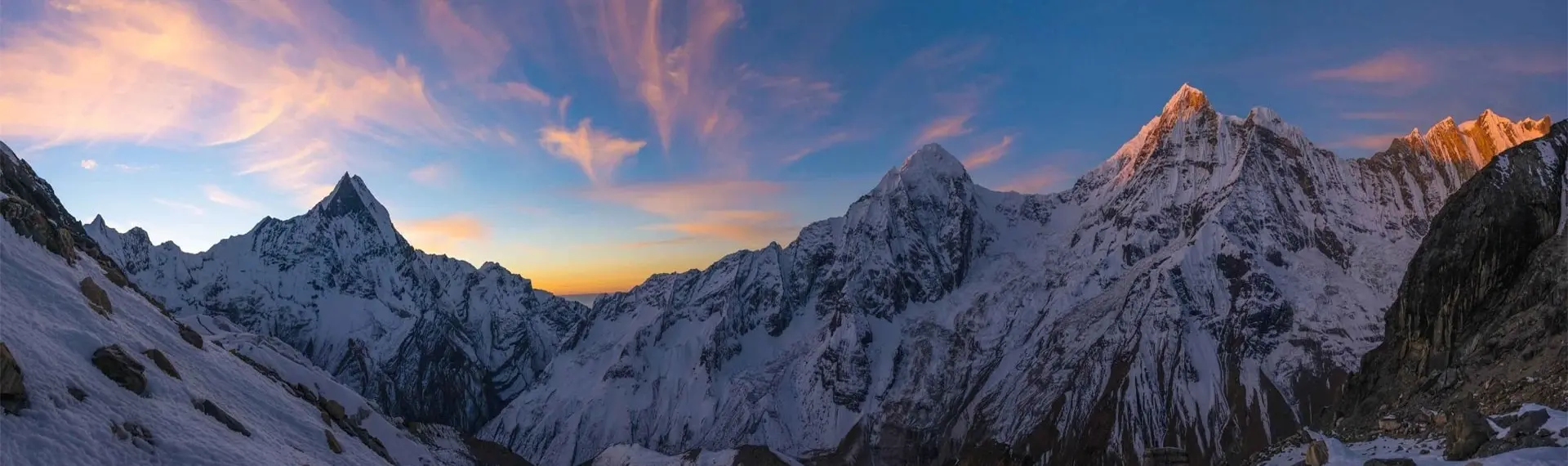
The stunning panoramas are undoubtedly one of the reasons why the Annapurna Base Camp Trek stands out. It is an opportunity to witness the spectacular Annapurna range. The range is named after the Hindu goddess of food and nourishment, Goddess Annapurna. The key peaks that you witness during the Annapurna Base Camp Trek are Annapurna I (8901 m), Annapurna South (7219 m), Annapurna II (7937 m), Annapurna III (7555 m), and Annapurna IV (7455 m). You can also witness Machhapuchre (6993 m), Hiunchuli (6441 m), Gangapurna (7455 m), Lamjung Himal (6983 m), Dhaulagiri (8167 m), Nilgiri (7061 m), and many more. The mountains look even more magical during sunrises and sunsets.
Himalayan Wildlife Sightings in the Annapurna Conservation Area
The trekking trails of Annapurna Base Camp and the entire Annapurna range lie within the Annapurna Conservation Area. It is the largest protected area of the country, covering 7629 sq km. It is inhabited by diverse species of flora and fauna, including rare and endangered species. Over 1,200 plant species are found here. Likewise, many mammals (red panda, Himalayan tahr, musk deer, etc.), reptiles, amphibians, and over 450 species of birds inhabit the conservation area. The conservation area has been playing a crucial role in preserving the biodiversity and ecosystems of the region. During the trek, you will get a chance to witness many of the diverse flora and fauna. If you are lucky, you may catch a glimpse of rare wildlife.
Rich Cultural Discovery on the Annapurna Trail
The Annapurna region is home to Gurung and Magar ethnic communities. They are indigenous groups who have unique cultures, traditions, and customs. While on the Annapurna Base Camp journey, you will cross several villages with traditional houses and terrace farms. You can see traditional stone houses, prayer flags, monasteries, and chortens. Similarly, you will stay in teahouses in popular settlements such as Ulleri, Ghorepani, Tadapani, Chhomrong, and more. You will get a glimpse of their culture and lifestyle. Many local teahouses host cultural programs to entertain their guests. This way, you can immerse yourself in their culture and gain insights into their rich history. It is also a chance to experience the warm hospitality of the Himalayas.
Accommodation, Food and Facilities in Annapurna Base Camp Trek
Along the trek to Annapurna Base Camp, trekkers get accommodation, food, and other facilities in locally run tea houses and small lodges. Even if you’re a first-time trekker, you can feel confident knowing that you’ll experience comfort and hospitality throughout the adventure. Likewise, no matter how high you move in the trek, you can expect warmth, hearty food, and a friendly atmosphere to make your trek to ABC worry-free.
What to Expect from Teahouses and Lodges
Regarding accommodation, teahouses and lodges on the Annapurna Base Camp trek are simple, cozy, and social places. Teahouses are family-run wooden or stone buildings with a central dining room, views of the surrounding hills and mountains, and guest rooms. At most teahouses, rooms are usually twin-share with wooden beds, mattresses, pillows, and blankets. Still, we suggest you bring a sleeping bag for extra warmth and comfort.
While the lower areas, like Ghandruk, Chhomrong, and Jhinu Danda, have rooms with attached bathrooms and hot showers, don’t expect such facilities at higher elevations. Room prices are budget-friendly, that cost about USD 5-10 per night at lower elevations and increasing slightly at higher elevations. Moreover, most teahouses are run by local families, including Gurungs and Magars; you can chat with them, learn about village life, and taste regional dishes.
Meal Options and Local Cuisine on the Trek
Along with accommodation, food availability on the ABC trek is excellent. Every teahouse along the trek offers a full menu for breakfast, lunch, and dinner. Foods are designed to keep trekkers energized, featuring a mix of local Nepali dishes and basic Western comfort food. Likewise, Portions are typically large by trekking standards.

Typical Nepali trekking staples like dal bhat (rice, lentils, vegetables), noodles, soups, momos (dumplings), and fried potatoes are common options for getting energy along the way. However, some lodges also serve simple Western and international dishes such as pasta, pancakes, toast, and omelets in larger villages like Chhomrong and around the base camp. In addition, meals are served in warm communal dining rooms where trekkers sit together at long tables with trekkers from all around the world. Thus, the dining time is also an opportunity to connect with different people and build friendships if you are interested.
Internet, Mobile, and Communication Facilities
Trekkers on the Annapurna Base Camp Journey can expect reasonably good mobile coverage with their SIMs for internet and communication. Likewise, they can get paid Wi‑Fi in most teahouses and access to enough electricity to keep essential devices charged. Nepal Telecom (NTC) and Ncell are the two main providers on the route to ABC, and both work well in lower areas like Pokhara, Nayapul, Ghandruk, and up towards Chhomrong. As the altitude increases, NTC generally maintains better reach than Ncell.
Permits, Documentation & Safety
For the Annapurna Base Camp Trek, trekkers need a specific permit in addition to basic travel documents. With the right paperwork, insurance, and awareness of altitude and trail conditions, the trek is safe and manageable even for beginners.
Annapurna Conservation Area Permit (ACAP)
The Annapurna Conservation Area Permit is required for the trek to Annapurna Base Camp. TIMS was also necessary, but under the new rules regarding permits, it is no longer required. The Annapurna Base Camp Trek takes place within the conservation area. Hence, you will need a permit to access the region. You have to pay a certain amount to obtain the permit. Moreover, the cost varies for SAARC nationals and non-SAARC nationals. The cost of ACAP is as follows:
|
Nationality |
Cost (per person) |
| SAARC National | NPR 1,000 |
| Other Foreigners | NPR 3,000 |
The Annapurna Conservation Area is home to thousands of species of flora and fauna and diverse ecosystems. Likewise, it is one of Nepal’s largest conservation areas. The conservation project aims to protect the biodiversity and cultural heritage of the Annapurna region. And the funds obtained by the permit also go for the area’s development.
Visa and Other Essentials
All foreign travelers, except Indian nationals, will need a Nepal entry visa to travel and trek in Nepal. You can get a visa on arrival at the Tribhuvan International Airport in Kathmandu. Similarly, you can also get a visa from land borders with India and China. Your passport must be valid for at least 6 months beyond your planned departure, and you must provide a passport-size photo for the visa.
The visa fees will vary depending on the duration of your stay in Nepal. You can get a single- or multiple-entry visa, depending on your requirements. The costs are as follows:
|
Days |
Cost |
| 15 | USD 30 |
| 30 | USD 50 |
| 90 | USD 125 |
If you want to extend your visa, you must do so before your current visa expires. You can extend your visa for 150 days from the Department of Immigration in Kathmandu or Pokhara. You can pay visa fees in USD, pounds, euros, or other major currencies.
Travel Insurance
The Annapurna Base Camp route is safe to travel on. It takes you to an elevation relatively lower than others, like the Everest Base Camp Trek or the Annapurna Circuit Trek. Nonetheless, there is some risk during the trek, and travel insurance provides a safety net.
You must get travel insurance for the ABC Trek. Since it is a high-altitude trek that takes you to at altitude of 4,130 m / 13549 ft, it must cover an elevation of up to 4,500 m / 14,763 ft. Similarly, travel insurance must also cover medical and emergency expenses, including helicopter rescue and evacuation.
In emergencies, such as severe injuries or symptoms of altitude sickness, guides will call for immediate helicopter rescue. No medical facilities are available at the trek’s rural routes. Therefore, travel insurance is crucial for trekking in Nepal.
Route, Distance & Elevation
You will begin your Annapurna Base Camp Trek from Pokhara (822 m / 2,696 ft). So, first, you must travel from Kathmandu to Pokhara, the gateway to the Annapurna region. You can either fly or take ground transportation to get to Pokhara from Kathmandu. From Pokhara, it is a one-and-a-half-hour drive to Nayapul (1,070 m / 3,511 ft). From Nayapul, the actual trek begins. You will slowly begin trekking past small villages and stunning hillside farms at the beginning. Then, it enters a forest trail alongside the Bhurungdi River. You will trek past villages like Birethanti, Sudame, and Hile before reaching Ulleri (2,020 m / 6,627 ft). Just before you reach Ulleri, you must climb steep stone staircases.
From Ulleri, the trail continues to ascend through dense subtropical forests of rhododendrons, oaks, and firs. The spectacular Mount Annapurna, Machhapuchre, and Hiunchuli are also visible. The mixed trail, featuring paved stone staircases and varied terrain, takes you to Ghorepani (2,860 m / 9,383 ft). From Ghorepani, it is an hour’s hike through the dense rhododendron forest to Poon Hill View Point (3,210 m / 10,531 ft). You will return to Ghorepani from Poon Hill before setting off for the village of Tadapani (2,630 m / 8,629 ft). The trail from Tadapani also takes you through dense, verdant forests. You will pass by famous settlements like Chuile and Ghandruk to reach Chhomrong (2,340 m / 7,677 ft). Then, you will ascend through Bamboo forests, trekking alongside the Modi River to reach the Himalayas (2,950 m / 9,678 ft).
The exciting part of the trek begins as you ascend to Annapurna Base Camp (4,310 m / 14,140 ft) via Machhapuchre Base Camp (3,700 m / 12,139 ft). The trail from the Himalayas goes alongside a narrow gorge and past the icy Hinku Cave. After passing Deurali, you will enter the Annapurna Sanctuary and then go to Annapurna Base Camp. After exploring ABC and appreciating your victory, the trek returns. Descending from the base camp is easier than climbing it. You will retrace your steps to Chhomrong and reach Bamboo Village (2,310 m / 7,578 ft). The trail drops alongside the exposed ridge to reach Jhinu Dada (1780 m / 5,839 ft). The final walk takes you down to Siwai before you take a jeep back to Pokhara.
Annapurna Base Camp Trek Distance from Pokhara
The distance of Annapurna Base Camp from Pokhara is approximately 81.1 km / 50.40 miles. However, it can vary slightly depending on the route trekkers take. The common starting point is Nayapul, but trekkers can also choose Ghandruk or Jhinu Danda. The distance from Ghandruk to Annapurna Base Camp is 70 km / 43.50 miles, which offers an alternative route for those starting in this beautiful village. Our 13-day Annapurna Base Camp Trek’s starting point is Nayapul.
Driving from Pokhara to Nayapul takes about 1.5 hours. The distance between Pokhara and Nayapul is 44 km / 27.34 miles. From Nayapul, you will begin your trek. The distance from Nayapul to Annapurna Base Camp is 37.1 km / 23.05. It usually takes 7 to 11 days to cover the distance. Trekkers can plan their itinerary based on their time availability and fitness level.
Transportation Options For Annapurna Base Camp Trek
Getting to Pokhara marks the initial phase of the journey to Annapurna Base Camp. Transportation facilities are readily available from Kathmandu to Pokhara, with various options. Air and road are two common options for getting to Pokhara from Kathmandu. Likewise, you can choose a different mode of ground transportation to get to Nayapul from Pokhara to start your trek. Here is a brief on transportation options during Annapurna Base Camp:
Flights from Pokhara to the Trailhead

The fastest and most convenient mode of transportation is air. It takes 30 minutes to fly from Kathmandu to Pokhara. Several airlines offer regular flights between cities. In addition to its convenience, traveling by air allows you to witness beautiful landscapes and mountain vistas from an aerial view. A one-way flight from Kathmandu to Pokhara costs around USD 105 to 125 per person, which can be higher during the peak trek season.
Note: You can also take a helicopter tour of the Annapurna Base Camp. The heli ride is a one-day Annapurna Base Camp trip that takes you right up to the base camp. It allows you to skip the physically demanding trek and is ideal for travelers with limited time. Compared to a standard flight, the Annapurna Base Camp Helicopter Tour is expensive. It costs anywhere from USD 650 to 1,000 and above, depending on the included facilities and whether the ride is private or shared.
Road Journey from Kathmandu to Pokhara to the Trek Start
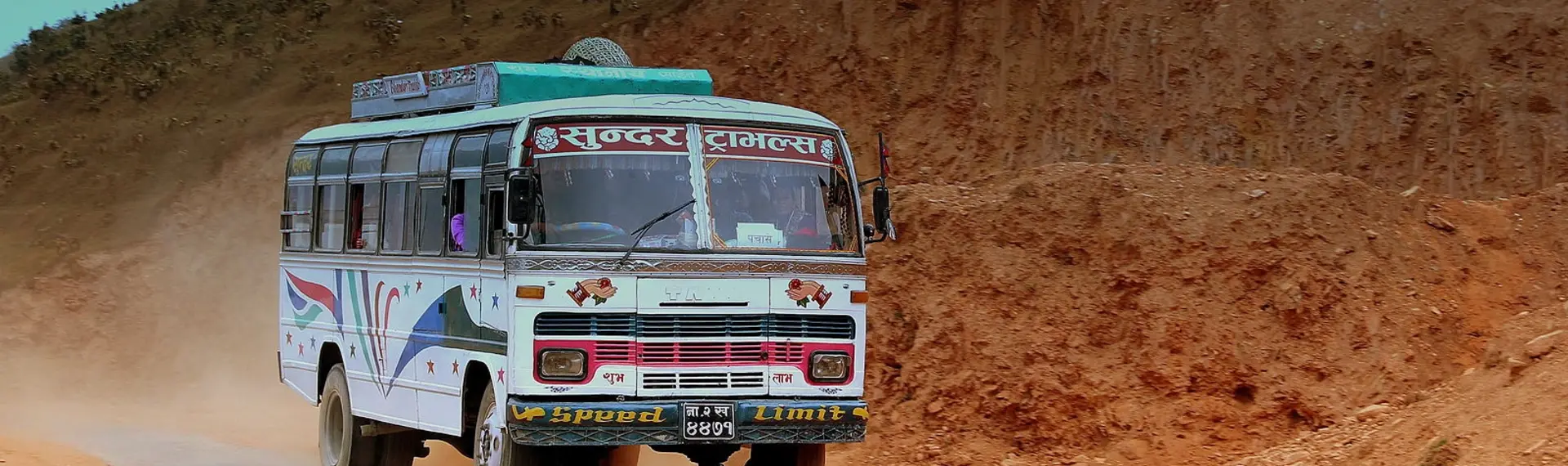
The most common and budget-friendly way to travel from Kathmandu to Pokhara is by road. It takes 6 to 8 hours via the Prithvi Highway to get there. There are various transportation modes available for road travel. You can take a local bus, a tourist bus, or a private vehicle. We recommend a tourist bus or private vehicle. The local buses are cheaper, but they are slow and uncomfortable.
The cost of various transportation modes from Kathmandu to Pokhara is as follows:
|
Type of Vehicle |
Cost Per Person |
| Tourist Bus | USD 15 |
| Local Bus | USD 10 |
| Jeep/ Private vehicle | USD 150 to 200 |
In addition, you can take a local bus, a shared jeep, or a private car/taxi to Nayapul from Pokhara. Local buses leave from Pokhara’s Baglung bus park every day and are budget-friendly but less comfortable. Shared jeeps are faster and a bit more comfortable than local buses, but departure times can be less predictable. Moreover, a private taxi or jeep is more convenient and flexible but costs more.
The cost of various transportation modes from Pokhara to Nayapul is as follows:
|
Type of Vehicle |
Cost Per Person |
| Local Bus | NPR 200 |
| Shared Jeep | NPR 800 to 1,000 |
| Private Taxi / Jeep | NPR 3,500 to 5,000 |
Challenges and Tips for Annapurna Base Camp Trek
Annapurna Base Camp is a moderately difficult trek suitable for trekkers of all levels. However, it presents its own set of challenges that make it quite difficult. They are as follows:
Altitude and Weather
The Annapurna Base Camp sits at an altitude of 4,130 m / 13,549 ft. It is also the highest point of the trek. During the 13-day trek, you will go from the low altitude of Pokhara at 822 m/ 2,696 ft to 4,130 m / 13,549 ft. Due to the high altitude, there is a risk for trekkers experiencing symptoms of altitude sickness. The oxygen level in the atmosphere begins to get thinner above 2,500 m / 8,202 ft. There is also a decrease in air pressure.
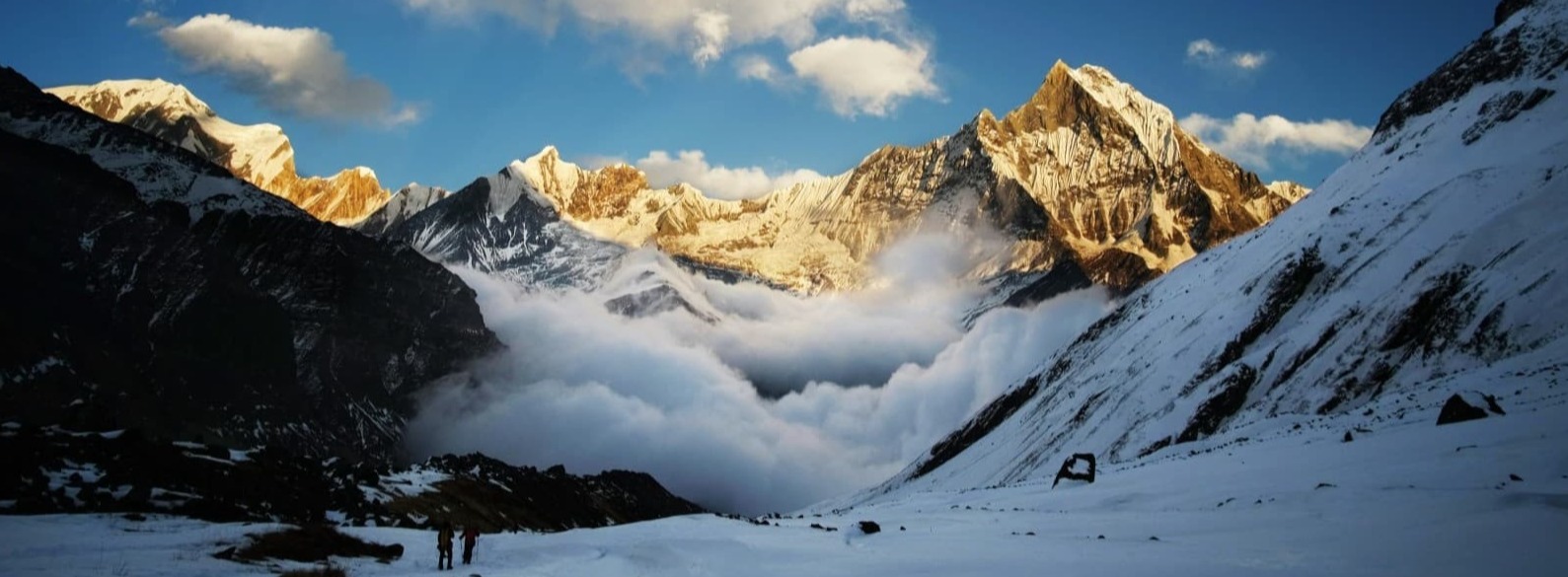
As a result, trekkers may experience various altitude-related symptoms, such as nausea, headaches, extreme fatigue, and shortness of breath. The best way to minimize the risk is to take acclimatization days and gradually ascend to a high altitude. As you ascend, the climb becomes more strenuous. Due to the lack of oxygen, trekkers can quickly lose their breath. Hence, trekkers must be aware of the high altitude during the ABC Trek.
The unpredictable weather conditions are another challenge that makes the Annapurna Base Camp Trek difficult. Despite the season, the weather in higher-altitude regions can change at any time. The higher you go, the more unpredictable the weather becomes. As a result, trekkers may come across unforeseen challenges, such as sudden rain showers, high winds, a drop in temperature, etc. Trekkers must prepare adequate clothing and gear to handle sudden weather changes during the Annapurna Base Camp Trek.
Trail Terrain and Conditions
During the 13-day Annapurna Base Camp Trek, you will have to trek through varied landscapes. The trek begins with a gentle ascent through lush subtropical forests of rhododendrons, oaks, firs, and breech. Similarly, you will have to ascend and descend on stone staircases. While on trek, you will climb more than 3000 stone staircases.
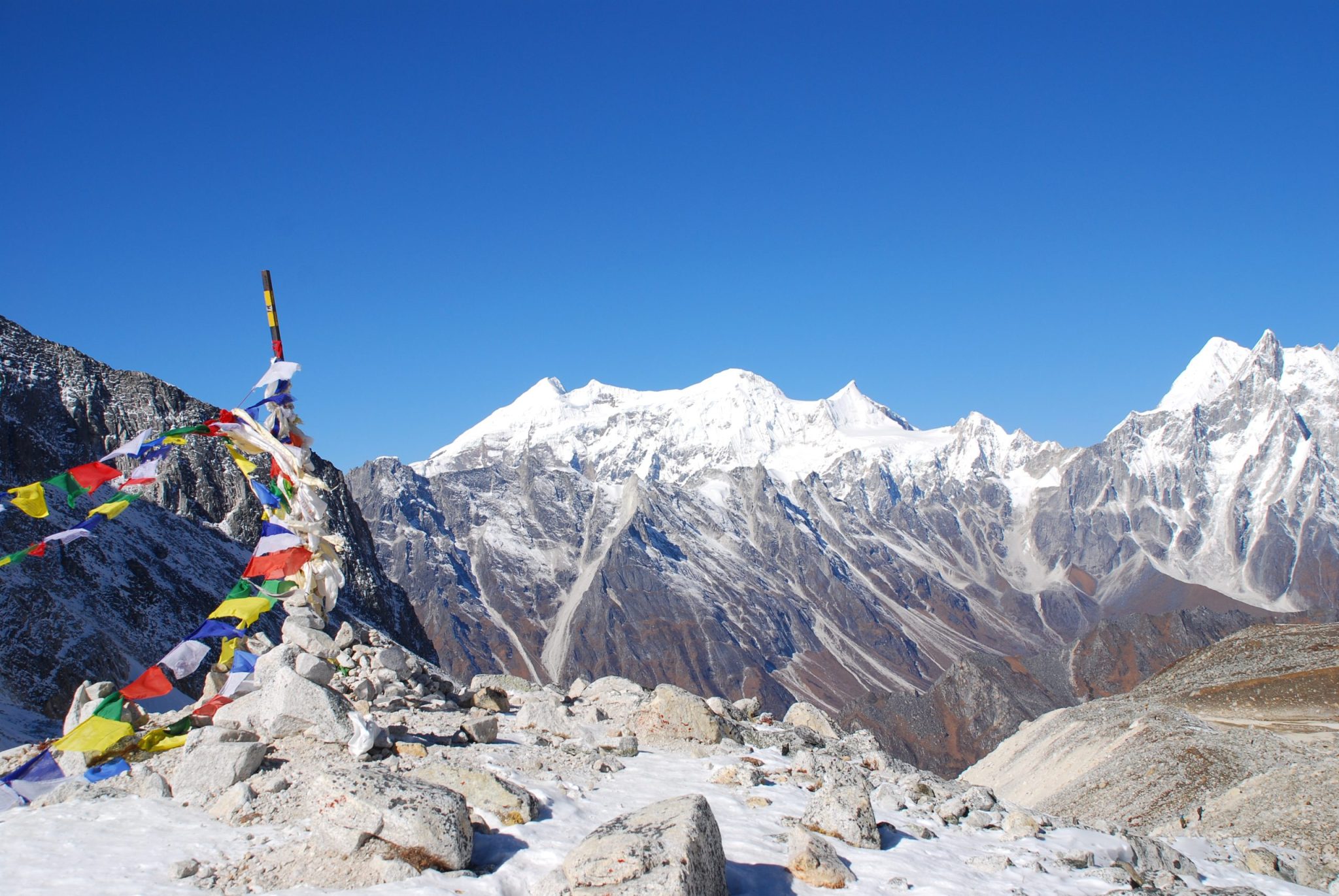
The trek gradually becomes more challenging as you must climb steeply along rough, narrow, rocky pathways. As you move to higher altitudes, the dense forest changes into alpine meadows and highland pastures. The landscape starts to become barren as you get closer to Annapurna Sanctuary. Moreover, you must trek past rocky fields and some icy trails to get to the Annapurna Base Camp.
Health Safety and Emergency Tips
If you are going to trek Annapurna Base Camp, it is necessary to get a health check before starting the journey, especially if you have heart, breathing, or joint problems. Your doctor can consult you whether the trek suit your body and assess fitness for altitude, adjust medications, and advise on altitude sickness prevention and treatment. Besides, we suggest you to carry a small first-aid kit, with your regular medicines, altitude sickness tablets recommended by a doctor, and basic hygiene items.
In an emergency, ask your guide for help as they can provide basic care, call rescue services, and direct you to evacuation points if symptoms become serious. Likewise, maintain communication through charged phones, local SIM cards where coverage exists, or trekking guides who carry radios or satellite communication. For personal safety, we suggest you not to walk alone and inform your guide immediately about any health change such as chest tightness, headache, or breathlessness. Also, respect local rules, stay on designated paths, manage waste properly, and follow environmental guidelines.
How to Prepare Physically Mentally and with Gear
By training your body, preparing your mind, and choosing the right gear is how you can have a good preparation for Annapurna Base Camp Trek. Physically, you can prepare yourself by focusing on cardio exercises like brisk walking, jogging, cycling, or stair climbing 3–5 times a week. It also involves strength training for your legs and core with squats, lunges, and planks so you can walk on different route 5-7 hours a day.
Mentally, you can prepare yourself by learning about the route and expecting realistic vision of the trek like; simple tea house facilities, changing weather, and some tough days. Also, stay positive, and remind yourself why you wanted to reach base camp to stay motivated.
Moreover, for good preparation carry such clothes that makes you warm and comfortable. Consider packing layered clothing (base layer, warm mid layer, and waterproof outer layer) for changing temperatures. Likewise, invest in good trekking boots with ankle support, moisture wicking socks, and a suitable backpack with rain cover. In addition, with a good training and smart packing, even beginners can successfully reach Annapurna Base Camp and enjoy the views rather than just suffering through the effort.
Best Seasons to Trek Annapurna Base Camp
Annapurna’s Spring Magic
Spring is one of the best times for the Annapurna Base Camp Trek. The days are bright, warm, and sunny. Likewise, trekkers can enjoy longer daylight. In early spring, the temperature is slightly cooler, and there can be light snow at higher passes. However, the temperature gradually rises as the season progresses. The sky is clear, and it is one of the best times to enjoy gorgeous views of the mountain ranges.
Another great thing about trekking to Annapurna Base Camp in spring is enjoying the blooming rhododendron forests and vibrant landscapes. The Annapurna Conservation Area has one of Nepal’s dense rhododendron forests. They bloom in different colors: red, pink, and white. Other Himalayan floral species are also in full bloom. Spring is an active time for wildlife. So, there is a chance that you might spot rare wildlife during the trek.
| Months | Average max. temperature | Average min. temperature |
| March | 4°C to 8°C ( 39.2°F to 46.4°F) | -8°C to -5°C (17.6°F to 23°F) |
| April | 8°C to 12°C (46.4°F to 53.6°F) | -4°C to -2°C (24.8°F to 28.4°F) |
| May | 12°C to 14°C (53.6°F to 57.2°F) | -1°C to 2°C (30.2°F to 35.6°F) |
Lush Green Valleys and Misty Monsoon of Summer
The clear spring weather gradually gives way to summer in Nepal. It brings monsoons and heavy rainfall in Nepal’s lower and hilly regions. Therefore, the trekking trails get wet and slippery. There is also the risk of landslides and mudslides due to heavy rain. Additionally, visibility is poor, and flights are frequently canceled or delayed.
Overall, summer is not the best time for the Annapurna Base Camp Trek. But if you want to take up the challenge at this time of year, you will need proper rain gear, such as waterproof shoes, a raincoat, and a rain cover. It is also crucial to monitor the weather forecast and trail conditions consistently.
| Months | Average max. temperature | Average min. temperature |
| June | 16°C to 18°C (60.8°F to 64.4°F) | 3°C to 6°C (37.4°F to 42.8°F) |
| July | 17°C to 19°C (62.6°F to 66.2°F) | 6°C to 8°C (42.8°F to 46.4°F) |
| August | 17°C to 19°C (62.6°F to 66.2°F) | 6°C to 8°C (42.8°F to 46.4°F) |
Golden Autumn Forests and Unmatched Mountain Views
With the best weather and climatic conditions, autumn is the peak trekking season. It has the most favorable and stable weather for the Annapurna Base Camp Trek. The days are warm with moderate temperatures. However, it can get chilly at night. The monsoon season also ends by early autumn, so the trails are dry and in perfect condition for trekking. It makes journey a little more comfortable.
Moreover, the visibility is excellent during autumn. It offers the best and most stunning views of the Annapurna and Dhaulagiri ranges. Autumn foliage also adds to the beauty of the landscape. Hence, it is the best time for photographers as they can capture magical photographs. During this time, Nepal’s biggest festivals, Dashain and Tihar, also fall. You get to enjoy the festive atmosphere while trekking. The great weather and incredible scenery make autumn an ideal time for the ABC Trek.
| Months | Average max. temperature | Average min. temperature |
| September | 10°C to 14°C (50°F to 57.2°F) | 0°C to 5°C (32°F to 41°F) |
| October | 8°C to 12°C (46.4°F to 53.6°F) | -6°C to 0°C (21.2°F to 32°F) |
| November | 4°C to 10°C (39.2 to 50°F) | -10°C to -6°C (14°F to 21.2°F) |
Snowy Peaks and Crisp Mountain Air in Winter
As autumn transitions into winter, the weather becomes colder. The temperature gradually decreases, especially at higher altitude regions. The daylight is shorter, and mornings are usually foggy. However, the days are sunny and warm. It begins to snow in higher areas, and as the snow gradually piles up, it can block high mountain passes. Similarly, the higher region trails are icy and slippery. You also have to carry proper winter gear.
Despite the challenges, many seasoned trekkers prefer winter treks. Winter offers a grand view of the snowy landscapes, as the entire higher-altitude region is covered with snow. Likewise, it is the best time to witness the glistening snow-covered peaks. As it is off-season, there are few trekkers on the trails, which allows you to enjoy the serene atmosphere. Many accommodations at higher altitudes may close for winter, so make sure you book them before your trek.
| Months | Average max. temperature | Average min. temperature |
| December | 0°C to 6°C (32°F to 42.8°F) | -10°C to -12°C (14°F to 10.4°F) |
| January | -2°C to 5°C (28.4°F to 41°F) | -12°C to -15°C (10.4°F to 5°F) |
| February | 2°C to 7°C (35.6°F to 44.6°F) | -12°C to -10°C (10.4°F to 14°F) |
Cost Factors and Budgeting for Annapurna Base Camp Trek
The Annapurna Base Camp Trek costs USD 850 per person in general. However, the cost depends on factors such as the trekking season, accommodation style, and the services you choose. Likewise, most of your budget goes to permits, transport, plus optional expenses such as guides, porters, and small daily extras.
Many facilities, such as hot showers, device charging, and Wi-Fi, come with small additional costs. Also, choosing higher-end rooms with attached bathrooms will raise your overall budget. If you are a budget traveler looking to save money, choose basic teahouse rooms and order mostly local dishes. Likewise, carry a power bank and a local SIM/data plan (where coverage is available) to reduce paid charging and Wi‑Fi usage. Moreover, carry a refillable water bottle with a water purification tablet, and bring some snacks from Pokhara or Kathmandu rather than buying on the trail.
Below is the approximate budget table for the Annapurna Base Camp trek per person in USD:
| Expense Category | Details | Approx. Cost (USD) | Notes / Tips |
| Permit (ACAP) | Mandatory for all foreign trekkers in the Annapurna region. | 23 to 30 for foreigners and 7.5 for SAARC nationals | Buy in Kathmandu/Pokhara or via agency; carry printed copies for checkpoints. |
| Transportation | Kathmandu-Pokhara bus/flight + Pokhara -trailhead jeeps/buses. | 60-150 | Buses are cheaper; flights and private jeeps save time but cost more. |
| Accommodation | Teahouses along the route, mostly basic twin rooms. | 5-10 per night | Prices rise with altitude; attached bath or nicer lodges cost more. |
| Meals | Breakfast, lunch, dinner, tea/coffee on trek. | 15-25per day | Local dishes are a better value than Western meals. |
| Guide | Licensed trekking guide per day. | 25-35 per day | Cost split among the group. |
| Porter (optional) | Porter to carry 15–20 kg of gear. | 15-25 per day | Great for comfort; confirm weight limits. |
| Gear Rental | Sleeping bag, down jacket, poles, etc. | 40-80 per trek | Renting in Pokhara/Kathmandu saves luggage and purchase costs. |
| Hot Showers | Gas/solar showers in teahouses. | 2-4 per use | Limit frequency to save money and stay warm at high altitude. |
| Wi‑Fi | Teahouse Wi‑Fi or paid internet cards. | 2-3 per day, | consider mobile data lower on the trail. |
| Charging Devices | Charging phones, cameras, and power banks in lodges. | 2-4 per charge | Bring a large power bank and a multi-plug to reduce paid charging. |
| Travel Insurance | Trekking insurance with rescue coverage. | 50-150 per trip | Essential for emergency evacuation; buy before arriving in Nepal. |
A Typical Day on the Annapurna Base Camp Trek
Each day of our Annapurna Base Camp Trek is full of exciting events. You will get to witness stunning scenery, pass by traditional settlements, eat local meals, and explore new places. There will also be plenty of opportunities to take spectacular photographs. So, be ready for an adventurous every day.
Each day starts early in a simple teahouse, where you wake to cool mountain air. After you freshen up, you’ll pack your gear and have a basic breakfast such as eggs, porridge, bread, or pancakes with tea or coffee. After breakfast, you set off for 5-7 hours of trekking through stone steps, forests, rivers and ridges while enjoying changing landscape ABC stunning views of Himalayan peak.
Along the way, you’ll pass through numerous Gurung and Magar settlements. After a while of trekking, you’ll pause at teahouses for tea, lunch, and snacks such as dal bhat, noodles, or momos, while watching clouds move across the high walls of the Modi Khola valley. After lunch, the trek continues. You’ll pass through rhododendron, oak, and bamboo forests in the lower sections, then more open alpine terrain higher up. Before reaching the day’s destination, you have chances to see birds and occasional Himalayan wildlife. Evening is generally spent watching glowing sunsets on the Annapurna range, along with a starry Himalayan sky.
The dinner is usually served at 7:00 PM. After dinner, your guide will provide a brief for the following day’s journey. Then, you are free to enjoy your time. You can play games, read books, watch documentaries, or have a friendly chat with your friends or locals. Similarly, you can learn a few Nepalese greetings with your guide.
Is Annapurna Base Camp Trek Suitable for Beginners
Yes, the Annapurna Base Camp Trek is suitable for beginners with reasonable fitness who have prepared in advance. The trail follows well‑marked paths with stone steps, gradual ascents, and frequent teahouses to rest and relax along the way. Likewise, the trek doesn’t take you directly from lower to higher; instead, it lets you gain altitude steadily while allowing your body to adjust to changing surroundings.
One of the best aspects of the ABC trek for beginners is that they get to enjoy varied scenery from terraced fields, rhododendron and bamboo forests, river valleys, and the amphitheater of the Annapurna Sanctuary. Similarly, the trek lets you experience Gurung village culture, local teahouses, and Nepali food.
To make the trek less demanding, first‑timers are advised to build fitness with regular walks or short hikes, use trekking poles on steep stairs, and stay well hydrated. Likewise, it is necessary to take rest days or shorter altitude gain for acclimatization, and bring suitable gear.
The safe, non‑technical walking, teahouse facilities, and the chance to experience unforgettable memories make the Annapurna Base Camp trek suitable for beginners. In addition, booking or planning early helps to secure a suitable itinerary, guide, or porter for a safe adventure among first-time trekkers.
Alternative Treks and Variations in Annapurna Region
The Annapurna region is one of Nepal’s most iconic and premier trekking hotspots. The destination is known for its varied landscape, mountain views, and cultural diversity. The region offers every kind of Himalayan landscape, from subtropical valleys and rhododendron forests to high alpine ridges.
Indeed, the journey to Annapurna Base Camp is the most popular route in the region; some travelers seek alternative routes that better match their time, fitness, and crowd preferences. ABC trek may not fit everyone’s choice. For example, for those looking for a shorter trip, Ghorepani Poon Hill and Mardi Himal can be better options. As a result, comparisons like Mardi Himal vs Annapurna Base Camp are common among trekkers deciding between a compact scenic hike and a classic high-altitude journey. Likewise, if someone chooses a more adventurous route, the Annapurna Circuit, Nar Phu, or Upper Mustang can better suit them. So, whatever one prefers, the Annapurna region offers each trek’s variation.
Even with this wide variety of choices, the Annapurna Base Camp Trek remains the region’s most iconic route. The combination of changing landscapes, welcoming teahouse culture, and close‑up high‑altitude scenery makes ABC the best option even when trekkers explore other trails. Still, here are two major alternatives to the Annapurna Base Camp trek:
Mardi Himal Trek

Mardi Himal Trek is a moderately difficult adventure in the Annapurna region of Nepal. The trek follows forested ridges to high viewpoints thet offer mesmerizing sights of Mount Machhapuchhre (Fishtail), Annapurna South, and the surrounding Annapurna range. It is a short journey that takes about 11 days and start with a drive with a drive from Pokhara to Kande, followed by a trek to Pitam Deurali. Then the trek takes you through rhododendron and oak forests up to Forest Camp, Low Camp, High Camp, and recahes to Mardi Himal Viewpoint. Compared with the Annapurna Base Camp Trek, Mardi Himal is shorter, quieter, and more “off‑the‑beaten‑path.”
Ghorepani Poon Hill Trek
The Ghorepani Poon Hill Trek is a shorter, easier trek in the Annapurna region. The journey takes only 6 days and reaches a maximum altitude of 3,210 m / 10,499 ft at the Poon Hill viewpoint. Poon Hill is a famous location for its sunrise panorama over the Annapurna and Dhaulagiri ranges, where golden light scatter over the tip of Mount Dhaulagiri, Annapurna South, and Machhapuchhre. Along the way, the route passes through dense rhododendron and oak forests, stone staircases, and traditional Gurung and Magar villages. Thus, the trek combines mountain scenery and local culture even in short duration.
Compared with the Annapurna Base Camp Trek, Ghorepani Poon Hill is less time‑consuming, involves lower elevations and fewer altitude‑related challenges. Many trekkers choose Poon Hill as a first Himalayan trek to get used to multi‑day hiking before going for a longer and higher ABC trail. Moreover, for those seeking the full adventure, the Annapurna Base Camp Trek offers unparalleled mountain panoramas and cultural immersion.
Annapurna Base Camp Compared to Other Popular Treks
Annapurna Base Camp Trek vs Annapurna Circuit Trek

Annapurna Base Camp and Annapurna Circuit Trek are both classic treks in the same region. However, they offer quite different experiences. The ABC Trek’s core focus is to take you to the Annapurna Sanctuary, surrounded by peaks like Annapurna I, Annapurna South, Hiunchuli, and Machhapuchhre. On the other hand, the Annapurna Circuit is a longer journey, circling much of the Annapurna range, passing through multiple climate zones and cultures, and reaching a high point at Thorong La Pass at 5,416 m / 17,769 ft.
The table below is a concise comparison of the Annapurna Base Camp Trek vs the Annapurna Circuit Trek:
| Aspects | Annapurna Base Camp Trek | Annapurna Circuit Trek |
| Distance & Duration | Roughly 70-100 km / 43.50-62.13 miles over about 7-12 days, depending on start point and side trips. | Roughly 160-230 km / 99.42-143 miles over about 14-21 days, depending on route variations and transport shortcuts. |
| Altitude & Difficulty | Max altitude around 4,130 m / 13,549 ft at Annapurna Base Camp; generally rated moderate with steady but manageable ascents on a single valley trail. | Max altitude 5,416 m / 17,769 ft at Thorong La Pass; rated moderate to challenging due to longer distance, high pass, and more demanding acclimatization. |
| Scenery & Landscapes | Terraced fields, rhododendron forests, river valleys, then a dramatic 360° panorama of Annapurna I, Annapurna South, Hiunchuli, and Machhapuchhre at the Sanctuary. | Subtropical valleys, waterfalls, deep gorges, pine forests, alpine zones, glaciers, and the dry, Tibetan‑style landscapes of Manang and Mustang as you circle the range. |
| Accessibility | Easier access from Pokhara, and can be completed in a short duration. | Requires more time and planning; more days at altitude, better suited to trekkers with a flexible schedule. |
| Accommodation & Facilities | Frequent villages, consistent food menus, and good availability of basic comforts like hot meals, simple rooms, and communal dining areas. | Teahouses throughout, but some stages are more remote and basic, especially near Thorong La |
| Who It’s Best For | Trekkers wanting a memorable but manageable Himalayan trek | Those seeking a longer, more varied adventure with a higher challenge level, a more remote feel in places, and the satisfaction of completing one of the world’s classic high‑pass circuits. |
Annapurna Base Camp vs Everest Base Camp Trek

Everest Base Camp and Annapurna Base Camp are among the most popular trekking destinations in Nepal. Both are moderate-grade treks suitable for trekkers of any fitness level. So, which one is better? Both treks offer rich adventure and cultural experiences. Everest Base Camp Trek is comparatively more challenging than the Annapurna Base Camp Trek. It has more challenging terrain and a higher altitude. ABC takes a shorter time and is more easily accessible. Its relatively easier trail makes it ideal for beginners. So, based on your requirements and fitness, you can make your choice.
Here is the clear comparison table between the two destinations:
| Aspects | Annapurna Base Camp Trek | Everest Base Camp Trek |
| Distance & Duration | Roughly 70-110 km / 43.50-62.13 miles over about 7-12 days, depending on start point and side trips. | Roughly 110-130 km / 68.35-80.77 miles over about 12-16 days, including acclimatization days. |
| Altitude & Difficulty | Max altitude about 4,130 m / 13,549 ft at Annapurna Base Camp; generally moderate, with lower overall altitude and slightly lower risk of altitude sickness. | Max altitude about 5,364 m / 17,598 ft at Everest Base Camp and around 5,545 m / 18,192 ft at Kala Patthar; more demanding, with higher altitude and a greater need for careful acclimatization. |
| Scenery & Landscapes | Lush terraced fields, rhododendron and bamboo forests, river gorges, and stunning peaks including Annapurna I, Annapurna South, Hiunchuli, and Machhapuchhre. | High‑alpine and glacial landscapes of the Khumbu: deep valleys, moraine, icefalls, and iconic views of Everest, Lhotse, Nuptse, and Ama Dablam from EBC and Kala Patthar. |
| Variety & Overall Feel | More greenery and varied vegetation; it combines close‑up high peaks with rich mid‑hill scenery, giving a mix of nature and culture in a route. | Less vegetation at higher levels, but very stunning high‑mountain atmosphere; focuses strongly on big, iconic Himalayan summits and glaciers. |
| Accessibility & Logistics | Starts near Pokhara with road access; no domestic flight required on standard itineraries, usually lower total cost and simpler logistics. | Starts with a flight to Lukla; higher transport costs and a greater chance of weather delays make it more complex and expensive overall. |
| Accommodation & Facilities | A good number of teahouses with basic but comfortable rooms and meals; prices and facilities are generally a bit more budget‑friendly and varied. | Similar teahouse system but generally higher prices at altitude; some places offer slightly more upmarket lodges, yet high‑level villages are more limited and basic |
| Cultural Experience | Strong immersion in Gurung and Magar communities. | Focus on Sherpa culture, monasteries, and famous villages like Namche and Tengboche. |
| Best For | Trekkers wanting a memorable but manageable trek | Trekkers dreaming of Everest and ready for more altitude, cost, and commitment, seeking a tougher high‑mountain challenge and iconic experience. |
Solo vs Group Trek
Solo Trekking on the Annapurna Base Camp Trek is like a journey of freedom. While trekking completely alone with no one on your side is not possible due to a new rule implemented in April 2023, which requires hiring a licensed guide for trekking in Nepal. Because of this, what used to be “solo trekking” has effectively become “private guided trekking.”
Solo trek means you’ll choose your own pace, when to stop for photos, tea, or rest, and you can change your daily plan by consulting with your guide. Solo trekking also feels more personal and quiet, which is great for thinking, enjoying nature, and focusing on photography or writing.
On the other hand, the Annapurna Base Camp group trek is more social and supported. In a group trek, the journey will be affordable as you’ll share the cost of the guide, porter, and other expenses. In a group, the pace is set together, decisions are made as a team, and you always have people to talk to, share views with, and celebrate the journey, which will be motivating and fun. In addition, the group trek helps avoid feelings of isolation during the trek.
FAQs For Annapurna Base Camp Trek
Frequently Asked Questions (FAQ)
Is Annapurna Base Camp Trek safe?
Are there age restrictions for Annapurna Base Camp Trek?
Can I trek without a trekking guide?
How difficult is the Annapurna Base Camp Trek?
What accommodations can I expect during the ABC Trek?
Do I need permits for the Annapurna Base Camp Trek?
How crowded is the ABC route?
When is the best time for Annapurna Base Camp Trek?
What is altitude sickness? Is there a risk of altitude sickness during ABC Trek?
Is safe drinking water available during the trek?
Annapurna Base Camp Trek Additional Information
Gear and Packing List for the Trek
Take a look at the list of things you must pack for the Annapurna Base Camp Trek:
Clothing items:
- Trekking t-shirts/ long-sleeved t-shirts
- Lightweight trekking pants
- Waterproof/ windproof jacket, down jacket
- Insulating layers
- Moisture-wicking socks and innerwear
- Warm hats, gloves, socks
- Comfortable and sturdy hiking boots
Equipment and gear:
- Backpack (40 to 50 liters)
- Adjustable trekking pole
- Headlamp/ flashlight with extra batteries
- Water Bottle
- Sleeping Bag
- Rain cover/raincoat
Personal items:
- Toiletries
- Personal hygiene products
- Power bank
- Electronic devices
- Diary/ book/ Annapurna Base Camp Trek map
- Snacks or energy bars
Why Choose CoreTreks for Annapurna Base Camp Trek
There are many trekking agencies in Nepal, but why should you choose CoreTreks? Well, here are the top reasons:
- Airport Pickup and Drop: We offer private-vehicle pickup and drop-off services. Our representative will be at the airport to pick you up upon arrival and assist with your hotel transfer. Similarly, they will drop you off at the airport two hours before departure.
- Priority on Safety: Our clients’ safety is our number one priority. We believe in making the trek experience enjoyable, memorable, and safe. Our guides and porters will take personal care of you. And in an emergency, the guide will take the best action to ensure your safety first.
- Last-Minute Booking: CoreTreks is here to help you make a last-minute booking. Contact us 3 days before your departure, and we will make the arrangements. The quality will not be compromised, and you won’t have to worry about hidden charges.
- Customizable Itineraries: If our package does not meet your requirements, do not worry. You can 100% customize any trek package itinerary to suit you better. Our expert will help you tailor any trek to your liking according to your plan and budget.
- Sustainable Practice: We follow a sustainable development policy and do our part in preserving the environment. Our trek group is limited to 15 or fewer people. It is our small step towards minimizing the impact of trekking in the protected area.
- Experienced Staff: At CoreTreks, all our staff are professionals with years of experience in trekking and touring. All our guides are registered with the Nepal government and have extensive first-aid training. Likewise, our porters are professionals with adequate knowledge in the field. So rest assured, you are in safe hands!
Step by Step Booking Procedure for Annapurna Base Camp Trek
Thinking of joining the Annapurna Base Camp Trip with us, take a look at our booking procedure:
Step 1: Click the booking option and complete the online form.
Step 2: If you want to customize the itinerary, specify it to the tour operator.
Step 3: Our tour operator will mail you the itinerary and the trip cost.
Step 4: Check the itinerary thoroughly before confirming. If there are any mistakes, make adjustments.
Step 5: To secure a booking, you must provide a copy of your passport and deposit 25% of the total trip cost. The deposit is nonrefundable but will be applied as a lifetime deposit in the event of trip cancellation.
Step 6: After the payment, you will receive a booking confirmation.
Step 7: You must make a full payment before the trek and provide us with travel insurance.
Step 8: Finally, prepare for your adventure to the Annapurna Base Camp.
Useful Information for Annapurna Trekkers
Money Exchange and Banking Options
Before starting the trek to Annapurna Base Camp, you must exchange money, as there is no money exchange center after Pokhara. Thus, you should already have enough Nepali Rupees in cash for your whole trek. You find banks and official money exchange counters at Kathmandu and Pokhara, where you usually get the best rates and are safe to use.
If you are trevelling through a trekking agency, you don’t need to worry about trek’s expenses. You just need to carry cash to buy souvenir and for personal expenses. However, if you are planning to travel by yourself, you should carry more cash to pay for whole trek, including rooms, food, hot showers, charging, Wi‑Fi, snacks, and tips.
Local Languages, Culture, and Trekking Etiquette
Local people are what makes the Himalyan adventure including of Annapurna region makes the adventure special. The trek to Annapurna Base Camp is a journey through the Gurung, Magar, and some Thakali communities. People there usually speak Nepali plus their own local languages (such as Gurung and Magar). But, many lodge owners and guides speak basic English with trekkers.
A friendly “Namaste” with a smile is the normal greeting like we say “hi” in foreign country. So, remeber the word to connect with locals along the trek. Remember to ask before taking someone’s photo, walk clockwise around mani walls and stupas, and remove shoes and hats when entering monasteries or temples. Likewise, we suggest you to buy small items from village shops, and chat respectfully with them to learn about festivals, farming life, and traditions.
Plan Your Annapurna Adventure Today and Make It Unforgettable
The 13 Days Annapurna Base Camp Trek is one of Nepal’s classic trek routes. It wonderfully blends adventure, nature, and culture. The beautiful trails offer incredible sights and fulfilling experiences. Likewise, the trek brings everything that makes the Himalayas special, from mountain views to rhododendron and bamboo forests, sparkling rivers and waterfalls, and a route that winds through warm and hospitable villages.
Reaching Annapurna Base Camp itself, standing in a 360‑degree view of snow peaks at over 4,000 meters, gives a feeling of pride and amazement that many trekkers describe as a once‑in‑a‑lifetime moment. So, what are you waiting for? Don’t you want to feel that experience? If yes, don’t be late, plan it today with us (CoreTreks). Booking through CoreTreks means professionals handle every aspect of logistics, so you can focus fully on walking with peace of mind. Start planning your Annapurna Base Camp Trek now, to make your journey into a truly remarkable adventure to talk about for the rest of your life.
Travellers Reviews
66 Reviews in TripAdvisor
Advisor link
Short But Great Trek
I’m really thankful I got the chance to trek through Nepal it had been a dream of mine for a long time. Thanks to CoreTreks for making it come true.
Our guides and porters were amazing and helped us so much along the way. I’m really impressed by how hardworking they are. I’m already looking forward to coming back to Nepal.
Hyunyoung
Korea, Democratic People
Pokhara Was Amazing
I loved this trip. Trekking has always been something I enjoy, especially when it lets me explore new places. Nepal had been on my wish list for a long time, and I’m so happy I finally got to trek the Annapurna Circuit.
CoreTreks gave us amazing service. They even arranged a short tour of Pokhara, which I really enjoyed. Thanks again and keep up the great work!
Catherine
Canada
Helpful Guides Made It Worth It
I don’t usually complain, but the bus ride from Kathmandu to Pokhara wasn’t very comfortable. If I could do it again, I’d take the flight instead.
But the trek to Annapurna Base Camp was really good. The guides helped me a lot and cleared up all the things I was unsure about. Thank you for being so patient with my questions. I definitely recommend booking with CoreTreks they did a great job.
Nimasha
India
Join our Fixed Departure Group Trips
Our fixed group tours are thoughtfully scheduled and offer specific departure dates, providing a fantastic opportunity for both solo traveler and groups to come together. Read more about fixed departure.
Annapurna Base Camp Trek Departure Date
13 Days
Trip Days
8 Nov, 2026
Start Sunday
20 Nov, 2026
End Friday
1
Pax Booked
12
Group Size
USD 1,010
Per Person
Booking Open
Status
13 Days
Trip Days
15 Nov, 2026
Start Sunday
27 Nov, 2026
End Friday
3
Pax Booked
15
Group Size
USD 1,010
Per Person
Booking Open
Status
13 Days
Trip Days
22 Nov, 2026
Start Sunday
4 Dec, 2026
End Friday
2
Pax Booked
12
Group Size
USD 1,010
Per Person
Booking Open
Status
13 Days
Trip Days
29 Nov, 2026
Start Sunday
11 Dec, 2026
End Friday
3
Pax Booked
12
Group Size
USD 1,010
Per Person
Booking Open
Status
Plan your private Trip
If these dates do not suit your plans, please contact us to request alternative dates. We are more than happy to customise the itinerary and schedule to better fit your needs.
There is no additional cost on the private trip. Group discount will be applied on checkout.


Popular Trips
Lets do a great journey.

$USD 1,520 per person
6 Nights 7 Days Bhutan Tour
Reach 4,000m in 7 Days


