After recent events, Nepal is back to normal and ready to share its cultural and natural wonders with you.


Upper Dolpo is a remote, enchanting, and least explored trekking destination in the northwestern part of Nepal in the district of Dolpa. It shares its border with Tibet and has Tibetan influence over its culture. Surrounded by the Dhaulagiri mountain range and the Tibetan Plateau, Upper Dolpo becomes the rain-shadow area, resulting in arid landscapes. Since it lies in the Shey Phoksundo National Park and has a rich cultural history, it is a restricted area for trekking. However, that doesn’t mean you cannot enter the region or trek there. You will have to get a special permit to do so. This travel guide will give you the information you need to plan a trek to Upper Dolpo.
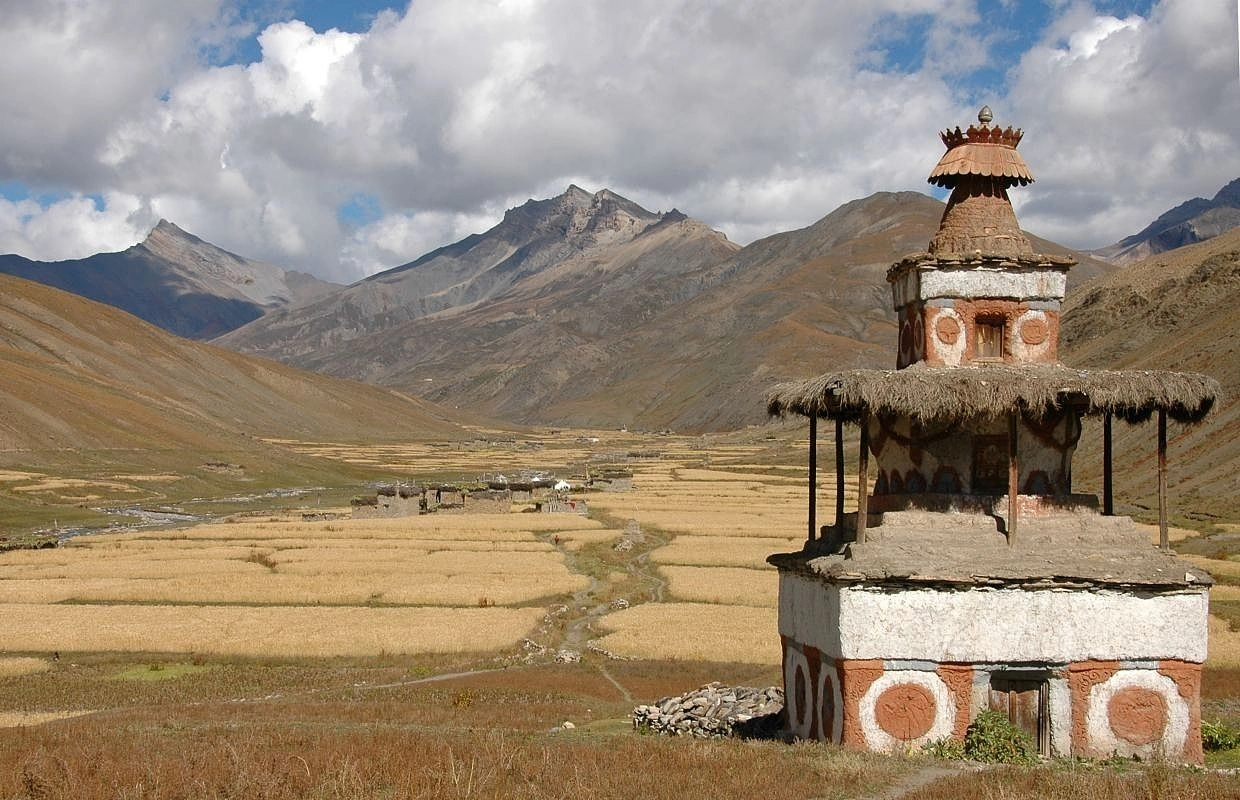
Upper Dolpo lies beyond the Dhaulagiri range in the Trans- Himalayan region of northwestern Nepal. So, when the moist vapor from the south travels northward, it encounters the towering mountains and rises towards the top. At the top, the moist air cools down, resulting in heavy rainfall on the windward side. The air gets compressed, absorbing moisture when it reaches the leeward side (Upper Dolpo). Hence, Upper Dolpo receives minimal yearly rain, resulting in desert-like structures and xeric shrublands. The annual precipitation here is extremely low at around 200mm, even during the monsoon season.
Upper Dolpo experiences variations in temperature throughout the year. The winter (December to February) is freezing, with nighttime temperatures reaching up to -20°C in the higher passes like Sela La Pass (5,240 meters) and the Nagdalo La Pass (5,360 meters). The daytime temperature also is around 5°C, making it chilly. Spring (March to May) and Autumn (September to November) have warmer days. The temperature reaches up to 18°C to 20°C during these seasons in the day, while the nights can still be chilly. Upper Dolpo witnessed the highest temperature in the Summer (June to August), reaching up to 22°C. The nighttime in the summer is also warm. Below is the monthwise table with the minimum and maximum temperatures of Upper Dolpo.


Upper Dolpo was once part of Tibet during the 8th and 9th centuries. Later, in the 14th century, it became an independent kingdom. However, the surrounding neighbors, Lo Manthang (of Upper Mustang) and Jumla ruled over it at different times. In the 18th century, during the unification of Nepal, Lo Manthang was annexed to Nepal, and so was Upper Dolpo. Since then, it has been part of Nepal and remained secluded for years until 1973.

In 1973, Peter Matthiessen traveled through Upper Dolpo to find the Snow Leopard and wrote about it in his book “The Snow Leopard.”With the popularity of the book, Upper Dolpo also gained global attraction. In 1989, the region was opened to the foreigners. Ten years later, in 1999, Upper Dolpo again reached a wider audience through the Eric Valli Oscar-nominated film Himalaya (also known as Caravan). The film showed the region’s landscapes, culture, and the struggles of its people. Since then, Upper Dolpo has received significant visitors but only with a Restricted Permit. In 2024, director Min Bahadur Bham from Nepal shot his film Shambhala in the Upper Dolpo, showcasing the polyandrous tradition.
Upper Dolpo’s culture is rooted in Tibetan Buddhism and the ancient Bon religion. Numerous monasteries exist, including Shey Gompa (established in the 11th century) and Yangtsher Gompa. The people of Dolpo are called Dolpapa or Dhol-wa in the local dialect. They follow festivals like the Shey festival, which happens once every 12 years. Dolpapa speaks the Dolpo dialect along with Tibetan. People there rely on yak herding, farming barley and potatoes, and trading salt and wool.
Besides, there is some etiquette you must follow in your Upper Dolpo Trek. The first is respecting the local traditions and cultures. For example, always walk clockwise around the mani walls and remove your shoes before entering the monasteries. And always ask for permission if you want to take photographs of locals or the monasteries.
Here are some important tips for your trek to Upper Dolpo.
Due to Upper Dolpo’s geographical location and vast cultural history, the government tightly monitors the region to ensure the safety of culture and the environment. To trek in the region, you must get a Restricted Area Permit. The permit costs USD 500 per person for the first ten days and USD 50 per day afterward. You must also obtain a Shey-Phoksundo National Park permit to enter the region.
Since Upper Dolpo lies in the remotest location and is also a rain shadow area, the cultivation is limited to a few crops. All the food in the region must be carried on foot, so minimal food options are available. Similarly, accommodation options are also limited to camping due to the sparse nature of accommodations. Coretreks will manage your camping and provide you with cooking staff and porters.
Trekking in the Upper Dolpo involves hiking some of Nepal’s highest passes, including the Sela La Pass (5,240 meters) and the Nagdalo La Pass (5,360 meters). Altitude sickness in such high elevations is always a possibility. Hence, you should include acclimatization to adjust the thinning oxygen level.
Trekking in the Upper Dolpo is physically and mentally taxing as it involves walking in the rugged terrain in a high-altitude region. Hence, you need to be physically and mentally fit for the trek. You can train your body by focusing on the cardiovascular and strength training. You can go on short hikes to simulate the trekking situations for mental preparation.
The people of Upper Dolpo follow either the Bon religion or Tibetan Buddhism. They have their customs, traditions, and etiquette. Hence, you must respect their ways of life. Since the region lies inside the national park, it is home to rare animals and plants. You mustn’t harm those animals and plants. Also, you should not leave the waste behind.
The weather conditions of the Upper Dolpo are harsh and unpredictable. Hence, the gear and equipment you pack must fit the varied temperatures. The gear and equipment that you shouldn’t miss include thermal base layers of clothing, insulated clothes, tents, backpacks, boots, poles, and a sleeping bag.

