The Annapurna Base Camp Trek difficulty is one of the main concerns for those who want to undertake this iconic adventure. Although graded as moderate in difficulty, how demanding is the trek when you actually hit the trail? That’s what we are going to find out in this blog.
Annapurna Base Camp (ABC) is one of the most popular trekking destinations in Nepal. Its well-marked trail takes you through lush lower subtropical jungles to the glacial basin within Annapurna Sanctuary. Similarly, the trail offers stunning scenery of the changing landscapes of the Annapurna region. ABC is a multi-day journey, but it is considered easier than the Everest Base Camp Trek or the Annapurna Circuit Trek. The maximum altitude is 4,130 m, which is comparatively lower. Due to the well-balanced challenge and reward, ABC Trek is suitable for all trekkers, including novices.
Table of Contents
Having said that, the rewarding experience does not come easily. You do not need athlete-level fitness, but you must be able to make steep uphill and downhill hikes on varied terrain. Likewise, you must be able to walk 5 to 6 hours on average each day. Aside from physical demands, trekkers must also be aware of mental challenges. In this blog, we will break down all the difficulty factors of the Annapurna Base Camp Trek so that you can be fully prepared for the extraordinary trek journey.
Understanding the Annapurna Base Camp Trek Route
Before jumping into the difficulties of the Annapurna Base Camp, we need to understand the trek route. The trek itinerary can vary, and the duration can range from 7 to 14 days. To provide you with a clear understanding of the route, we will take CoreTreks’ standard 13-day itinerary as a reference.
Nayapul serves as the trailhead for the ABC Trek, but some itineraries begin from Hile. You will drive to the starting point from Pokhara. From the trailhead, you will gradually start ascending through beautiful villages, terrace farms, forests, and alpine meadows. At the beginning of the journey, you will traverse Magar settlements like Ulleri and Ghorepani. From Ghorepani, the famous Poon Hill viewpoint is an hour away. It also goes through the dense forests of rhododendrons, oaks, and firs.
Locals At Ghorepani
As you gradually ascend, you will come across Gurung villages like Tadapani, Chhomrong, and Deurali. The vegetation also changes from subtropical forests to coniferous ones. Then, it changes into alpine meadows and glacial moraines as you head towards Machhapuchhre Base Camp. From here, you will enter the glacial basin of Annapurna Sanctuary. After trekking for a while, you will reach the Annapurna Base Camp.
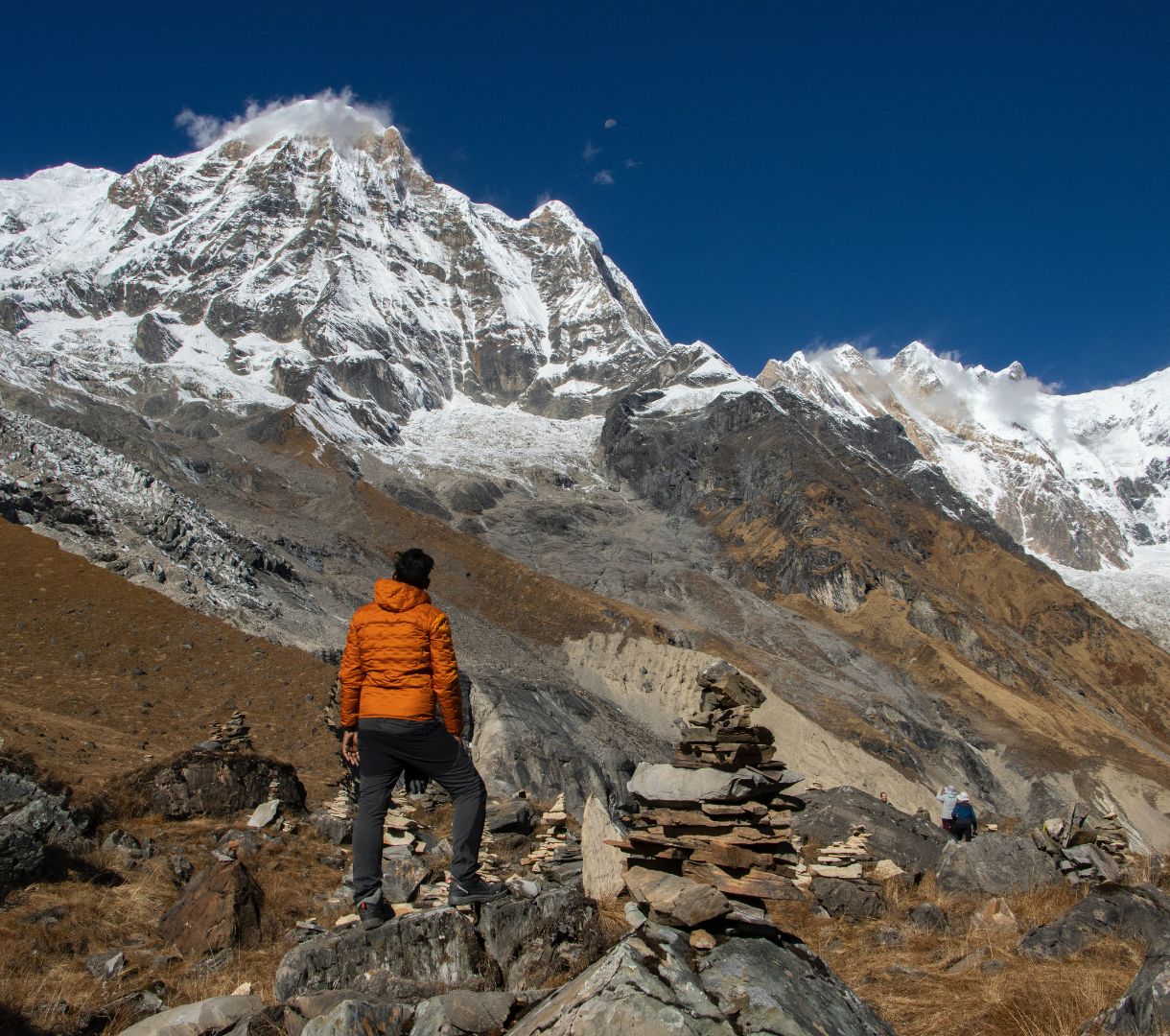
On your way to the base camp, you will not only trek on a forest trail, but also on endless steep stone staircases and rugged terrain. You will also cross wooden bridges over streams and rivers. The varying terrain and gradual altitude gain will put your physical fitness to the test. However, the stunning contrasts in landscape and culture will offer memorable views. The snow-capped mountains like Annapurna I, Machhapuchhre (Fishtail), Dhaulagiri, Hiunchuli, and more further add to the mesmerizing scenery.
Trek from Himalaya to Annapurna Base Camp via Machhapuchhre Base Camp
4,130 m
5 hours (trek)
8-10 km
9
Trek from Annapurna Base Camp to Bamboo
4,130 m
5-6 hours (trek)
10-12 km
10
Trek from Bamboo to Jhinu Danda
2,310 m
4-5 hours (trek)
9-10 km
11
Trek from Jhinu Danda to Siwai and drive to Pokhara
1,780 m
3 hours (trek) 2 hours (drive)
13-15 km (trek)
12
Pokhara to Kathmandu
1,350 m
25 minutes (flight) 7 hours (drive)
–
13
Departure
–
–
–
Annapurna Base Camp Difficulties
Now that we understand the route to Annapurna Base Camp, let us dive into the trek’s difficulties in more detail:
The Terrain Test and Stairway Marathon
Let us start with one of the main difficulties of the ABC Trek, which is the uneven terrain. You must trek on a trail that alternates between muddy, loose gravel, and rocky slopes. Hence, you must be cautious about your footing. There are also steep ascents and descents. Additionally, the section from Hile to Ulleri to Ghorepani has thousands of stone steps. This is what we mean by “stairway marathon.”
The combination of uneven paths and steep stone staircases requires muscular strength, stamina, and cardiovascular endurance. To add to the challenge, you must trek for 5 to 7 hours on this challenging terrain. It can be more difficult for beginners who are not used to long hours of trekking on rugged paths. But these conditions will even test seasoned trekkers.
Hidden Altitude Transition and Its Effects
The maximum altitude of Annapurna Base Camp is relatively lower at 4,130 m. However, it is still high enough for trekkers to experience altitude-related symptoms. You will start from Nayapul at 1,070 m, and in a matter of a few days, ascend to the base camp. It may not seem like much, but the gradual altitude gain has subtle yet significant effects. The mildest forms of altitude sickness are known as Acute Mountain Sickness (AMS) symptoms. It is dangerous to overlook them, as they can quickly turn severe.
These hidden altitude effects can not only slow your progress but also reduce your energy. Acclimatization and steady ascent are the best ways to mitigate the invisible altitude challenges. Even physically fit and seasoned trekkers must not underestimate these risks. They must take proper precautions to ensure their safety.
Another lesser-known difficulty of the Annapurna Base Camp is the microclimates. Due to the changing altitude, the climate also changes dramatically within a few kilometers of trekking. The climatic changes that you will experience during the ABC Trek are:
Subtropical zone (800 to 1,200m):
In the lower regions, such as Nayapul or Tikhedhunga, you will experience a warm and humid climate. Expect average temperature of 15 °C to 30 °C (59 °F to 86 °F). These areas also receive heavy rainfall during the monsoon season. The vegetation is lush and vibrant in these areas. You can see forests of rhododendrons, oaks, sals, and more. Similarly, it is also common to see terrace rice farms and banana trees.
Temperature zone (1,200 to 2,500m):
The mid-elevation areas, such as Ghorepani and Tadapani, fall within the temperate zone. These regions are moderate and cool, with temperatures ranging from 10°C to 25°C (50°F to 77°F). You can also see dense forests of rhododendron, oak, and pine here. As these areas also receive rainfall during the monsoon, they are humid and misty. So, you can see ferns and mosses in forests.
Poon Hill 3210 M.
Subalpine zone (2,500 to 3,500m)
These areas have cool and damp climatic conditions. The area around Dovan and Deurali falls under these zones. You can experience a misty atmosphere with frequent drizzle. The air also becomes thinner as you ascend higher. Cold wind in the noon is also common. The average temperature ranges from 0°C to 15°C (32°F to 59°F). You can still see a forest of rhododendron and bamboo. But it gradually changes into coniferous forests of juniper and birch.
Alpine zone (3,500 to 4,500m)
The temperature takes a plunge as you move to an altitude of 3,500 m. Areas like Machhapuchhre Base Camp and Annapurna Base Camp fall in these areas. The climatic conditions are alpine and cold, with temperatures ranging from –10 °C to 10 °C (14 °F to 50 °F). Although days are sunny and warm, the temperature at night can drop below freezing point. Due to the cold climatic conditions, the area only has sparse shrubs and grasses. There are mostly snowfields and rocky moraines.
Isolation and Mental Fatigue
Many trekkers also underestimate the mental challenge that they can experience during the Annapurna Base Camp Trek. Long hours of trekking, challenging terrain, changing climatic conditions, and remote locations cause stress to trekkers. Although the trail is well-marked and teahouses are available at every other stop, the facilities become limited. It can make them feel anxious and isolated.
Each day you will repeat the routine, which can make it feel monotonous. The steep stone cases can feel endless and exhausting. These psychological challenges can cause mental fatigue, which in turn can lead to physical tiredness. Hence, the ABC Trek difficulty is not only about physical stamina. It also requires strong mental endurance and resilience. Therefore, trekkers must also be prepared to cope with mental fatigue during the journey.
Overcoming the ABC difficulty
The Annapurna Base Camp Trek is a journey that has both physical and mental challenges. You will need more than just fitness to overcome them. Here are some ways to overcome the difficulty:
Common Altitude Symptoms and Proper Acclimatization in Annapurna
As we mentioned before, while ascending to high altitude, trekkers can experience altitude sickness. There is a shift in the air pressure, oxygen levels, and temperature. It can cause trekkers various symptoms of Acute Mountain Sickness (AMS). Its symptoms include headache, dizziness, loss of appetite, insomnia, nausea, and shortness of breath. Sometimes the lack of oxygen can cause the body to react even at moderate elevation.
The best way to manage the altitude is acclimatization. It allows your body to adapt to the growing elevation naturally. Similarly, proper rest and hydration also help the body to adjust to the high altitude. Drink at least 3 to 4 liters of water each day to prevent dehydration.If you are a beginner, it is recommended that you do not gain more than 500-600 m per day. During the day, you can explore higher areas, but sleep at a lower elevation if possible. Do not over-exert yourself, and if the AMS symptoms persist, descend immediately.
Chhomrong
The best points to acclimate along the ABC route, and the reasons are as follows:
Ghorepani (2,850 m): It is located at an altitude that comes before the major altitude gain after Ulleri. Hence, staying here overnight helps your body to adapt to the elevation. Additionally, you can enjoy one of the most beautiful sunrises from the Poon Hill viewpoint.
Chhomrong (2,170 m): It is another spot to take rest during the ABC Trek. The village is located at the spot right before entering the Annapurna Sanctuary.
Deurali (3,230 m): It is situated at an elevation right before entering the high alpine zone. The oxygen level is significantly low by the time you reach here. Hence, it is crucial to take a steady pace.
Preparation for your ABC Trek
The Annapurna Base Camp Trek does not require technical climbing skills, but proper preparation is the key. First, you must physically prepare yourself to tackle the long hours of hiking on a demanding trail. Cardiovascular training, like running, cycling, jogging, brisk walking, and swimming, is excellent for building stamina. Leg and core exercises like squats, lunges, and step-ups build strength for steep uphill and downhill treks.
Similarly, practice hiking by carrying a daypack. It simulates real trekking conditions, helping to build endurance and stamina. Mental preparation includes building mental endurance and staying positive. Researching the trek’s difficulties helps create realistic expectations. There will be stressful and uncomfortable moments, such as unpredictable weather, cold mornings, and sore muscles, among others. Therefore, it is essential to remain calm and motivated at all times.
I had heard about the Annapurna Base Camp Trek, but being there was even more amazing. It was cold like we thought, since it’s at the base of the mountains. But the people were so nice and welcoming.
We had local tea that tasted really good I wanted to bring some home but couldn’t. Still, we had a great time. CoreTreks took care of us and our bags the whole way. I really loved Nepal and the mountains. I’ll come back again for sure.
I had heard about the Annapurna Base Camp Trek, but being there was even more amazing. It was cold like we thought, since it’s at the base of the mountains. But the people were so nice and welcoming.
We had local tea that tasted really good I wanted to bring some home but couldn’t. Still, we had a great time. CoreTreks took care of us and our bags the whole way. I really loved Nepal and the mountains. I’ll come back again for sure.
Our trek to Annapurna Base Camp went really well. Everything followed the plan, and the CoreTreks team guided us every step of the way.
Be ready for lots of hiking, it’s not super easy. But the kind and friendly people of Nepal helped us along the way. The food was also really tasty. We had a few small problems, but the guides handled them quickly.
Looking forward to coming back again soon.
Love from the UK
Our trek to Annapurna Base Camp went really well. Everything followed the plan, and the CoreTreks team guided us every step of the way.
Be ready for lots of hiking, it’s not super easy. But the kind and friendly people of Nepal helped us along the way. The food was also really tasty. We had a few small problems, but the guides handled them quickly.
Looking forward to coming back again soon.
Love from the UK
The Annapurna Base Camp trek was amazing, and the CoreTreks team was super helpful throughout. I especially loved Pokhara and honestly wish I had more time to enjoy it. The city is full of life with so many fun things like paragliding, boating, and bungee jumping.
Next time I visit Nepal, I definitely want to try paragliding in Pokhara.
Thanks again to the hardworking team at CoreTreks. You made the trip easy and fun. I highly recommend booking with them.
The Annapurna Base Camp trek was amazing, and the CoreTreks team was super helpful throughout. I especially loved Pokhara and honestly wish I had more time to enjoy it. The city is full of life with so many fun things like paragliding, boating, and bungee jumping.
Next time I visit Nepal, I definitely want to try paragliding in Pokhara.
Thanks again to the hardworking team at CoreTreks. You made the trip easy and fun. I highly recommend booking with them.
This was honestly the best trip I’ve ever had. I’ve loved Nepal and its people from the start. I had been planning to trek to Annapurna Base Camp for almost a year, and I finally got to do it.
Huge thanks to CoreTreks and the whole team. The guides were patient and explained everything so well. I had no complaints at all. If you’re thinking about trekking in Nepal, I truly recommend CoreTreks.
This was honestly the best trip I’ve ever had. I’ve loved Nepal and its people from the start. I had been planning to trek to Annapurna Base Camp for almost a year, and I finally got to do it.
Huge thanks to CoreTreks and the whole team. The guides were patient and explained everything so well. I had no complaints at all. If you’re thinking about trekking in Nepal, I truly recommend CoreTreks.
Aileen
Swaziland
Trek Was Nice, Should Have Booked A Flight To Pokhara
We had a really fun time trekking to Annapurna Base Camp. The only thing I wish we did differently was flying to Pokhara instead of taking the bus.
The highway drive was nice but it took six and a half hours, and we lost time we could’ve spent exploring the city. Still, the whole trip was amazing. CoreTreks and the team made sure everything was smooth and comfortable. I would definitely recommend them.
We had a really fun time trekking to Annapurna Base Camp. The only thing I wish we did differently was flying to Pokhara instead of taking the bus.
The highway drive was nice but it took six and a half hours, and we lost time we could’ve spent exploring the city. Still, the whole trip was amazing. CoreTreks and the team made sure everything was smooth and comfortable. I would definitely recommend them.
We just finished the Annapurna Sanctuary Trek with CoreTreks, and it was a really nice trip. The trail from Naya Pul through Poon Hill to Annapurna Base Camp was smooth and easy to follow. The stone steps made walking easier.
The mountain views were so beautiful. We were surprised that the tea houses had cozy rooms and tasty food. The local people were very kind, which made our journey feel even more special.
We just finished the Annapurna Sanctuary Trek with CoreTreks, and it was a really nice trip. The trail from Naya Pul through Poon Hill to Annapurna Base Camp was smooth and easy to follow. The stone steps made walking easier.
The mountain views were so beautiful. We were surprised that the tea houses had cozy rooms and tasty food. The local people were very kind, which made our journey feel even more special.
I don’t usually complain, but the bus ride from Kathmandu to Pokhara wasn’t very comfortable. If I could do it again, I’d take the flight instead.
But the trek to Annapurna Base Camp was really good. The guides helped me a lot and cleared up all the things I was unsure about. Thank you for being so patient with my questions. I definitely recommend booking with CoreTreks they did a great job.
I don’t usually complain, but the bus ride from Kathmandu to Pokhara wasn’t very comfortable. If I could do it again, I’d take the flight instead.
But the trek to Annapurna Base Camp was really good. The guides helped me a lot and cleared up all the things I was unsure about. Thank you for being so patient with my questions. I definitely recommend booking with CoreTreks they did a great job.
Nimasha
India
Aside from these preparations, trekkers must plan for logistics. You will need to obtain the Annapurna Conservation Area Permit (ACAP) from the Nepal Tourism Board or local permit offices through a registered trek agency, like CoreTreks. Likewise, you need to pack essential clothing and gear. You should carry warm clothing and the necessary equipment. However, be careful not to overpack. Pack light and smart.
Booking the trek through a reliable travel company like CoreTreks makes the journey safer and hassle-free. They handle all the permits and logistics. The agency has local guides trained in first aid and emergency support. So, you can focus on trekking and the extraordinary experience.
Simple Tips for First-Time Trekkers in the Annapurna Region
Annapurna Base Camp is a good option for beginners. It introduces you to trekking in the Annapurna region. Here are some quick and smart tips for first-time trekkers:
Learn about the Annapurna Base Camp Trek route, trekking distances, altitude gain, and unpredictable weather. Do not underestimate the difficulties.
Research about the key acclimatization stops and strategic locations for overnight stops.
Choose the best season for trekking. The weather in the Himalayas can change rapidly, so never ignore any weather updates.
Pack light, smart, and keep your backpack under 10-12 kg. Avoid unnecessary or heavy personal items.
Walk at a comfortable pace and take regular breaks to avoid fatigue. Although you might be excited to reach the base camp as soon as possible, avoid rushing.
Stay hydrated and eat a nutritious diet that is rich in carbohydrates and protein.
Practice hiking with weighted backpacks. You can also build fitness, strength, and endurance through hill or stair climbing.
Select a reputable local trekking company that offers an experienced guide and a porter to carry your luggage.
Prepare Well And Enjoy The Annapurna Base Camp Trek
Overcoming the Annapurna Base Camp Trek difficulty is not only about strength or stamina. It is about preparation, patience, and endurance. With proper training, research, smart packing, and strategic acclimatization, even first-time trekkers can successfully complete the trek. It will be a once-in-a-lifetime adventure that rewards you with mesmerizing mountain views and a rich cultural experience. The difficulties are part of the journey that makes it more thrilling and unforgettable.
Navigating the trails of ABC will test you in different ways. So, you need to be prepared for them and stay positive. This way, even first-time trekkers can complete the trek safely. All your efforts will be rewarded when you stand before the towering peaks of Annapurna I, Annapurna South, Machhapuchhre, Hiunchuli, and more. Joining the trek with a reputable travel company like CoreTreks allows you to focus on enjoying the journey. We will handle all the permits, logistics, and other essentials. While reaching your ultimate destination of Annapurna Base Camp, you will also discover your strength along the way.
Mr. Bhatta is one of our licensed trekkers (issued by Ministry of Culture, Tourism and Civil Aviation, Nepal) and has years of experience with trekking in the Himalayan region. He belongs to the Gorkha region, and trekking with him is interesting, enriching and engaging. He has been working with CoreTreks since 2015.
Guiding trekkers for 11 years now, he is fully knowledgeable of the areas in the Himalayan region. He guides trekkers through the trails of Everest Base Camp, Annapurna Circuit, Ghorepani Poon Hill and many more. Mr. Bhatta always keeps safety first which is why many trekkers enjoyed his company in their journey.
Related Blogs
Annapurna Base Camp Trek Accommodation
Annapurna Base Camp Trek may be fun, thrilling, and challenging, but it can get more difficult if you don’t manage your place to stay. Accommodation is where trekkers stay during their ABC trek, so they are essential factor. In this blog, we will discuss Annapurna Base Camp Trek accommodation, the choices you can choose from, their advantages,…
Everest Base Camp vs Annapurna Base Camp: Which One Should You Choose?
Looking to trek in Nepal but can't decide between Everest Base Camp vs Annapurna Base Camp Trek? This blog helps you compare the two routes, covering everything from scenery to cost. Hiking in the Himalayas is a dream for many travelers. And two of the most popular treks in Nepal are Everest Base Camp Trek…
The country is famous for exploration and several hikers love trekking in Nepal. The topography of the Nepalese Himalayan Mountains offers various stunning trekking routes. It would be unfair to list the best treks in Nepal, however after a thorough analysis we present to you the five best treks in Nepal. Here are the 6…
This site uses cookies to optimize your user experience. By using this site, you are consenting to our use of these cookies. Check out our Privacy Policy.