There are numerous major attractions of Mustang that make it an ideal destination for travelers visiting Nepal. The Mustang region is a popular trekking destination in Nepal. It is situated in the rain shadow area of the Himalayas and offers spectacular views of the mountains. The region is home to the world’s deepest gorge, the Kali Gandaki Gorge.
The Mustang region is also home to the ancient kingdom of Lo. The kingdom was opened to tourism in 1992, and since then, it has become a popular tourist destination.
Trekking in the Mustang region is an experience of a lifetime. The region offers a variety of trekking trails that are suitable for all levels of trekkers. Whether you are a beginner or an experienced trekker, you will find a trek that suits your needs and the best attractions of the Mustang region.
So, what makes the Mustang region so popular among tourists? Keep reading to find out!
5 Major Attractions of Mustang Region that are so Popular
Himalayan Wild Horses (Mustang)
Mustangs (Wild Horses) are an iconic breed of horse that have been domesticated in the Himalayan region of Nepal for centuries. The breed is believed to have originated in Tibet, and continues to be extremely important to the local culture and economy. They may be small, but they are strong and can survive in high altitudes and harsh landscapes. The Nepalese Mustang is a hardy breed of Himalayan wild horses that are a low-maintenance breed that has adapted to survive in the extreme altitudes and rugged terrain of the region.
A Once-In-A-Lifetime Journey
From the moment we started planning the trip, CoreTreks showed great professionalism and care. They made sure everything went smoothly. The places we stayed were comfortable, and the meals were really good.
The views in Upper Mustang were amazing. There were huge cliffs, deep canyons, and wide open spaces that took our breath away.
If you’re thinking about trekking in Nepal, you should definitely try a trip with CoreTreks.
From the moment we started planning the trip, CoreTreks showed great professionalism and care. They made sure everything went smoothly. The places we stayed were comfortable, and the meals were really good.
The views in Upper Mustang were amazing. There were huge cliffs, deep canyons, and wide open spaces that took our breath away.
If you’re thinking about trekking in Nepal, you should definitely try a trip with CoreTreks.
Sonali Mehta
India
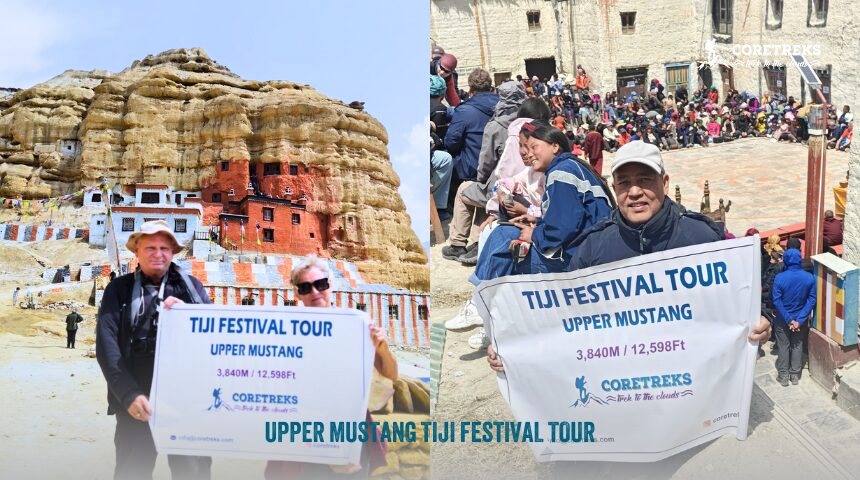
The horses are often cared for with such faithfulness that they develop strong bonds with their owners. Although much of Nepal’s economy has shifted away from farming and animal husbandry in recent years, Mustangs remain integral to festivals, traditional sports, and horse racing in the region. These wild horses hold cultural significance, as they are often depicted in folktales, songs, and art. During the Tiji Festival, these horses are dressed and paraded as a symbol of community strength and ancestral pride. Similarly, they are connected with mountains and symbolize strength and freedom.
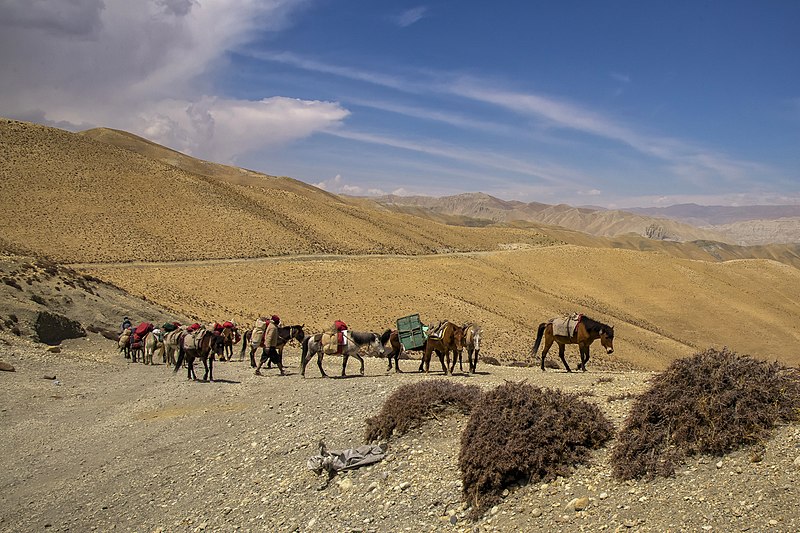
Horse Caravan In&Nbsp;Upper Mustang
Sherpa people traditionally used Mustangs (Wild Horses) to transport goods between villages and over mountain passes, but they were also used to carry people. In recent years, they have been exported to the USA and Europe, where they are especially popular as show animals.
The locals in Upper Mustang still use these horses for transporting goods and herding yaks and sheep. They are also used for horse riding treks where travelers can ride on their backs to explore secluded areas.
The Layout of Upper Mustang
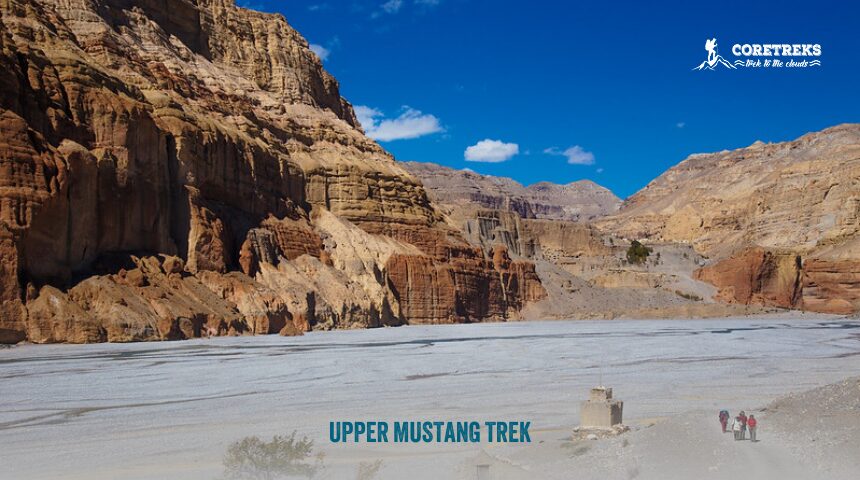
Mustang lies in the northwestern corner of Nepal and is part of the Himalayas. The area is located in a high-altitude desert of the Trans-Himalaya in Central Asia. It is located on the borders of Tibet and Nepal, and comprises the upper part of the Kali Gandaki gorge, the deepest canyon in the world. Upper Mustang is a high-altitude desert located in the Trans-Himalayas. Its landscape includes eroded canyons, wind-blown plateaus, interesting rock formations, and valleys—all of which are home to ancient monasteries, chortens, and other spiritual monuments.
The average elevation of the Mustang region is 13,000 feet (4,023m). Its highest peak, Nilgiri Himal, is 20,160 feet and is located to the south. The Last Forbidden Kingdom of Lo Manthang sits at an altitude of 3,800 meters (12,500 feet). Another interesting fact about the Upper Musang region is that it is carved by the Kali Gandaki River. The river flows through the Kali Gandaki Gorge, and the riverbed is rich in fossils of ammonites, locally known as shaligram. These shaligrams hold a significant religious connection for Hindu devotees, as they are associated with Lord Vishnu. The riverbed of the Kali Gandaki River served as a crucial trade route between Nepal and Tibet.
Rock Painting Of Upper Mustang
The Annapurna and Dhaulagiri ranges cause the rain shadow effect in Upper Mustang. As a result, the area receives very little rain and, in some areas, there is no rain at all. This desert-like climate, together with a high altitude, makes Mustang an inhospitable terrain. High afternoon winds are common in Upper Mustang, sweeping across the valley. The average temperature range is from -10 degrees Celsius to +35 degrees Celsius and can occasionally drop to -20 degrees Celsius. In winter, many areas of Upper Mustang are closed due to the harsh winter weather and freezing temperatures. The rugged layout carved by time and natural elements is another major attractions of Mustang.
The people of Mustang are descendants of both Tibetan and Nepali immigrants. The unique culture and ethnic communities are among the major attractions of Mustang region. This region is home to two distinct yet intertwined ethnicities: the Gurung and the Thakali. They share similar yet different cultures, traditions, and lifestyles.
The Gurung people are traditional Tibetan Buddhists and were historically nomadic goat and sheep herders. Today, animist beliefs remain prevalent among the Gurung, alongside the practice of Buddhism. Their religion is a blend of Buddhism, Bon, and some Hindu influences. They still follow their traditions of shamanic rituals, oral storytelling, traditional singing, and dancing. The primary language of the Gurung is Nepali, though they also speak their own Gurung language. Although the Gurung practice a vibrant traditional lifestyle, many have shifted to a more modern lifestyle in recent years.
Festival In Upper Mustang
The Thakali people are an indigenous ethnic group with a strong tradition often blended with Buddhist and Hindu beliefs. They have their own distinct Thakali language, and also speak Nepali fluently. Thakalis are known for their high business acumen and have preserved their distinct cultural identity. They have a very organized community life, and during special festivals like Yartung, they all come together for celebration. Thakalis have a distinct set of traditional dishes, which include mustard pickles and buckwheat bread. Their famous dish, Thakali thali, which consists of rice, lentil soup, meat, pickles, and salad, is loved by Nepalese worldwide.
The Mustang region of Nepal is one of the most mysterious and remote places in the world. For centuries, it has been home to the unique culture and lifestyle of the local people, who have developed a unique way of life and culture in this rugged and barren landscape. One of the main attractions of Mustang region is its numerous monasteries, or “Gompas”, which are sacred sites for Buddhists. There are also holy temples revered by Hindus in different areas of the region.
Monastery In Mustang
Among the numerous monasteries and temples in Upper Mustang, the main attractions are as follows:
Ghar Gompa
Among the major attractions of Mustang, you cannot miss the ancient Buddhist monastery, Ghar Gompa. It is one of the oldest Tibetan monasteries in Nepal, dating back to the 8th century. It is believed that the monastery was built by Guru Rinpoche Padmasambhava. The monastery is situated within the walled city of Lo Manthang, at an elevation of 3,931 meters. The gompa has a traditional fortress-like structure. Similarly, intricate wall paintings can be seen on the walls and ceilings.
Ghar Gompa is related to the Nyingma sect of Tibetan Buddhism. Moreover, it holds significant importance for Buddhist devotees, as Guru Rinpoche Padmasambhava himself founded the monastery. They believe that the monastery was built to trap a demon who hindered the construction of Samye Monastery in Tibet. Hence, it holds both cultural and religious significance for the Mustang region.
Muktinath Temple
The Muktinath Temple is one of the most sacred Hindu temples in Nepal. It lies at the foot of the high mountain pass of Thorong La in the Muktinath valley of Mustang. The temple is believed to be over 2000 years old and devoted to Lord Vishnu. It is one of the highest temples in the world at 3800 meters. Muktinath is considered a sacred site for both Hindu and Buddhist pilgrims.
The temple is one of the eight sacred shrines in the Hindu Vaishnavas. There are 108 water spouts within the Muktinath temple premises, which are believed to cleanse one’s sins. Similarly, there is a small Buddhist shrine inside, which burns an eternal flame fueled by natural gas from the earth. Hindus consider Muktinath Temple as the “Place of Salvation.” Meanwhile, Buddhists associate it with Guru Rinpoche and refer to it as “Chumig Gyatsa” or “Hundred Waters.”
Jhong Cave Monastery
The Jhong Cave Monastery, also known as Chhoser Cave Monastery, lies in the Upper Mustang region of Nepal. Its construction dates back to the 11th century. The monastery is a five-story building with numerous rooms, including prayer rooms, meditation rooms, and living quarters. Locals believe that monks used these rooms for religious practices. Hence, the cave holds deep religious and spiritual significance for Buddhists in the region.
In ancient times, the monks also used the caves for burials. The atmosphere of the Jhong Cave Monastery feels mysterious and spiritual. Inside the cave, there are also narrow passages, ancient murals, and tiny windows overlooking the semi-arid landscape of Upper Mustang. The Jhong Cave is believed to have been built by early Tibetan monks. Hence, the cave is considered to be an early link to Tibetan Buddhism and its growth in the Mustang region.
Mustang’s Cave Paintings
The Mustang Region in Nepal is one of the largest forms of prehistoric art in the world. Discovered in the early 20th century, they are highly preserved and well-known cave paintings that date back to the 14th century or earlier. The walls of the caves and large alcoves are decorated with intricate designs that illustrate daily life and religious practices of people living in the region during that era. Monks and pilgrims used these caves for prayer, meditation, and retreat.
The majority of the paintings feature Buddhist motifs, including depictions of caves, the god Bhairava, mandalas, and stupas. Similarly, there are also Hindu influences in some of the art. Especially noteworthy are elaborate paintings of the Vishnu avatar Narasimha and Shiva. Many of the paintings feature fossil pigments in shades of red, yellow, and green, in stark contrast to the gray and brown hues of the surrounding mountains. These paintings also reflect the fusion between Tibetan Buddhism and Bon traditions.
Here Guru Rimpoche (Padmasambhava) Eviscerated A Huge Demoness, The Balmo, Her Blood And Liver Dyeing The Steep Eroded Hills In Red And Purple-Grey.towards The End Of The Valley These Wind-Sculpted Cliffs House Groups Of Caves. The Mud Wall With Red Ochre Stripes Indicates A Religious Function. Shrines Burrowed Into The Very Blood Of The Balmo.
The murals and paintings resonate deeply with Guru Rinpoche’s teachings on Buddhism and spiritual wisdom. Hence, monks and pilgrims visited these caves for prayer and meditation. “The mind is the source of all suffering and all happiness.” This is one of the teachings shared by Guru Rinpoche. The ancient caves of Mustang and the paintings of Buddhist deities perfectly capture this quote. It makes the visitor engage their mind to gain spirituality and recognize their happiness.
The Mustang region of Nepal is one of the most important archaeological sites in the world, and the cave paintings are important artefacts of the area’s past. They provide valuable cultural and historical insights into the religious and social practices of the local communities during the ancient period. Hence, it is undoubtedly one of the major attractions of Mustang in Nepal.
Conclusion
The Mustang region in Nepal is a popular trekking destination for a variety of attractions and regions. The region is home to some of the most beautiful scenery in Nepal, as well as a rich history and culture. If you’re interested in exploring these major attractions of Mustang, reach out to us at info@coretreks.com for booking inquiries. We can’t wait to show you all that Mustang has to offer!
Mr. Bhatta started as trekking guide and is now a successful travel operator in Nepal. He is an environmentalist, committed to promote Ecotourism in Nepal. Mr. Bhatta has been engaged in improving the livelihood of residence of The Himalayas through Helping Hands for Himalayan People (HHHP Nepal) a non-profit organization built to improve living standard of the local community.
Boudhanath Stupa is one of the most sacred Buddhist sites in the world. It is a religious site and a cultural hub for pilgrims, especially Tibetan Buddhists. Similarly, it is one of Nepal's largest, 36-meter-high, and 100-meter-wide stupas in the capital city of Kathmandu. The stupa is located just 7 km northeast of central Kathmandu,…
The Everest Base Camp Trek in February is a one-of-a-kind experience that trek enthusiasts must take once. Contrary to many trekkers who believe winter months are unsuitable for Himalayan ventures, trekking in February is doable. It is just the time when the cold winter slowly transitions into the warm spring season. Therefore, trekking on the…
Many of you might be curious about the Manaslu Circuit Trek after earthquake in Nepal and whether it is safe for trekking. Fortunately, yes. The trail that was heavily damaged by the 2015 Nepal earthquake has re-opened. So what are the conditions of the trails, accommodation availability, and risks of Manaslu Circuit Trek after the…
This site uses cookies to optimize your user experience. By using this site, you are consenting to our use of these cookies. Check out our Privacy Policy.