Those looking to climb trekking peaks in Nepal are often confused between Mera Peak VS Island Peak. This article will explore all the vital information about these two peaks. So make sure you read until the end, and you can decide which is best for you!
Nepal is home to Mount Everest, the highest mountain in the world, and seven other highest mountains worldwide. Mera Peak and Island Peak are famous training peaks for these high-mountain expeditions. Both peaks stand above 6000 meters but have specific characteristics. So, what are the differences between Mera Peak and Island Peak? Let’s find out!
Table of Contents
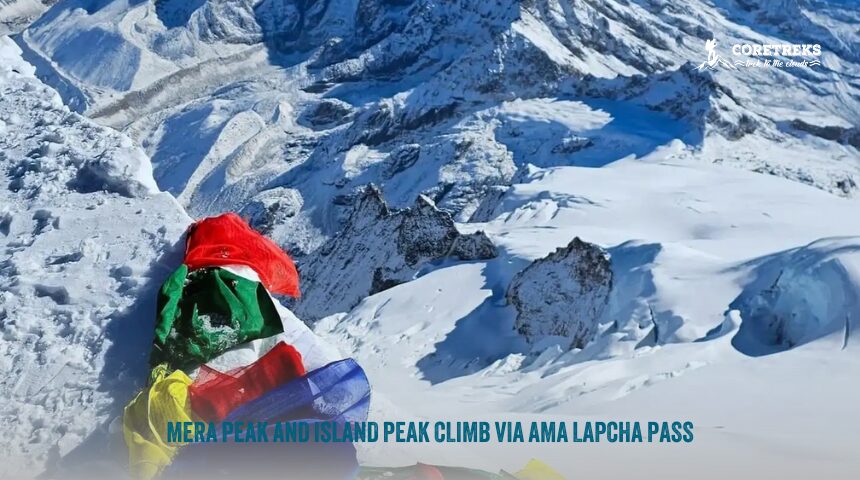
Mera Peak and Island Peak Climb Via Ama Lapcha Pass
Mera Peak is the highest trekking peak in Nepal, at 6476 meters. It is part of the Mahalangur Himalayan range and lies north of the Hinku Valley in the Everest region. The peak consists of three summits: Mera North (6476m), Mera Central (6461m), and Mera South (6065m). Mera Peak’s geographical coordinates are 27° 42′ 33″ N latitude and 86° 52′ 6″ E longitude. The distance between the peak and Mera Base Camp is around 65 km.
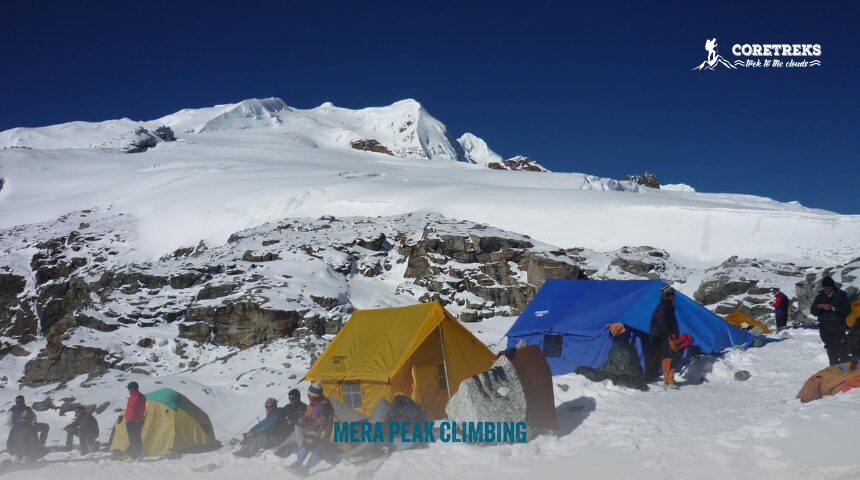
Camping During Mera Peak Climbing
The British Expedition team of Edmund Hillary, Tenzing Norgay Sherpa, and George Lowe, led by Sir Eric Shipton, was the first to explore the Mera Peak region in the early 1950s. Col. Jimmy Roberts and Sen Tenzing were the first to ascend to the Mera Peak on May 20, 1953.
Trek on off-beat and quieter trekking trails in the Everest region.
It is great for beginners because the climb is quiet and simple.
Get a chance to explore the beautiful and remote Hinku Valley and Khumbu Valley.
Witness five of the world’s tallest peaks, i.e., Mt. Everest, Makalu, Lhotse, Cho-Oyu, and Kanchenjunga.
Reach the summit of Nepal’s highest trekking peak, Mera Peak, at 6,461 meters.
Immerse yourself in the delightful culture and customs of the Sherpa people, which has Tibetan Buddhism influence.
Great Climb With Strong Support
CoreTreks did a great job organizing our Mera Peak climb. From the time I landed in Kathmandu to the day I left, everything was smooth and well taken care of.
The trek had beautiful views, and we stayed in comfy places with tasty meals that kept us going. Our guides were experienced and made sure we were safe and enjoying the trip. The training and rest days really helped us get ready for the Mera Peak climb.
Big thanks to CoreTreks for such an unforgettable adventure.
CoreTreks did a great job organizing our Mera Peak climb. From the time I landed in Kathmandu to the day I left, everything was smooth and well taken care of.
The trek had beautiful views, and we stayed in comfy places with tasty meals that kept us going. Our guides were experienced and made sure we were safe and enjoying the trip. The training and rest days really helped us get ready for the Mera Peak climb.
Big thanks to CoreTreks for such an unforgettable adventure.
Anna Petrovna
Russian Federation
Island Peak
Location
The Island Peak, locally known as the Imja Tse, is an extension of Mount Lhotse Shar’s south-end ridge in Eastern Nepal. The British Expedition team, led by Eric Shipton, named the peak in 1953 because it appears as an island amidst the sea from Dingboche. The peak is 6,160 meters above sea level and lies within the Sagarmatha National Park. Its geographical coordination is 27° 55′ 14.84″ N latitude and 86° 56′ 6.58″ E longitude. The distance between Lukla and the Island Peak Base Camp is around 40 to 47 km.
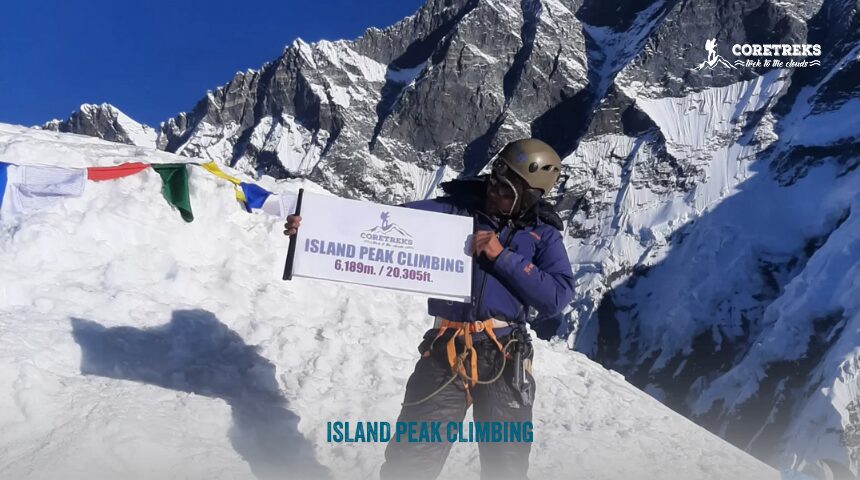
Island Peak
The 1953 British expedition team, which included Charles Evans, Charles Wylie, Alfred Gregory, Tenzing Norgay, and seven other Sherpas, first summited the southwest summit of the Island Peak. Later, Hans-Rudolf Von Guten and two Sherpas summited the central peak in 1956.
Trek on the classic route to the Everest Base Camp and experience the vibrant Sherpa culture.
Hike through the forest trails of Sagarmatha National Park.
Visit the ancient and most significant monastery in the Everest region, the Tengboche Monastery.
Witness the beautiful Khumbu Glacier and Khumbu Icefall.
Explore and summit the Island Peak at 6,189 meters.
View the spectacular mountain vistas like Mount Everest, Lhotse, Nuptse, Ama Dablam, Thamserku, and many more.
Totally Satisfied With The Service
As someone who loves trekking, I was excited to try Island Peak and Everest Base Camp. It was a real adventure. The climb was tough and the weather was wild, but we finished the journey and it felt amazing.
Thank you to everyone at CoreTreks who helped me reach one of the biggest goals of my life. I’ll always remember this time. So glad I went with them.
As someone who loves trekking, I was excited to try Island Peak and Everest Base Camp. It was a real adventure. The climb was tough and the weather was wild, but we finished the journey and it felt amazing.
Thank you to everyone at CoreTreks who helped me reach one of the biggest goals of my life. I’ll always remember this time. So glad I went with them.
Bradley
Australia
Comparing Mera Peak VS Island Peak
Difficulty level
The Alpine Grading of Mera Peak is PD, i.e., the peak has a challenging section and requires some technical climbing skills. There are no steep or technical sections, and reaching 6,461 meters is quite easy. However, trekkers must walk on glaciers and know how to use an ice axe, fixed ropes, and crampons. For the final stretch, trekkers must ascend at a 50-degree angle using a jumar on a fixed rope. It requires a lot of physical strength and determination to reach the summit of Mera Peak.
Island Peak’s alpine grading system is PD+, indicating that the mountain has some technical sections and requires basic knowledge of mountaineering tools. The trails to the summit are physically challenging, with rough terrain, deep crevasses, and steep ascents. Climbing from the Island Peak lower base camp to the upper base camp is a slope of 60 to 65 degrees. Then, for the final part of the climb, you will have to cross crevasses and climb a slope of 70 to 80 degrees. To reach the summit, you must use a fixed rope, ice axes, and crampons. Island Peak is undoubtedly a physically demanding climb.
Compared to Island Peak, climbing Mera Peak is a bit easier, with fewer steep paths and no technical climbing. Meanwhile, Island Peak Climbing has technical and steep trails, which make it more physically demanding. Hence, Island Peak is more challenging than climbing Mera Peak. Despite being a relatively easy climb, Mera Peak sits at a higher altitude and takes longer. Thus, climbers must plan a proper Mera Peak itinerary, including an adequate acclimatization day.
Scenic views and landscapes
Both Island Peak and Mera Peak lie in the Everest region of Nepal, so the scenery and views are relatively similar.
From Mera Peak, you can witness the five tallest mountains in the world, Mt Everest, Kanchenjunga, Lhotse, Makalu, and Cho Oyu. Similarly, you can witness other towering mountains such as Ama Dablam, Nuptse, Pumori, and many others.
Meanwhile, Island Peak offers spectacular views of Mt Everest, Lhotse, Middle, Lhotse Shar, Makalu, Ama Dablam, Kanchenjunga, Baruntse, and more.
Best climbing season and weather conditions
Mera and Island Peak are adjacent to the Mahalangur range, so the weather and climate conditions are identical. The best climbing seasons are spring and autumn. However, the weather at higher elevations is unpredictable. Despite the season, it can change rapidly, and trekkers must prepare for all types of weather during the climb to Mera or Island Peak. Take a look at the recommended season for both peaks:
Season
Crowd
Recommendation
Spring (March to May)
Extremely crowded
Highly recommended
Summer (June to August)
Extremely low
Considerable
Autumn (September to November)
Extremely crowded
Highly recommended
Winter (December to February)
Less crowded
Considerable
You will come across the following climatic zones while climbing Mera or Island Peak:
Climatic Zone
Altitude (in meters)
Temperate Climate
1200m – 2100m
Frigid Climate
2100m – 3100m
Alpine Climate
3300m – 5000 m
Tundra Climate
5000m and above
Success Rate
Both Mera and Island Peak are non-technical trekking peaks. The success rate for Mera Peak is around 90%, and for Island Peak, it is around 85 to 90%. Climbers must take proper precautions, like acclimatization, and hire an experienced guide. The weather condition also plays a crucial part in the successful summiting of the peaks. To avoid high winds, the climb begins early, and you will reach the summit by noon. So, book the trip with a reputable trek agency and hire an experienced guide and porter to accompany you. You must also choose the right time and an ideal itinerary that suits you best.
Experience And Preference
There is no need for prior experience to join Mera or Island Peak. Hence, it is suitable for beginners as well as experienced climbers. However, they must have a healthy body and excellent physical fitness to participate in the venture. During either of the climbs, you will reach an altitude above 6000 meters. The trails are demanding, and the unpredictable weather can cause unforeseen challenges. The rocky and icy trail, with its vertical climbs, will test your physical and mental fitness.
In addition to good fitness, climbers must also have basic mountaineering skills. They must be able to use mountaineering gear, including ropes, ice axes, ladders, and crampons. The best way to prepare for the Mera and Island Peak is to undertake fitness-building exercises and training a few months beforehand. Mental preparation is also equally important. Whether to go for Mera Peak or Island Peak depends on your preference. But whichever you choose, they are perfect for adventurers and thrill seekers.
Summary: Mera Peak VS Island Peak
Here is a quick summary on Mera Peak VS Island Peak:
Features
Mera Peak
Island Peak
Highest altitude
6476 meters
6189 meters
Best time
Spring and autumn
Spring and autumn
Technical difficulty
Low
Moderate
Ideal for
Beginners to seasoned climbers
Beginners and those looking for a technical climb
Permit
Khumbu Pasang Lhamu Rural Municipality Entry Permit Makalu Barun National Park Entry Permit Mera Peak Climbing Permit
Khumbu Pasang Lhamu Rural Municipality Entry Permit Sagarmatha National Park Entry Permit Island Peak Climbing Permit
Ultimately, it comes down to your preferences when deciding between Mera Peak VS Island Peak. If you want a more challenging climbing experience, Island Peak is an ideal choice. Mera Peak is a better choice for more non-technical climbs. But whether you choose Island Peak or Mera Peak, you are set for a remarkable journey with thrilling adventure.
Despite the challenges, both peaks are ideal for beginners. With good preparation, training, and a proper plan, you can choose to climb either peak. Hence, these are famous trekking peaks and training grounds for mountain expedition teams. Now that you have all the necessary information, you can decide which peak is better!
FAQs
Is Mera Peak easier than Island Peak?
In terms of technical climbing, Mera Peak is easier than Island Peak. Although Mera Peak is slightly higher than Island Peak, there are fewer technical sections. Mera Peak has the alpine grading of PD, which requires basic climbing and mountaineering skills. Meanwhile, Island Peak has a PD+ alpine grading, which requires more technical and mountaineering skills.
Can beginners climb the Island Peak?
Yes, beginners can climb Island Peak. There is a need for basic mountaineering and technical skills, but there is no need for prior experience. Island Peak is perfect for new novice mountaineering and a practice peak for mountain expeditions. Climbers must have good physical fitness and health to summit the peak successfully.
Which peak is higher? Mera or Island Peak?
Mera Peak is 6,476 meters above sea level, while Island Peak is 6,165 meters above sea level. Hence, Mera Peak is higher than Island Peak. Even though Mera Peak is higher, the climb is easier and has fewer technical parts. Meanwhile, Island Peak is slightly lower in altitude but has more challenging and technical areas.
What is the success rate of Mera Peak?
The success rate of Mera Peak is around 80%, and about 1,800 climbers successfully climbed the peak in 2022. Many climbers have successfully reached the peak, but altitude sickness is the main reason behind those who fail. Hence, acclimatization and a properly planned itinerary are crucial for successfully reaching the summit of the Mera Peak.
How should I train for Island Peak?
Since Island Peak requires basic mountaineering skills, you need to do mountaineering training and be comfortable using gear like a jumar, fixed line, ice axe, crampons, etc. You can also undertake specific mountaineering training. Exercises and training like core stability, weight training, long endurance hikes, strength, and endurance training are beneficial for Island Peak climbing.
Mr. Bhatta started as trekking guide and is now a successful travel operator in Nepal. He is an environmentalist, committed to promote Ecotourism in Nepal. Mr. Bhatta has been engaged in improving the livelihood of residence of The Himalayas through Helping Hands for Himalayan People (HHHP Nepal) a non-profit organization built to improve living standard of the local community.
Boudhanath Stupa is one of the most sacred Buddhist sites in the world. It is a religious site and a cultural hub for pilgrims, especially Tibetan Buddhists. Similarly, it is one of Nepal's largest, 36-meter-high, and 100-meter-wide stupas in the capital city of Kathmandu. The stupa is located just 7 km northeast of central Kathmandu,…
The Everest Base Camp Trek in February is a one-of-a-kind experience that trek enthusiasts must take once. Contrary to many trekkers who believe winter months are unsuitable for Himalayan ventures, trekking in February is doable. It is just the time when the cold winter slowly transitions into the warm spring season. Therefore, trekking on the…
Many of you might be curious about the Manaslu Circuit Trek after earthquake in Nepal and whether it is safe for trekking. Fortunately, yes. The trail that was heavily damaged by the 2015 Nepal earthquake has re-opened. So what are the conditions of the trails, accommodation availability, and risks of Manaslu Circuit Trek after the…
This site uses cookies to optimize your user experience. By using this site, you are consenting to our use of these cookies. Check out our Privacy Policy.