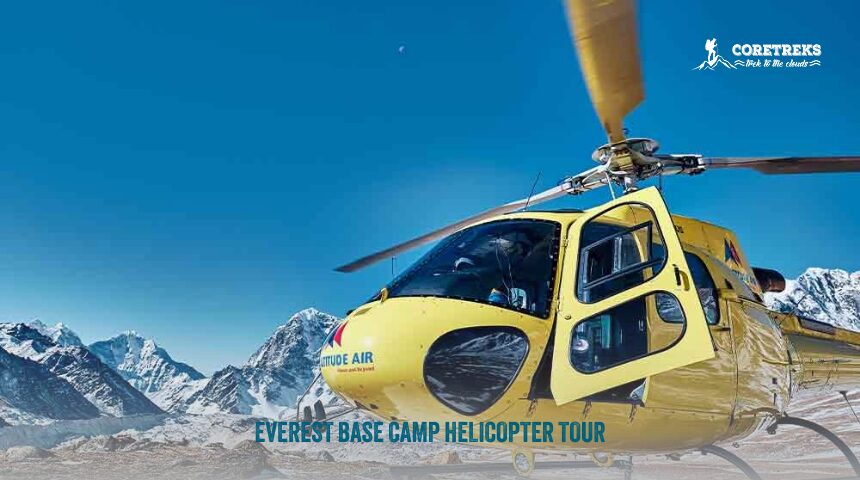
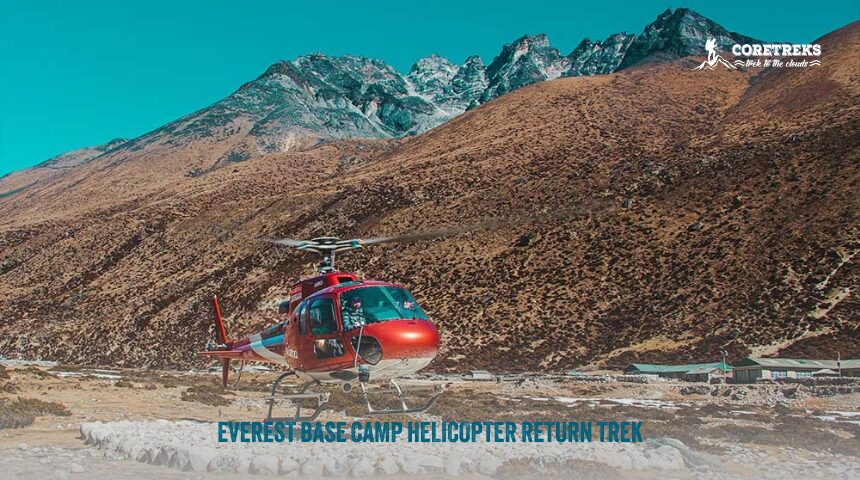
Can a helicopter fly to the top of Mount Everest, or is it just a myth? It is a question many wonder about. You might have seen dramatic rescue scenes and Hollywood-style summit touchdowns. These have further inspired the myths that helicopters can reach the top of the giants. However, the reality is not what is shown in the big pictures. Helicopters cannot land on the true summit of Everest at an altitude of 8.848.86 m (29,031.7 ft). Still, it does not mean the Everest skies are off-limits.
While it may not be possible to land at the top of the world’s highest mountain, you can still take Everest Base Camp Helicopter Tours that take you close to it. The helicopter flies very close to the massive mountain, over glaciers, crevasses, ridges, and colossal ice walls. It is one of the most adventurous and scenic flights, with a cinematic feel. Now it might make you wonder, if the helicopter can fly to remarkable heights and in thin air, what can it not land at the summit?
We are here to explain this in detail. In this blog, we will explain everything about helicopter flights to Everest and why they cannot land at its summit. So make sure you read until the end!
Table of Contents
Why flying to Everest is more than just a trip?
It is a dream for many to fly to Everest. The flight is not just a thrilling journey but also an emotional and sensory experience. The heart-throbbing feeling begins as soon as the aircraft’s rotor starts. It takes off and hovers over the scenic landscapes of Nepal. The scenery changes as you move deeper into and above the Khumbu region. Similarly, the cold Himalayan air presses against the windows. You will fly over lush forests of rhododendrons, oaks, firs, and bamboo. Then, you will fly over alpine meadows, streams, waterfalls, glacier fields, and the glistening Khumbu Icefall. From the window of your aircraft, you can see the maze of deep crevasses, towering icefalls, and raw, icy formations. The view is unique and cannot be seen from the ground.
In addition to the cinematic aerial view, the flight to Everest reveals to you a completely different world. The trip feels deeper, spiritual, and more intimate. The helicopter also passes over beautiful Sherpa villages such as Namche Bazaar, Tengboche, Dingboche, and more. You can see small, colorful houses clustered together, with small fields around them. Likewise, you can see ancient monasteries such as Tengboche, Pangboche, and Thame stand out for their red-and-gold roofs. They stand out against the deep green of the forests and icy white of the mountains. You can also see suspension bridges, colorful prayer flags, tiny mani walls, and stupas, which add a spiritual touch even from high above.
Witnessing Everest from the sky makes it feel alive, grander, and powerful. Trekking on the classic trail remains the authentic way to experience the beauty of the Himalayas, but helicopter flights have made it more convenient for travelers to enjoy it. Even those with physical challenges can now experience the beauty and power of Everest. The helicopter flight to Everest takes only a few hours, so it is suitable for anyone with limited time. Thus, flying close to the world’s highest mountain is not just a trip, but an extraordinary and unforgettable adventure that will stay with you for a lifetime.
How high can Helicopters really go on Everest?
Helicopters can fly up to 7,000 to 8,000 m (23,000 to 26,000 ft) in the Everest region, depending on the model and weather. However, landing at the summit of Everest is not possible for standard helicopters. Only specialized high-altitude aircraft, like the Airbus H125 (formerly AS350 B3), have managed to land just below the summit for a limited time and under ideal conditions.
Standard helicopters can fly at high altitudes. However, as the elevation increases, the thin air makes it increasingly challenging. There have been some extraordinary moments in the history of the Everest helicopter landing. On 14 May 2005, the AS350 B3 model aircraft set a world record by briefly landing on the summit of Mount Everest under perfect, controlled conditions. It was a rare exception and not possible every day. In normal operation, the helicopter can fly up to 5,500-6,000 m comfortably. The altitude range is ideal for enjoying spectacular aerial views and is within safe performance limits.
There is also a huge difference between how high the helicopter can fly and how high it can land safely. It is easier for an aircraft to fly when it remains in motion. Landing it on high altitude is a different story. A helicopter must hover steadily, maintain stable lift, and have sufficient power to take off again. On Everest’s summit at 8.848.86 m, the air is too thin, and even small mistakes can be fatal. Different helicopter models react to the environment differently. In Nepal, the AS350 B3 (now Airbus H125), AS350 FX II, and Bell 407 and its variants are the standard models used in the Everest region. The AS350 B3 stands out from other models for it is designed to fly at high altitude and has powerful capabilities.
The Everest Helicopter Tours often take place in the early morning. It is because colder air is slightly denser, providing the helicopter with extra lift. Additionally, the Himalayan weather is more stable, fresh, and calm. The payload, i.e., passenger and cargo weight, is also carefully reduced at higher elevations. The weight limit for the Everest Base Camp (EBC) Helicopter Tour is around 500 kg from Kathmandu to Lukla. It is then reduced to 240-250 kg for the shuttle flight to Everest Base Camp or Kala Patthar due to the high altitude. It is also the reason why high-altitude rescues often fly with minimal gear to keep the aircraft as light and responsive as possible.
The high altitude, thin air, drop in oxygen levels, and rapidly shifting weather are some of the major reasons why a helicopter can’t fly to the top of Everest. The pilots explain that although the aircraft’s blades spin, the air does not provide enough resistance to keep it steady. They also talk about the rapidly changing microclimate of the Himalayas that adds to the challenge. Phenomena such as “ghost winds” that strike suddenly near the Death Zone can shift the helicopter’s balance. It is a serious technical challenge to even hover for a few seconds under such conditions.
As mentioned before, flying and landing on the Everest’s summit are entirely different. There is a real risk when it comes to landing at the summit. The unpredictable weather creates pockets of turbulence that can toss the aircraft. A slight miscalculation can make landing impossible. These are also the reasons why the helicopters land at safe spots, such as Kala Patthar or Everest Base Camp. Here are all the reasons for an aircraft not to fly to the top of Everest:
Air so thin it Challenges every Rotor and Engine
The higher the helicopter climbs into the Himalayas, the air starts to disappear. Even routine actions become more challenging. It is like trying to lift a heavy backpack at sea level versus at the top of a mountain. You will find it more difficult, and your muscles will have to work harder due to a low oxygen level. The helicopter rotor works the same way and faces the same struggle. Due to thinner air, the aircraft’s engines lose power, and the lower air density reduces lift.
Helicopter engines require oxygen to produce power, and rotors require dense air to create lift. The lack of oxygen causes the aircraft to lose power and responsiveness. The air density drops significantly from Lukla at 2,860 m to Everest Base Camp at 5,364 m.It drops even further as the helicopter pushes deeper into the Death Zone above 8,000 m. When the aircraft reaches near the summit, there is barely enough air for the blades to push against. As a result, the flight becomes difficult and unstable. While flying, every meter matters, and even small changes in altitude can significantly affect the aircraft’s performance.
Everest storms that can stop any flight in its tracks
The Everest has its own weather. Its microclimate is notorious for changing at an unsettling speed. The warm air rising from the valleys collides with the cold air flowing down from the upper slopes. This collision builds clouds and snow squalls within minutes. It also creates ghost winds. They are unpredictable and invisible air currents that can hit helicopters suddenly and make them unstable. Clouds, snow, and strong winds can appear out of nowhere, reducing visibility. It makes it harder for pilots to see the landing spot or even trap the aircraft midair.
To avoid weather-related issues, most Everest Helicopter flights are scheduled in the morning. At this time, the microclimates are less extreme, and visibility is better. The ghost winds are also least active. As the day progresses, the weather becomes increasingly unstable. By midday, cloud towers can rise, snow flurries sweep across ridges, and vertical air currents make flying dangerous. Every experienced pilot knows the timing and follows it respectfully. It makes the flight smoother and helps avoid being stopped in its tracks.
Rugged Mountains make landing nearly impossible
The summit of Mount Everest is not a wide, flat area where helicopters can land smoothly, as in the movies. It is, in fact, a narrow, knife-edge ridge that is mostly covered in fragile snow. The snow can collapse easily under its own weight. Therefore, there is no stable surface for the aircraft to land. Even a slight error or misalignment can bring disaster. For example, if the helicopter hovers too low, the rotor blade can get dangerously close to the exposed rock or hard ice. At its height, it requires precise control to remain stable.
The turbulent air and sudden wind gusts swirl around the cliffs and ridgelines of the Everest. These can push the helicopter in a different direction, throwing off its balance. The thin air reduces the response time to the pilot’s control inputs. Additionally, pilots may also struggle with a lack of clear visuals. The snowy landscape blurs everything into white and shadow. So, it makes it harder for pilots to judge depth and distance. Under such circumstances, holding a steady hover itself becomes a battle. So what might look like a simple landing is extremely dangerous.
Limited fuel and weight rules restrict high-altitude Flights
There is a reason for the limited fuel and weight restrictions on high-altitude flights. There is a strict “light and fast” rule in Himalayan aviation because at high elevation, every kilogram counts. The regular helicopters flying near Everest most often carry just the pilot and minimal fuel. There is little room for passengers, cargo, and equipment. If there is too much weight, the aircraft’s rotor cannot generate enough lift and hover in the thin air. A little weight or an extra liter of fuel can turn a safe ascent into a dangerous struggle.
Although the helicopter must operate on limited fuel, fuel consumption increases sharply in low-density air. It limits the hovering time and flight range. After the aircraft reaches its limit, it must either descend or return. Pilots must carefully plan the fuel, weight, and range of every kilogram and liter. It is an art of balancing thrill with physics. There is no place for even the slightest error, as it can compromise their safety or leave them stranded.
Pilot risks that make extreme Flights life threatening
We have discussed the challenges of weather, landscapes, and the limitations of the helicopter. There is one more reason why can’t a helicopter fly on top of Everest, and that is the human challenge. It’s not all about machines. Flying near Mount Everest is also a test of human endurance and decision-making skills under extreme stress. Moreover, they have to face extreme cold, oxygen deprivation, sudden weather shifts, and blurred vision. Every movement demands split-second decisions, with no room for error.
At extreme height, even a small sudden gust, turbulence, or microburst can turn the helicopter flight into a life-threatening situation. Radio communication can fail during the high valleys, isolating pilots. Their safety, as well as the passengers’, depends on their technical skills and split-second decisions. Therefore, it is extremely crucial for pilots to stay focused at all times. Experienced pilots also speak candidly about the risks, fears, and stress of flying near the towering giant. Operating an aircraft in these skies requires absolute concentration, humility, and endurance. It also requires pilots to respect the demands of the mountain.
Notable Helicopter Flights around Everest
High-altitude helicopters have improved accessibility, safety, and emergency response during Himalayan expeditions. Nepal Army Aviation plays a crucial role in rescue operations in the Everest and high-Himalayan regions. They are the last line of help in the mountains and often push operational limits while maintaining strict safety standards.
There have been a few notable helicopter flights around Mount Everest that stood out from the rest. The most monumental moment in aviation history was by French pilot Didier Delsalle. He flew the helicopter to the top of Everest and created a world record. It remains unmatched to date. In addition to record-setting stunts, helicopters have played a vital role in mountaineering logistics, from evacuating injured climbers to delivering supplies at higher camps. The helicopter service has also helped in scientific research in areas otherwise inaccessible.
From daring attempts to crash and recovery, here are some of the most notable events:
Most daring Helicopter attempts ever attempted
The most daring attempt and the only summit landing on Mount Everest occurred on 14 May 2005. French test pilot Didier Delsalle briefly landed an AS350 B3 on Everest’s summit under a strictly controlled experiment. To maximize the high-altitude performance, non-essential equipment and passenger seats were removed from the aircraft. There were no passengers, and the fuel was minimal. The flight timing was also perfect, with a cold morning and stable weather and wind.
Delsalle landed on the top of Everest and remained there for 3 minutes and 50 seconds. The helicopter hovered barely off its skids, with the engine running continuously. Then, it took off again without stopping. His achievement remains as the world record for the highest helicopter landing.
Although Didier Delsalle’s record remains unbroken, Nepalese pilots conduct high-altitude rescue missions, many above 6,500-7,000 m. These flights are more practical and often performed to provide immediate rescues. They extract injured climbers from Camp II or Western Cwm, conduct search-and-rescue operations, manage transport and supply logistics, and more. Pilots face one-shot decisions with no room for error. The Nepal Army and civilian rescue teams often conduct helicopter operations on Everest. Their missions may not be record-breaking, but they have helped to save lives and reshape high-altitude aviation.
Crash and Recovery that turns Failures into Wins
There have been a few Everest helicopter crashes over the years, despite strict protocols and experienced pilots at the controls. As you know by now, the mountain can be deadly and unpredictable. Some devastating crash incidents in the Everest region were:
2010 Fishtail Air Crash in the Solukhumbu
The 2023 Manang Air Crash, where a sightseeing Everest helicopter tour crashed and killed all six people on board.
The 2025 Rescue Mission Crash, where a rescue helicopter crashed near Everest Base Camp. Luckily, the pilot survived despite the aircraft being badly damaged.
The incidents occurred for various reasons, including hard landings, weather-related mishaps, and mechanical strain. All the mishaps were thoroughly studied. They were hard lessons that showed the hard reality of flying near Mount Everest. Each incident has led to further improvements in rigorous pilot training, more accurate weather forecasting, upgrades to aircraft components, and more structured operational procedures. These changes have reshaped Himalayan aviation. Additionally, Nepal’s aviation search-and-rescue teams have evolved through real-world experience. Today’s Everest flights are safer and more successful because past failures were studied, respected, and turned into successful progress.
Stories from Pilots who flew near Everest
There are many stories from both Nepalese and international pilots who flew near Everest. All of them speak about a mix of exhilaration and emotion. Many talk about the beauty of the Khumbu landscapes, Sherpa villages, and the sheer size of the mountain. Then, others speak of the dangers that are seen and some that appear without warning. Their stories tell of adventure, skills, and deep respect for the Everest. It is not only about human courage, but also about skills and aviation technology.
Among the many stories of the pilots who have flown close to Everest, Maurizio Folini’s record-setting high altitude rescue flight is a notable one. On 21 May 2013, Folini executed the highest helicopter rescue on Everest. He flew a Eurocopter AS350 B3 and evacuated an injured climber from an altitude of about 7,800 m, near the South Col or the Yellow Band area. Folini has flown numerous missions in Nepal’s Himalayas since around 2011. He is also credited with improving the modern high-altitude rescue protocols. Maurizio Folini has described his high-altitude rescue flights to Everest as a mentally heavier experience than being technically dramatic. He explains that during his record-setting rescue, his dominant feeling was absolute focus instead of excitement. At those heights, there was no room for confidence or heroics, but only discipline. Folini also describes that emotionally, the rescue felt like a strong sense of responsibility rather than fear.
Trekking vs Helicopter, Which Everest experience suits you?
It depends on the type of experience you want. Other factors, such as your fitness level, time, and budget, also influence the decision.
If you want a more immersive and authentic Everest experience, Everest Base Camp Trek is the best option. Although it takes longer, each day brings you closer to the mountain. Trekking allows you to traverse beautiful Sherpa villages, acclimate gradually to altitude, and experience the local culture. You can see the fluttering prayer flags, cross thrilling suspension bridges, visit ancient monasteries, and enjoy the mountain views from viewpoints. The journey is challenging but very rewarding. It is perfect for adventure seekers and trek enthusiasts.
Everest Helicopter flights are for those who do not want to undertake a long, physically demanding trek and are considered the fastest way to reach Everest Base Camp. It is suitable for those with limited time or who have physical constraints. The helicopter flight offers a unique and stunning aerial view of the surrounding mountains and the Khumbu landscape. You will see views not possible during trekking. Within a few hours, you will fly close to Everest and return. The flight also offers great opportunities for aerial photographs.
Here is a complete comparison between the Everest trekking vs the helicopter:
Feature/ Aspect
Trekking to Everest Base Camp (EBC)
Helicopter Ride to Everest Base Camp
Duration
12-14 days (round trip)
3-5 hours (total)
Physical Demand
Highly demanding
Very low
Cost
Moderate or budget-friendly
High
Scenic Experience
Gradual, immersive, and ground-level
Mind-blowing aerial views
Acclimatization
Gradual, slow, and safe
Limited (exposure to high altitude only for a short time)
Cultural Interaction
High (you will trek past villages and monasteries and stay at local teahouses)
Minimal
Adventure Factor
High sense of achievement
Low physical effort but high thrill
Environmental Impact
Lower
Higher (aviation footprint)
Best For
Adventure seekers, trekkers, and cultural travelers
Luxury travelers, families, seniors, and limited-time visitors
For those who want to experience authentic Everest trekking and mountain flight, they can take the Everest Base Camp Trek with a Helicopter return. You will trek to the Everest Base Camp and fly back to Kathmandu via helicopter.
I recently had the chance to cross something huge off my bucket list, a helicopter tour to Everest Base Camp. It was honestly an incredible experience, bringing so much joy from start to finish. The views were unreal, and I couldn’t believe how close I got to the world’s highest peak. From Kalapathar Hill, the panoramic views of Everest and the surrounding mountains were just breathtaking. It felt like the perfect spot to take in the beauty of it all.
I’m so grateful to CoreTreks Nepal for making this happen. The guides were fantastic—knowledgeable, friendly, and always making sure we were comfortable and enjoying ourselves every step of the way.
I recently had the chance to cross something huge off my bucket list, a helicopter tour to Everest Base Camp. It was honestly an incredible experience, bringing so much joy from start to finish. The views were unreal, and I couldn’t believe how close I got to the world’s highest peak. From Kalapathar Hill, the panoramic views of Everest and the surrounding mountains were just breathtaking. It felt like the perfect spot to take in the beauty of it all.
I’m so grateful to CoreTreks Nepal for making this happen. The guides were fantastic—knowledgeable, friendly, and always making sure we were comfortable and enjoying ourselves every step of the way.
While some people may enjoy the long trek to Everest Base Camp, I found a different and perfect way to experience it. Choosing the incredible Everest Base Camp helicopter tour, we had an unforgettable adventure and loved every moment of the journey. Along with the stunning views of Mount Everest, our stop at the Everest View Hotel was a refreshing break, offering beautiful views of both Everest and the impressive Ama Dablam peak. A big thank you to CoreTreks for organizing this amazing and thrilling helicopter tour.
While some people may enjoy the long trek to Everest Base Camp, I found a different and perfect way to experience it. Choosing the incredible Everest Base Camp helicopter tour, we had an unforgettable adventure and loved every moment of the journey. Along with the stunning views of Mount Everest, our stop at the Everest View Hotel was a refreshing break, offering beautiful views of both Everest and the impressive Ama Dablam peak. A big thank you to CoreTreks for organizing this amazing and thrilling helicopter tour.
I never thought I’d get the chance to see Mt. Everest up close, but CoreTreks Nepal made it happen with their amazing helicopter tour.
The trip was unforgettable and gave me memories I’ll always hold close. I’m really thankful to CoreTreks Nepal for putting together such a beautiful experience.
I never thought I’d get the chance to see Mt. Everest up close, but CoreTreks Nepal made it happen with their amazing helicopter tour.
The trip was unforgettable and gave me memories I’ll always hold close. I’m really thankful to CoreTreks Nepal for putting together such a beautiful experience.
It was truly amazing to be surrounded by the majestic Himalayan peaks as our helicopter smoothly landed on a stunning Helipad. The landing spot offered an incredible view of the towering Mt. Everest and the nearby snow-covered mountains. Our excitement grew as we began the unforgettable Everest base camp helicopter tour. This adventure became the highlight of my entire holiday, offering a breathtaking perspective of the magnificent Himalayan peaks, with Mt. Everest standing tall in front of us. It was an experience I’ll never forget, and I’m deeply thankful to CoreTreks for making this extraordinary helicopter journey possible.
It was truly amazing to be surrounded by the majestic Himalayan peaks as our helicopter smoothly landed on a stunning Helipad. The landing spot offered an incredible view of the towering Mt. Everest and the nearby snow-covered mountains. Our excitement grew as we began the unforgettable Everest base camp helicopter tour. This adventure became the highlight of my entire holiday, offering a breathtaking perspective of the magnificent Himalayan peaks, with Mt. Everest standing tall in front of us. It was an experience I’ll never forget, and I’m deeply thankful to CoreTreks for making this extraordinary helicopter journey possible.
I had the incredible chance to take a helicopter ride to Everest Base Camp, and it’s an experience I’ll never forget. The helicopter landed smoothly on a beautiful helipad, surrounded by the stunning Himalayan peaks. Getting such a close-up view of Mount Everest and the snow-covered mountains was simply breathtaking.
I’m so thankful to CoreTreks for making this amazing trip happen. The views were unforgettable, and the whole experience will stay with me forever. If you’re looking for a unique and awe-inspiring way to see the Himalayas, I highly recommend this tour. It’s definitely worth it and will leave you in complete awe.
I had the incredible chance to take a helicopter ride to Everest Base Camp, and it’s an experience I’ll never forget. The helicopter landed smoothly on a beautiful helipad, surrounded by the stunning Himalayan peaks. Getting such a close-up view of Mount Everest and the snow-covered mountains was simply breathtaking.
I’m so thankful to CoreTreks for making this amazing trip happen. The views were unforgettable, and the whole experience will stay with me forever. If you’re looking for a unique and awe-inspiring way to see the Himalayas, I highly recommend this tour. It’s definitely worth it and will leave you in complete awe.
The Everest helicopter tour turned out to be a really exciting trip. The views of the Himalayas and Everest Base Camp from the air were amazing we were completely in awe.
Our guides were friendly and shared lots of helpful info, which made the whole experience feel safe and fun. Landing at Kala Patthar was a big highlight. Being there in the middle of the mountains was something I’ll never forget.
Thanks to CoreTreks for planning this special trip. I recommend it to anyone who loves nature and a bit of adventure.
The Everest helicopter tour turned out to be a really exciting trip. The views of the Himalayas and Everest Base Camp from the air were amazing we were completely in awe.
Our guides were friendly and shared lots of helpful info, which made the whole experience feel safe and fun. Landing at Kala Patthar was a big highlight. Being there in the middle of the mountains was something I’ll never forget.
Thanks to CoreTreks for planning this special trip. I recommend it to anyone who loves nature and a bit of adventure.
Amelia Clarke
Belgium
Everest Helicopter Trip costs and what to expect
The Everest Helicopter Trip costs range from USD 1,250 to USD 1,500 per person for a shared flight and USD 4,500 and more for a private charter.
Shared group flights are generally more cost-effective for solo travelers. However, it has a fixed departure schedule, and you will have to share the flight with other travelers. Private charter is more flexible and customizable, but more expensive. It is ideal for families, luxury travel, or celebrating birthdays and anniversaries. Government-registered trek agencies and operators operate the helicopter tour packages. Hence, they have experienced pilots, well-maintained aircraft, and onboard oxygen support.
Whether you are in a shared helicopter flight or a private charter, you can expect a thrilling and scenic flying adventure. Almost all tours begin in the morning, when visibility is best, and the wind is calmer. You will make strategic stops in Lukla and, occasionally, in Pheriche for refueling. Because hovering time is strictly limited, landing at the Everest viewpoints is brief. You will get to see spectacular aerial views of the Khumbu landscapes, Khumbu Icefall, glaciers, and sweeping panoramas of the Himalayas. The moment you see the scenery, you will be overwhelmed with mixed emotions of awe and happiness. It may be a short journey, but the memory will stay with you for a lifetime.
Fly close to the roof of the world
We hope this blog has debunked the myth of a helicopter flying to the top of Mount Everest. To land on Everest is not as easy as it is portrayed in the movies. At a height of 8.848.86 m, flying the aircraft itself is a challenge. Moreover, landing on the fragile snow and jagged ridges of the summit is extremely dangerous. It is technically possible, but not practical or safe for routine use. Hence, helicopter flights to Everest are conducted only for rescue and logistics support, rather than for dramatic summit landings.
Helicopter Ride
In aviation history to date, the feat was achieved only by Didier Delsalle under controlled conditions. Although you cannot fly to Everest, you can take helicopter tours that take you close to the mountain at safe spots. The Everest Helicopter Tours are safe and operated by professionals. It allows you to witness the beauty of the world’s highest mountain, its towering ridgelines, glaciers, and icefall from a perspective not possible by trekking. If you also want to fly near Mount Everest, contact us directly at CoreTreks!
Mr. Regmi has been a certified climbing instructor for 11 years instructor (licensed by Ministry of Culture, Tourism and Civil Aviation, Nepal) and is one of the most experienced trekking guides. He spent his childhood in Solukhumbu among the mountains. He joined CoreTreks in the year 2015 and has been guiding trekkers up the trails of Everest Region. With his local expertise and discipline for safety and precautions, he is one person you can always trust while trekking in the Himalayas.
The Himalayans regions have no clear marking but with Mr. Regmi you are always in good hands. He knows the ins and outs of the historic sites in the region that helps in trekking through the trails of Himalayas. Everest Base Camp Trek, Annapurna Circuit Trek, Manaslu Circuit Trek are some of his regular routes. He also has a knack of keeping trekkers hooked with his conversation by sharing his trekking stories and some amusing facts about the Himalayas.
Related Blogs
Boudhanath Stupa
Boudhanath Stupa is one of the most sacred Buddhist sites in the world. It is a religious site and a cultural hub for pilgrims, especially Tibetan Buddhists. Similarly, it is one of Nepal's largest, 36-meter-high, and 100-meter-wide stupas in the capital city of Kathmandu. The stupa is located just 7 km northeast of central Kathmandu,…
The Everest Base Camp Trek in February is a one-of-a-kind experience that trek enthusiasts must take once. Contrary to many trekkers who believe winter months are unsuitable for Himalayan ventures, trekking in February is doable. It is just the time when the cold winter slowly transitions into the warm spring season. Therefore, trekking on the…
Many of you might be curious about the Manaslu Circuit Trek after earthquake in Nepal and whether it is safe for trekking. Fortunately, yes. The trail that was heavily damaged by the 2015 Nepal earthquake has re-opened. So what are the conditions of the trails, accommodation availability, and risks of Manaslu Circuit Trek after the…
This site uses cookies to optimize your user experience. By using this site, you are consenting to our use of these cookies. Check out our Privacy Policy.