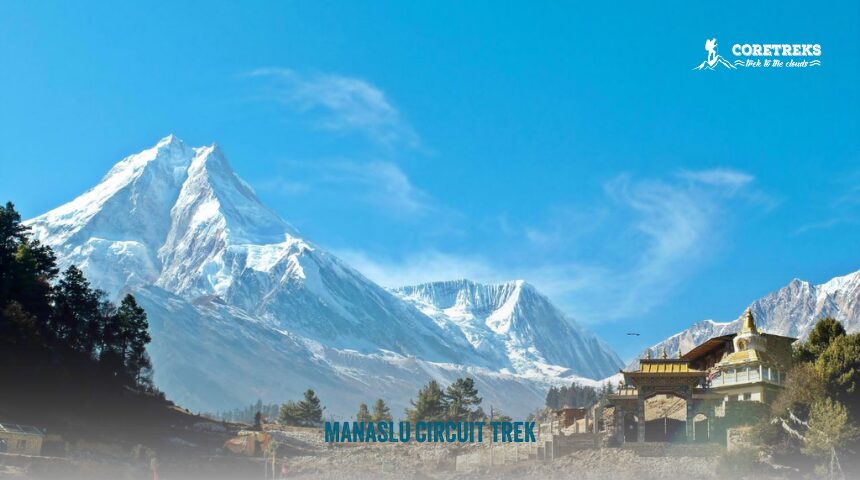
Ever wondered how far and high the legendary Manaslu Circuit Trek really goes? Covering the total distance of 177 kilometers (110 miles), the journey begins from Machha Khola at 870 meters. The trail gradually begins to gain elevation from here onwards, reaching the staggering height of 5,160 m above sea level at Larke La Pass. The dramatic Manaslu elevation changes on the trek are also reflected by the striking transition of landscapes along the route. You will go from dense groves of rhododendrons and terraced fields to alpine meadows and mountain glaciers.
Each step takes you closer to the snow-capped mountain peaks. The standard Manaslu Circuit Trek itinerary spans from 14 to 15 days. Thus, you will gradually gain elevation and take acclimatization stops at a village like Samagaun. It gives your body adequate time to adjust to the high elevation and minimize the risk of altitude sickness. Similarly, the remote trek also takes you to Nepal’s restricted trekking areas. These areas fall in the high altitude, marked by the barren and semi-arid landscapes.
With the Manaslu Circuit Trek altitude gain, you will also experience a cultural shift. You will pass through traditional Gurung villages in the lower regions, and trek past Tibetan settlements at higher altitude areas. By understanding the Manaslu Circuit Trek elevation profile, you can best prepare for the raw Himalayan adventure, physically and mentally. It helps you understand the challenges and enjoy the real adventure fully. Let’s look at the full details of the Manaslu Circuit Trek distance, elevation, and what you can expect!
Table of Contents
Manaslu Circuit Trek Distance and Elevation Gain
By knowing the total distance and daily altitude gain, you can plan your itinerary more effectively. Similarly, you can strategically place acclimatization days. It also helps you to train properly and build resilience for the daily challenges. This way, you will have adequate information and awareness, so that nothing catches you off guard during the trek.
To provide you with clear details on the Manaslu trek daily distance and trek altitude gain, here is a day-to-day breakdown of our Core Treks’ 15 Days Manaslu Circuit Trek itinerary:
Day
Route
Distance (km)
Elevation Gain/Loss (m)
Notes
1
Arrival in Kathmandu (1,350 m)
–
–
–
2
Kathmandu Sightseeing Tour (1,350 m)
–
–
Visit UNESCO Heritage Sites
3
Kathmandu to Machha Khola (870 m) by drive
160 km
-480 m
8-9 hrs by bus
4
Machha Khola to Jagat (1,340 m)
15 km
+470 m
6 hrs
5
Jagat to Deng (1,625 m)
12-13 km
+285 m
6 hrs
6
Deng to Namrung (2,630 m)
19 km
+1,005 m
6-7 hrs
7
Namrung to Lho (3,180 m)
11-12 km
+550 m
4-5 hrs
8
Lho to Sama Gaun (3,530 m)
7 km
+350 m
3 hrs
9
Acclimatization at Sama Gaun (3,530 m)
–
–
Option for side hikes
10
Sama Gaun to Samdo (3,865 m)
8 km
+335 m
3 hrs
11
Samdo to Dharmasala (4,460 m)
6.5 km
+595 m
4 hrs
12
Dharmasala to Bhimthang (3,590 m) via Larke La Pass (5,160 m)
16 km
+700 m/ -1,570 m
8 hrs
13
Bhimthang to Tilije (2,300 m)
13 km
-1,290 m
7 hrs
14
Drive to Kathmandu via Besisahar
190 km
-950 m
8-9 hrs by bus
15
Departure
–
–
How Difficult is Manaslu Circuit Trek?
The Manaslu Circuit Trek adventure is a high-altitude and challenging trek. It requires both reasonable fitness and mental endurance. The trek encircles Mount Manaslu, the world’s eighth-highest mountain. Similarly, it takes 10 to 12 days to complete the journey, during which you must trek for 6 to 8 hours per day. You will hike on rough and rocky terrains while overcoming steep and narrow sections along the way. En route, you must also overcome numerous suspension bridges over gushing rivers. You must also navigate past landslide-prone areas. However, the trails are well-established for a safe trek experience. The rustic teahouses along the route also provide comfortable shelter for overnight rest and recovery.
In addition to the long distance and diverse terrain, the Manaslu trek altitude gain makes the journey more demanding. You will start from 870 m at Machha Khola and ascend to the high mountain pass of Larke La Pass at 5,160 m. Luckily, there is no need for technical climbing skills. But ascending to high elevations puts physical strain on the body. There is also a high risk of altitude sickness. It requires proper acclimatization and steady pacing to conquer the pass. The unpredictable weather and high afternoon wind further add to the trek’s difficulty. It requires reasonable strength, stamina, and endurance to conquer the Manaslu Circuit Trek daily distance and elevation. You must make physical and mental preparation for this true Himalayan adventure that will test trekkers to their limits. You can also take Tsum Valley Trek with Manaslu Circuit Trek for even more heart-throbbing and enriching trekking experience.
As mentioned before, there is a striking transition in landscapes and scenery as you move from a lower to a higher altitude region. You will go from lush subtropical forests and winding river valleys to alpine zones. There is also a unique blend of Tibetan-influenced culture that you can experience with altitude gain on the trek. As you navigate through the rugged terrain, you will cross suspension bridges, pass by ancient Buddhist monasteries, prayer flags, chortens, and stupas.
Similarly, you will also discover traditional settlements that are untouched by mass tourism. These age-old and traditional villages have their special atmosphere. You will get to witness bustling local life in the serene mountain solitude. During the trek, you will stop at numerous villages. Each stop offers a glimpse of the rich culture and tradition of the Manaslu region that makes the journey unforgettable. Take a look at the major stops along the Manaslu trail:
Samagaun at 3,530m
Samagaun
The beautiful village of Samagaun sits at an altitude of 3,530 m. It is at a perfect spot for acclimatization before ascending to higher elevations. There is a huge influence of Tibetan Buddhism. You can see traditional stone houses with wooden balconies and stunning views of Mount Manaslu and other surrounding Himalayan peaks. Similarly, you can see prayer flags fluttering in the mountain breeze and age-old mani walls. While acclimatizing at Samagaun, you can soak in the local culture while interacting with the friendly villagers. You can also visit monasteries nearby. The peaceful atmosphere of the villages allows you to connect to the mountain environment.
Short Hike to Birendra Lake
Birendra Lake
A stunning Birendra Lake at an elevation of 3,450 m lies in close hiking distance from Samagaun. It is a 30 to 45-minute hike and one of the major stops along the Manaslu Circuit Trekking route. Birendra Tal is a stunning glacial lake that originates from Manaslu Glacier. The turquoise still water reflects the surrounding snow-capped peaks and pine forests. The calm surroundings and lovely views make it a great place to stop and relax. It also allows you to appreciate nature’s calmness after a day of trekking. The short hike to the pristine glacial lake and fresh alpine air will rejuvenate you for the journey ahead.
Optional Altitude Challenge of Manaslu Base Camp above 4,800 m
The next major but optional stop along the Manaslu Circuit Trekking trail is Manaslu Base Camp. Sitting at an altitude above 4,800 m, the hike to the base camp is strenuous and ideal for adventurers. The steep and demanding hike to the Manaslu Base Camp from Samagaun takes 6 to 8 hours for a round trip. Surrounded by rocky hills and untouched high mountain scenery, you can enjoy wide views of Manaslu and other tall peaks. The base camp is an incredible spot that offers a powerful sense of accomplishment. You will also be able to connect with the raw energy from the towering peaks.
Final Acclimatization Stop at Samdo (3,875 m)
Samdo Village
Many Manaslu Circuit Trek itineraries include a final acclimatization stop at Samdo. It is a small traditional Tibetan-style village at an altitude of 3,875 m. Similarly, it is also rich in cultural heritage and offers stunning mountain vistas. You can make a strategic acclimatization stop at Samdo before crossing the high mountain pass of Larke La. Samdo also offers many cozy teahouses with friendly locals. Expect to receive warm hospitality during your stay. You can take the acclimatization stop to adapt to the Manaslu trek altitude gain and explore the village. The vibrant prayer flags, mani walls, and peaceful setting of Samdo prepare you for the journey ahead.
How Manaslu Circuit Trek Demands Smart Acclimatization
It is common for trekkers to experience altitude sickness during high-altitude treks, including the Manaslu Circuit Trek. The higher you go, the lower the oxygen level in the atmosphere. As a result, the human body struggles to adapt to the elevation, and it becomes harder to breathe. This is known as Acute Mountain Sickness (AMS). It is the mildest form and in some cases can progress into severe conditions known as High-Altitude Pulmonary Edema (HAPE) and High-Altitude Cerebral Edema (HACE). So, it is crucial to recognize the symptoms early for precaution and prevention. The common symptoms include:
Headache
Nausea or vomiting
Loss of appetite
Dizziness
Fatigue or weakness
Shortness of breath
Confusion or poor coordination
The best way to deal with the risk is to acclimate. It allows your body to adjust to the changing elevation, temperature, and surroundings. The most popular acclimatization stop along the Manaslu Circuit Trek route is Samagaun at 3,530 m. It is at an ideal altitude for acclimatization, i.e., not too high nor too low. This strategic location allows your body to adapt to the decreasing level of oxygen and the steep climb to Larke La Pass.
Similarly, you should keep a modest pace without rapid ascension. It is also crucial to follow the “Climb high, sleep low” principle. During the day, you can ascend to a higher region but descend to a slightly lower altitude to sleep at nighttime. Keeping your body hydrated throughout the journey also minimizes the altitude-related risk. Medications like acetazolamide can also ease the symptoms. Hiring a trained guide and porter also provides peace of mind. They can quickly recognize the symptoms and take necessary actions. While on the Manaslu Circuit Trek adventure, keep a positive mindset, but if you feel any discomfort, let your guide and porter know immediately.
Best Seasons for Manaslu’s Elevation Profile
Spring (March to May) and Autumn (September to November) are the best seasons for the Manaslu Circuit Trek. These seasons have the most favorable and stable weather conditions. Additionally, the temperature is mild, the skies are clear, and the mountain views are stunning. You can get the best views of Mount Manaslu and other surrounding peaks. The trails are also in good condition and dry. Hence, the stable weather and comfortable daytime temperatures make the trek less strenuous and stressful. The lower physical stress means your body will have more energy to adapt to the lower oxygen level. You can also maintain your steady pace and acclimatization schedule without worrying about sudden weather changes.
It is possible to do the Manaslu Circuit Trek in summer (June to August) and winter (December to February). However, the weather and climatic conditions are unstable during these times. The summer season collides with monsoon, so there is heavy rainfall in the hilly regions of the country. The trails are muddy, views are often clouded, and there is a high risk of landslides. On the other hand, extreme cold and snowfall at higher elevations in winter make the trek more challenging. The unstable weather and unfavorable temperature cause more stress. It results in your body using more energy to adjust to the cold or hot temperature. This can cause physical exertion, and trekkers are more exposed to the risk of altitude sickness. Therefore, it is highly advised that you choose spring and autumn for the Manaslu trek while also understanding its elevation profile.
Distance Management on Long Himalayan Days
Managing distance on long Himalayan trekking days like the Manaslu Circuit Trek is essential for a comfortable trekking experience. The average 6 to 8 hours of trekking is not for the faint of heart. In addition to the Manaslu trek daily distance, the high altitude gain makes the journey physically demanding. Planning the daily distance and steady pacing is the key to enjoying the journey without exhaustion or injury. Here are some important tips for managing long-distance trekking effectively:
Start early to avoid afternoon fatigue and to enjoy cooler temperatures.
Take regular short breaks every hour to rest and hydrate.
Instead of rushing, keep a steady and comfortable pace throughout the trek.
Hydrate yourself frequently and drink plenty of water to avoid altitude-related sickness.
Adjust your stride to match the terrain, such as taking shorter steps on steep climbs and a steady pace on flat pathways.
Use trekking poles to reduce strain on knees, especially during descent.
During short breaks, stretch occasionally to reduce muscle stiffness.
Eat high-energy snacks like nuts, energy bars, or dried fruits to keep yourself energized throughout the journey.
Understand the elevation gain, especially above 3,000 m, to avoid physical exertion and altitude sickness.
Wear comfortable and broken-in shoes to avoid discomfort and blisters.
Our Manaslu Circuit trek was a real adventure. Nim, our guide, and the porters helped us every step of the way. We visited small villages and stayed with local families, which gave us a closer look at Nepali culture.
Thakur made sure we felt safe and relaxed throughout the trip. Sai handled our emails and helped us plan everything, even after the trek. The whole team was professional and cared about our experience.
We truly recommend CoreTreks to anyone who wants a cultural and unforgettable journey through the beautiful parts of Nepal.
Our Manaslu Circuit trek was a real adventure. Nim, our guide, and the porters helped us every step of the way. We visited small villages and stayed with local families, which gave us a closer look at Nepali culture.
Thakur made sure we felt safe and relaxed throughout the trip. Sai handled our emails and helped us plan everything, even after the trek. The whole team was professional and cared about our experience.
We truly recommend CoreTreks to anyone who wants a cultural and unforgettable journey through the beautiful parts of Nepal.
Our trek through Tsum Valley and the Manaslu Circuit was an amazing journey. We had a lot of fun hiking the trails and felt lucky to explore such a remote and peaceful part of the Himalayas.
We also visited old monasteries, chortens, and gompas it added something really special to the trip. As someone who treks often, I didn’t find it too hard, and I enjoyed every bit.
Thanks to CoreTreks for guiding us and sharing details about every place we passed. I definitely recommend booking your Nepal trip with them.
Our trek through Tsum Valley and the Manaslu Circuit was an amazing journey. We had a lot of fun hiking the trails and felt lucky to explore such a remote and peaceful part of the Himalayas.
We also visited old monasteries, chortens, and gompas it added something really special to the trip. As someone who treks often, I didn’t find it too hard, and I enjoyed every bit.
Thanks to CoreTreks for guiding us and sharing details about every place we passed. I definitely recommend booking your Nepal trip with them.
I started the Manaslu Circuit trek with CoreTreks in October, and it turned into an amazing adventure. It was a tough trek, but also really rewarding and full of great moments.
Before the trip, CoreTreks made sure we were confident and ready. They handled every small detail so we didn’t have to worry. Our guide, Sai, had over ten years of experience and knew exactly how to manage anything that came up during the trek.
I’m already looking forward to visiting Nepal again, and I’ll definitely choose CoreTreks for my next trip too.
I started the Manaslu Circuit trek with CoreTreks in October, and it turned into an amazing adventure. It was a tough trek, but also really rewarding and full of great moments.
Before the trip, CoreTreks made sure we were confident and ready. They handled every small detail so we didn’t have to worry. Our guide, Sai, had over ten years of experience and knew exactly how to manage anything that came up during the trek.
I’m already looking forward to visiting Nepal again, and I’ll definitely choose CoreTreks for my next trip too.
Matthew
United Kingdom
Staying Safe on the Manaslu Circuit Trek
Although the Manaslu Circuit trekking trail is well-maintained and safe, trekkers must follow proper safety precautions. Common challenges like altitude sickness, slips, and unpredictable weather can be managed by following proper safety tips. You need to carry the right gear, check the weather forecast, and respect altitude limits. One of the main challenges of the Manaslu trek, which is the altitude gain, requires acclimatization, staying hydrated, and closely following your guide’s instructions. It is also highly advised that trekkers carry a basic first aid kit and buy travel insurance that covers high-altitude treks. Proper preparation and caution are the key to a safe and enjoyable trekking experience.
Pre-Trek Fitness and Hydration for Larke Pass Success
Ascending to the Larke La Pass requires both physical stamina and resilience. To conquer the pass, you should begin preparing a few months before your trek schedule. Regular cardio exercises such as running, cycling, jogging, or hiking help to strengthen your legs and core. It also helps to improve your physical stamina and endurance. Similarly, drinking plenty of water helps to relieve fatigue and reduce altitude sickness risks. You can get filtered or boiled water along the Manaslu trek route. However, you can carry water purification tablets or purchase safe bottled water. Although these preparations are moderate, they can make the journey more comfortable and fun.
Guides and Porters Help with More Than Just Bags
Local guides and porters also play a huge role in making the Manaslu Circuit Trek a safe and enjoyable venture. A guide does more than navigate the rough terrain. They also understand seasonal weather patterns and provide immediate assistance during emergencies. Additionally, a porter carries your luggage, relieving you of the physical load. It makes your long trekking hours comfortable and also avoids physical exertion. The guides and porters are more than your logistical support. They share local insights, cultural stories, and act as a bridge to overcome the communication gap. Your guide and porter are your invaluable partners during the demanding adventure.
Building Acclimatization Days into Your Itinerary
Acclimatization is a term that frequently arises during high-altitude treks, such as the Everest Base Camp Trek, Manaslu Circuit Trek, and Annapurna Circuit Trek. It is because altitude sickness can quickly become severe without proper precautions. Moreover, it can even turn fatal. Although the precise number is unknown, a hospital-based study estimated that 7.7 deaths per 100,000 trekkers occur in Nepal annually. Therefore, give your body adequate time to adapt to the elevation gain and surrounding changes. Also, follow altitude guidelines and do not overexert. Drink plenty of water and avoid alcohol and caffeine, which can worsen the symptoms of altitude sickness. Following these guidelines makes for a safe trek journey, and you will reach the summit without health issues.
Ready to Cross the Larke Pass and Rise with the Mountains?
Understanding the Manaslu Circuit Trek distance vs elevation profile helps you to prepare physically and mentally. It also helps you plan an itinerary that suits your fitness level, shaping the entire journey. By understanding the trek duration and daily distance of the Manaslu Circuit Trek, you can plan your pacing, taking consistent steps and breaks without rushing. Likewise, understanding the Manaslu trek altitude gain allows you to take strategic acclimatization days. It helps to avoid altitude sickness and also tackles challenging trail sections without overexerting.
Do not let the challenges scare you off. These challenges of the Manaslu adventure make the journey more rewarding. Moreover, it is a life-changing journey with thrilling adventure, mesmerizing views, and an enriching experience. So, embrace the trek’s uniqueness and turn your fears into excitement. With proper planning, adequate training, the right gear, and trusted logistical support, you can successfully overcome the trek’s difficulties.
Chhiring Sherpa grew up in Okhaldhunga as someone who’s fascinated to explore and learn everything that the Himalayas has to offer. He is a certified and licensed climbing instructor (licensed by Ministry of Culture, Tourism and Civil Aviation, Nepal). Mr. Sherpa has been a professional trekker for the past 12 years and is an integral part of our team since 2015. He has been certified for successfully climbing 8848m high Mt. Everest and several other mountains including Mt. Annapurna I (8091m) and Imja Tse which is 6165m.
Mr. Sherpa is responsible to execute a safe and successful climb using his expertise, which he developed during Advanced Mountaineering Training issued by Nepal Mountaineering Association (NMA). He has also been awarded for his successfully completion of the Rock Climbing Course by Nepal Mountaineering Instructors Association (NMIA). He provides essential equipment, instructions and opening routes to climbers. He is our trusted, well-known trekker and have guided thousands of climbers in his entire professional career.
Related Blogs
Boudhanath Stupa
Boudhanath Stupa is one of the most sacred Buddhist sites in the world. It is a religious site and a cultural hub for pilgrims, especially Tibetan Buddhists. Similarly, it is one of Nepal's largest, 36-meter-high, and 100-meter-wide stupas in the capital city of Kathmandu. The stupa is located just 7 km northeast of central Kathmandu,…
The Everest Base Camp Trek in February is a one-of-a-kind experience that trek enthusiasts must take once. Contrary to many trekkers who believe winter months are unsuitable for Himalayan ventures, trekking in February is doable. It is just the time when the cold winter slowly transitions into the warm spring season. Therefore, trekking on the…
Many of you might be curious about the Manaslu Circuit Trek after earthquake in Nepal and whether it is safe for trekking. Fortunately, yes. The trail that was heavily damaged by the 2015 Nepal earthquake has re-opened. So what are the conditions of the trails, accommodation availability, and risks of Manaslu Circuit Trek after the…
This site uses cookies to optimize your user experience. By using this site, you are consenting to our use of these cookies. Check out our Privacy Policy.